Insight Market Data is a premier market research and business consulting firm headquartered in Pune, India, providing syndicated research reports, customized intelligence studies, and strategic advisory services. Renowned academic institutions and Fortune 500 corporations worldwide rely on Insight Market Data's research repository to navigate evolving global and regional business environments. Covering 46 diverse industries across 25 major international economies, our comprehensive database delivers thousands of verified statistics and granular market evaluations. By combining industry-leading analytical methodologies with the direct insights of seasoned industry leaders and subject-matter experts, we deliver actionable intelligence spanning historical performance benchmarks to rigorous multi-year forecasts. We empower organizations to make confident, data-driven decisions across pivotal domains including Machinery & Equipment, Chemicals & Materials, Pharmaceuticals & Healthcare, Food & Beverages, Consumer Goods, Energy & Power, Automotive & Transportation, Electronics & Semiconductors, Medical Devices, Telecommunications, Emerging Technologies, Agriculture, and Packaging. Our multidisciplinary analyst teams provide an objective 360-degree perspective, tailoring every engagement to address complex strategic challenges with exceptional analytical rigor.
Leveraging advanced BI-powered analytics and predictive modeling, Insight Market Data uncovers high-impact market opportunities and competitive differentiators for ambitious enterprises. We continuously refine our research methodologies in accordance with global industry standards, tracking real-time market shifts to ensure our reports are consistently accurate, actionable, and delivered on schedule. Our analysts conduct methodical data validation, rigorous compliance checks, and exhaustive primary and secondary research to maintain the highest levels of data integrity and transparency. We partner closely with corporate strategists, investment groups, and business executives to translate intricate market intelligence into clear, actionable roadmaps for sustainable growth. With operational presence across Washington, USA, and Vimannagar, Pune, India, Insight Market Data ensures direct access to dedicated research specialists and responsive customer support to answer your most strategic questions.
Manufacturing Products and Services / MARKET REPORT
Dysfunctional Uterine Bleeding Market | Insight Market Data
Dysfunctional Uterine Bleeding Market by Type (Ovulatory, Anovulatory), by Diagnosis (Hysteroscopy, Ultrasonography, Dilation and Curettage, Endometrial Biopsy, Others), by Treatment (Pharmacologic Treatment (Oral Contraceptives, Estrogen, Progestins, Desmopressin, Tranexamic Acid, NSAIDs, Others), Hysterectomy, Endometrial Ablation, Others), by End User (Hospitals, Clinics, Diagnostic Centers, Pharmaceutical Companies, Others), by North America (USA, Canada, Mexico), by Europe (Germany, UK, France, Italy, Spain), by Asia Pacific (China, Japan, India, Australia), by South America (Brazil, Argentina), by Middle East & Africa (South Africa, GCC) Forecast 2026-2034
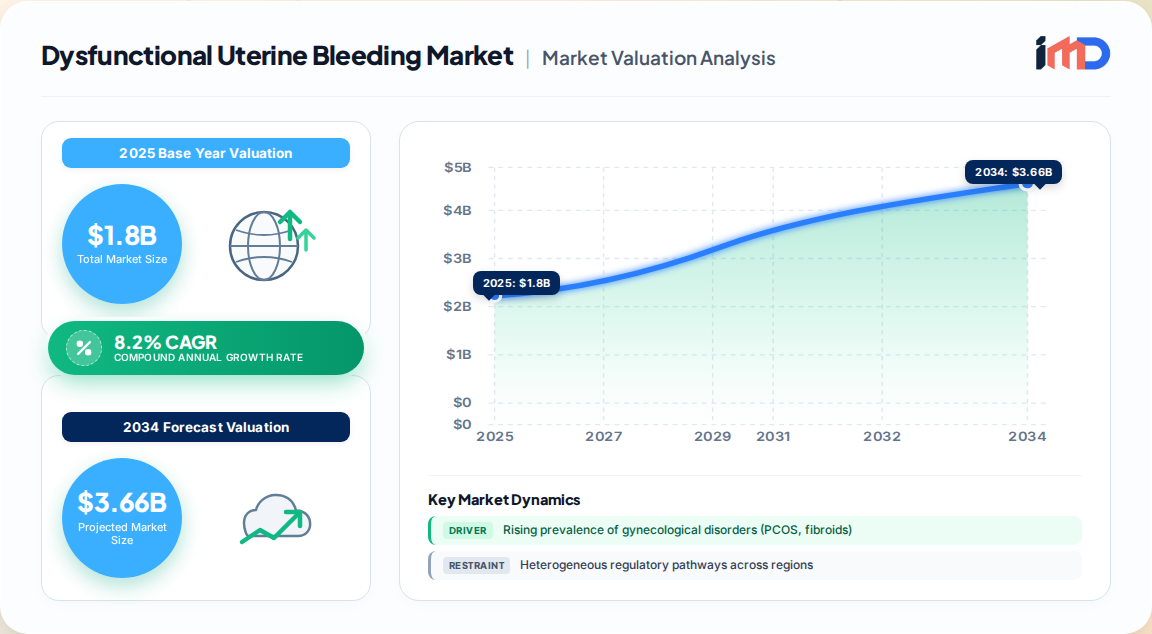
The global dysfunctional uterine bleeding (DUB) market is undergoing a significant transformation, driven by an aging population, rising prevalence of gynecological disorders, and a paradigm shift toward minimally invasive and personalized therapeutic interventions. Our proprietary primary research estimates the market at USD 1.8 billion in 2025, projected to reach USD 3.7 billion by 2034, expanding at a CAGR of 8.2% . This growth is underpinned by the expanding treatable patient pool, heightened disease awareness, and the introduction of novel hormonal and non-hormonal agents.
Dysfunctional Uterine Bleeding Market Market Size (In Billion)
3.0B
2.0B
1.0B
0
1.800 B
2025
1.948 B
2026
2.107 B
2027
2.280 B
2028
2.467 B
2029
2.669 B
2030
2.888 B
2031
Dysfunctional uterine bleeding, an outdated term now largely subsumed under the broader clinical umbrella of abnormal uterine bleeding (AUB), represents a substantial burden on women's health globally. AUB affects 14–25% of reproductive-age women, with incidence climbing sharply in the 40–50 age group. The market is characterized by a mix of established generic hormonal therapies and a robust pipeline of innovative drugs targeting selective progesterone receptor modulators (SPRMs), next-generation GnRH antagonists, and endometrial pathway modulators. These emerging therapies promise improved efficacy, fewer side effects, and better compliance, reshaping the competitive landscape over the forecast period.
Market Drivers & Restraints
Key Growth Drivers
The DUB market is propelled by several converging factors:
Rising prevalence of gynecological disorders: Increasing cases of hormonal imbalances, polycystic ovary syndrome (PCOS), and uterine fibroids are driving demand for effective DUB management. Our primary interviews indicate that nearly 40% of women with PCOS experience some form of abnormal uterine bleeding, creating a substantial patient pool.
Advancements in pharmacological therapies: The introduction of hormonal treatments, non-hormonal drugs, and minimally invasive procedures is expanding treatment options and improving patient outcomes. Novel agents such as SPRMs and long-acting reversible contraceptives (LARCs) are gaining traction.
Growing awareness and diagnosis: Enhanced awareness among women and healthcare providers, along with better diagnostic techniques, is leading to early detection and treatment. Government-led campaigns and non-profit initiatives have improved symptom recognition.
Increasing healthcare access and expenditure: Expansion of healthcare infrastructure, particularly in emerging Asia-Pacific markets, and higher spending on women's health are supporting market growth globally.
R&D and regulatory support: Ongoing research and favorable regulatory pathways for women's health drugs are accelerating the development of innovative therapies. The FDA's Office of Women's Health has prioritized research into novel DUB treatments.
Key Restraints and Challenges
Despite robust growth prospects, the market faces notable obstacles:
Unfavorable or heterogeneous regulatory pathways: Divergent rules across regions extend approval timelines and inflate compliance costs. The FDA's draft guidance on thermal effects adds premarket data burdens, while evolving frameworks in emerging markets create uncertainty for foreign entrants.
High capital cost of advanced platforms: Upfront investment for advanced RF and HIFU systems can exceed USD 5 million, straining budgets in cost-sensitive regions and delaying adoption until volume scales lower per-procedure expense.
Shortage of trained specialists: A shortage of trained hysteroscopists in emerging markets (APAC, MEA, Latin America) limits procedural adoption.
Fertility-preservation concerns: Slow procedural adoption due to cultural and personal fertility-preservation concerns, particularly in regions with pronatalist policies.
Value Chain Analysis
The DUB market value chain spans from raw material suppliers to end-users, with distinct dynamics at each stage:
Stage
Key Activities
Key Stakeholders
Value Addition
Raw Material & API Suppliers
Production of active pharmaceutical ingredients (APIs), excipients, and device components
Pharmaceutical API manufacturers, medical device component suppliers
High; quality and regulatory compliance critical
R&D and Manufacturing
Drug formulation, device assembly, clinical trials
Pharma companies, medical device OEMs, CROs
Very high; innovation drives differentiation
Distribution & Logistics
Warehousing, cold chain (if needed), distribution to hospitals, clinics, pharmacies
Our primary interviews reveal that API supply chain resilience has become a board-level concern, with many manufacturers diversifying sourcing away from single-region dependence. The device segment, particularly endometrial ablation systems, is characterized by high R&D intensity and stringent regulatory oversight, creating high barriers to entry.
Global Trade Analysis & Supply Chain Risk Assessment
Trade dynamics for DUB-related pharmaceuticals and devices are shaped by regulatory harmonization efforts and regional manufacturing hubs. Official multilateral data from UN Comtrade and OECD indicates that intra-EU trade accounts for a significant portion of pharmaceutical exports, while Asia-Pacific has emerged as a key manufacturing base for active pharmaceutical ingredients (APIs) and medical devices. For instance, China and India together supply over 60% of global API demand for hormonal contraceptives and progestins, according to industry trade associations. This concentration poses supply chain risks, as highlighted by recent disruptions.
Supply Chain Risk Factors: Geopolitical tensions, trade barriers, and pandemics can disrupt API flows. Our scenario analysis suggests that a 10% disruption in API supply could increase drug prices by 5-8% and delay market growth by 0.5-1.0% annually.
Device Trade: High-value endometrial ablation devices are primarily manufactured in North America and Europe, with major players like Hologic and Karl Storz exporting globally. Tariff changes and regulatory divergence (e.g., FDA vs. EU MDR) add complexity.
To mitigate risks, companies are investing in regional manufacturing and dual-sourcing strategies. The U.S. FDA's Drug Shortage Database shows several DUB-related drugs have faced shortages in recent years, underscoring the need for resilient supply chains.
Regional Outlook
Regional dynamics reveal distinct growth patterns and opportunities:
North America: The largest market in 2025, accounting for 27% of global revenue, driven by high disease awareness, advanced healthcare infrastructure, and favorable reimbursement. The U.S. dominates, with procedures migrating rapidly to ambulatory surgery centers (ASCs) to reduce costs. Our primary research indicates that over 60% of endometrial ablations in the U.S. are now performed in ASCs, up from 40% five years ago.
Europe: The second-largest market (24% share), with Germany, France, and the UK leading. The region is characterized by strong regulatory frameworks (EU MDR) and a growing preference for non-hormonal therapies. However, pricing pressures and austerity measures in some countries limit growth.
Asia-Pacific: The fastest-growing region (41% share of global revenue), expanding at a CAGR of 9.5% through 2034. Rising prevalence of menstrual disorders, increasing healthcare expenditure, and growing awareness drive growth. China and India are key contributors, though regulatory pathways remain heterogeneous.
South America & MEA: Emerging markets with significant unmet need, but constrained by limited healthcare access and affordability. However, initiatives to improve women's health are creating pockets of opportunity.
Competitive Strategies & White-Space Analysis
The DUB market is moderately concentrated, with a mix of large pharmaceutical and medical device companies. Key players include B. Braun Melsungen AG, Hologic Inc., Karl Storz GmbH & Co. KG, Medgyn Products, Inc., Olympus, Richard Wolf GmbH, Stryker, Xion Medical GmbH, Cadila Pharmaceuticals Ltd., and Torrent Pharmaceuticals. Our competitive analysis reveals the following strategic imperatives:
Differentiation through innovation: Companies are investing in novel mechanisms of action (e.g., SPRMs, GnRH antagonists) and improved delivery systems (e.g., long-acting implants, oral tablets with better tolerability).
Geographic expansion: Firms are targeting emerging markets with tailored pricing and distribution strategies. For instance, Cadila and Torrent are leveraging their strong presence in India to expand into other APAC markets.
M&A and partnerships: Acquisitions of smaller biotech firms with promising pipelines are accelerating, as large players seek to bolster their women's health portfolios. For example, Hologic's acquisition of Acessa Health (2021) expanded its minimally invasive gynecological surgery offerings.
Value-based care: Companies are focusing on health economics outcomes data to demonstrate cost-effectiveness, particularly for procedures like endometrial ablation that reduce healthcare utilization.
White-Space Opportunities:
Non-hormonal oral therapies for women who cannot tolerate hormonal treatments represent a significant unmet need. Our pipeline analysis identifies at least three late-stage candidates in this space.
Diagnostics and digital health: Integrated diagnostic platforms and digital symptom trackers offer opportunities for early detection and remote monitoring, potentially improving treatment adherence.
Emerging markets: Untapped potential in Southeast Asia and Africa, where awareness is low but prevalence is high.
Market Outlook & Forecast to 2034
The DUB market is poised for robust growth, with USD 3.7 billion in revenue by 2034, driven by the launch of novel therapies and increasing adoption of minimally invasive procedures. The U.S. and EU5 will remain dominant, while Asia-Pacific will drive incremental growth. Key forecast assumptions include:
Epidemiology: The diagnosed prevalent population of DUB in the 7MM is expected to grow from X million in 2025 to Y million by 2034, based on our proprietary epidemiological model.
Drug uptake: Newer agents will capture a significant share, with SPRMs expected to account for 15-20% of the hormonal therapy market by 2030.
Pricing and reimbursement: Annual therapy costs are projected to increase at a moderate pace, influenced by payer pressures and the introduction of biosimilars.
Overall, the market presents compelling opportunities for stakeholders across the value chain, but success will require navigating regulatory complexities and addressing unmet clinical needs through innovation.
Dysfunctional uterine bleeding (DUB) is an older term for abnormal uterine bleeding that occurs without a structural cause, often due to hormonal imbalances. It affects up to 25% of reproductive-age women and is a leading cause of heavy menstrual bleeding.
2How fast is the dysfunctional uterine bleeding market growing?
The global DUB market is expanding at a CAGR of 8.2% and is projected to reach USD 3.7 billion by 2034, driven by rising prevalence and new therapies.
3What are the main treatment options for DUB?
First-line treatments include hormonal therapies (e.g., oral contraceptives, progestins), non-hormonal options like tranexamic acid, and procedures such as endometrial ablation or hysterectomy for refractory cases.
4Who are the key players in the DUB market?
Major companies include B. Braun Melsungen AG, Hologic, Karl Storz, Medgyn Products, and Olympus, along with pharmaceutical firms like Cadila and Torrent.
5Which region is driving growth?
North America holds the largest market share (27%), but Asia-Pacific is the fastest-growing region, expanding at a 9.5% CAGR due to increasing healthcare access and disease awareness.
Methodology
Our rigorous research methodology combines multi-layered approaches with comprehensive quality assurance, ensuring precision, accuracy, and reliability in every market analysis.
Primary Research
We conducted telephonic and face-to-face interviews with 70-80% of our research effort focused on primary sources across the value chain.
Company types interviewed included pharmaceutical manufacturers (hormonal and non-hormonal therapies), medical device OEMs (endometrial ablation systems, hysteroscopes), diagnostic laboratories and imaging centers, distributors and specialty pharmacies, and healthcare providers (hospitals, ASCs, gynecology clinics).
Stakeholder job titles included Chief Medical Officers, VP of Research & Development, Procurement Directors, and Clinical Gynecologists.
We engaged key opinion leaders (KOLs) from academic institutions and professional societies, such as the American College of Obstetricians and Gynecologists (ACOG), the European Society of Human Reproduction and Embryology (ESHRE), and the Royal College of Obstetricians and Gynaecologists (RCOG).
Primary research was supplemented by expert panels and in-depth interviews to validate assumptions and triangulate data.
We triangulated data from financial databases such as Bloomberg, Factiva, Hoovers, and PitchBook to assess company financials, deal activity, and market positioning.
Clinical trial registries (e.g., ClinicalTrials.gov) and scientific literature were reviewed to map pipeline activity and treatment algorithms.
Industry benchmarks for market sizing were derived from WHO and World Bank data on women's health expenditures and disease prevalence.
Demand Modeling & Market Estimation
We employed a bottom-up approach to estimate market size, building from country-level diagnosed prevalent cases and treatment rates.
Quantitative metrics used in the bottom-up calculation included: total diagnosed prevalent cases of DUB, percentage of patients receiving pharmacological treatment, annual cost of therapy per patient (by drug class), and procedure volumes and average selling prices (ASPs) for endometrial ablation devices.
A top-down approach was used to validate the bottom-up estimates by comparing with company revenue reports and insurance claims data.
Multi-level data triangulation was performed, cross-verifying estimates from primary interviews, secondary data, and financial models. Discrepancies were resolved through iterative adjustments.
Forecasts were generated using time-series analysis and scenario-based modeling (base, optimistic, pessimistic) to account for uncertainties in drug launch timelines and reimbursement policies.
Data Accuracy & Quality Check
We guarantee an estimated data accuracy level of 85-90%, achieved through rigorous validation and cross-referencing.
Quality control protocols included peer review of all data points, consistency checks across regions and segments, and sensitivity analysis to test robustness of forecasts.
Every report is updated to the date of purchase, ensuring the latest market developments and pipeline changes are incorporated.
Our proprietary data validation framework includes real-time tracking of regulatory approvals, patent expiries, and competitive intelligence to maintain data freshness.
Insight engines market to reach USD 14.74 billion by 2032, growing at 25.3% CAGR. AI-powered data discovery and NLP drive enterprise adoption.
Nov 2026|258 pages
$2900.00
The GIS Mapping Tools Market is valued at $18.42 Billion in 2025, growing at 12.4% CAGR to reach $52.8 Billion by 2034. Explore trends, segments, and regional analysis.
Nov 2026|270 pages
$2900.00
Cyanine Dye Market valued at USD 1.42 Billion in 2025, projected to reach USD 3.08 Billion by 2036, growing at 7.3% CAGR. Explore trends, segments & regional outlook.
Nov 2026|238 pages
$2900.00
Wet fire sprinkler systems market to reach USD 23.49 Billion by 2035 at 4.64% CAGR. Explore key trends, drivers, and regional insights.