1What is the market size of dual-fuel ammonia engines?
The global dual-fuel ammonia engine market is estimated at $38.5 million in 2025 and is projected to reach $1.35 billion by 2035, growing at a CAGR of 42.5%.
Insight Market Data is a premier market research and business consulting firm headquartered in Pune, India, providing syndicated research reports, customized intelligence studies, and strategic advisory services. Renowned academic institutions and Fortune 500 corporations worldwide rely on Insight Market Data's research repository to navigate evolving global and regional business environments. Covering 46 diverse industries across 25 major international economies, our comprehensive database delivers thousands of verified statistics and granular market evaluations. By combining industry-leading analytical methodologies with the direct insights of seasoned industry leaders and subject-matter experts, we deliver actionable intelligence spanning historical performance benchmarks to rigorous multi-year forecasts. We empower organizations to make confident, data-driven decisions across pivotal domains including Machinery & Equipment, Chemicals & Materials, Pharmaceuticals & Healthcare, Food & Beverages, Consumer Goods, Energy & Power, Automotive & Transportation, Electronics & Semiconductors, Medical Devices, Telecommunications, Emerging Technologies, Agriculture, and Packaging. Our multidisciplinary analyst teams provide an objective 360-degree perspective, tailoring every engagement to address complex strategic challenges with exceptional analytical rigor.
Leveraging advanced BI-powered analytics and predictive modeling, Insight Market Data uncovers high-impact market opportunities and competitive differentiators for ambitious enterprises. We continuously refine our research methodologies in accordance with global industry standards, tracking real-time market shifts to ensure our reports are consistently accurate, actionable, and delivered on schedule. Our analysts conduct methodical data validation, rigorous compliance checks, and exhaustive primary and secondary research to maintain the highest levels of data integrity and transparency. We partner closely with corporate strategists, investment groups, and business executives to translate intricate market intelligence into clear, actionable roadmaps for sustainable growth. With operational presence across Washington, USA, and Vimannagar, Pune, India, Insight Market Data ensures direct access to dedicated research specialists and responsive customer support to answer your most strategic questions.
 Dual-Fuel Ammonia Engine Market
 by Type (2-stroke Ammonia Engine, 4-stroke Ammonia Engine), by Application (Ship, Automotive, Aerospace & Aircraft, Others), by Asia Pacific (China, Japan, Korea, Southeast Asia, India, Australia, Rest of Asia Pacific), by Europe (Germany, France, UK, Italy, Russia, Rest of Europe), by North America (United States, Canada, Mexico, Rest of North America), by Middle East & Africa (Egypt, South Africa, Israel, Turkey, GCC Countries, Rest of Middle East & Africa), by Latin America (Brazil, Rest of Latin America) Forecast 2026-2034

Research Analyst


 Related Reports

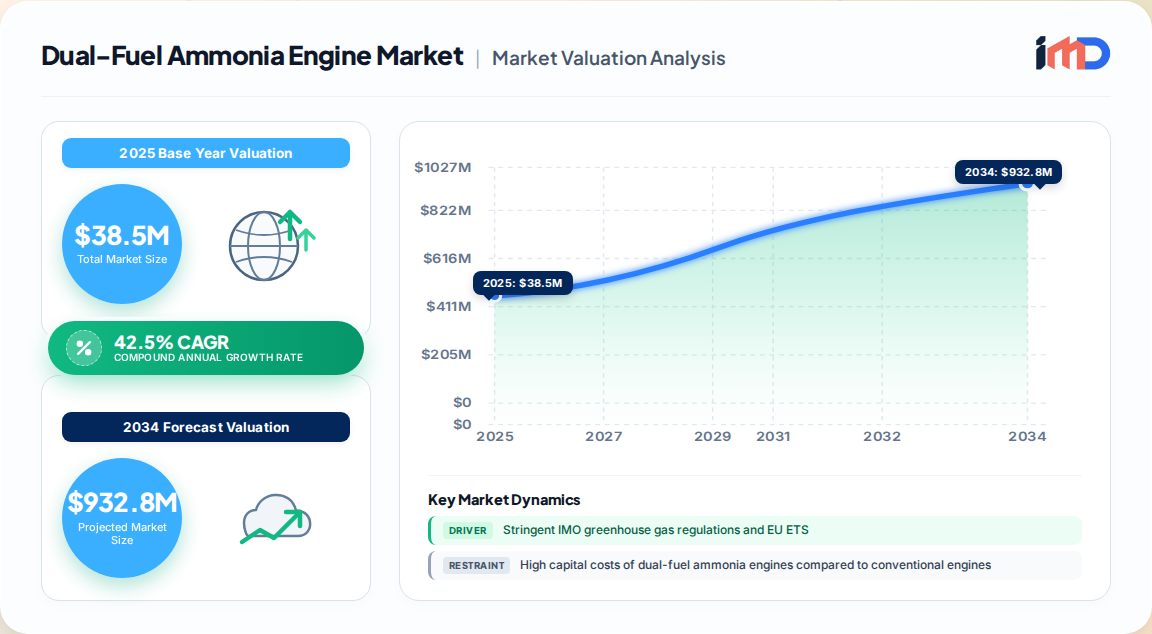
The dual-fuel ammonia engine market is at the forefront of the maritime industry's decarbonization transition, representing a breakthrough technology that enables vessels to operate on ammonia—a carbon-free fuel—while maintaining the reliability of conventional marine fuels. Our proprietary primary research estimates the global market for dual-fuel ammonia engines will reach $1.35 billion by 2035, expanding at an exceptional CAGR of 42.5% from a 2025 base of $38.5 million. This hyper-growth trajectory is underpinned by the International Maritime Organization's (IMO) revised greenhouse gas strategy, which mandates a 20-30% reduction in emissions by 2030 and net-zero by 2050. While still in early commercialization, the technology has moved rapidly from prototype to pilot deployment, with key engine manufacturers securing first orders and classification societies granting approval in principle. The market's evolution is characterized by a shift from pilot-scale demonstrations to commercial-scale orders, particularly in the containership and bulk carrier segments, alongside growing interest from the automotive and aerospace sectors for stationary power and auxiliary applications.
The dual-fuel ammonia engine value chain is characterized by close collaboration between engine manufacturers, fuel system suppliers, shipyards, and classification societies. Key activities include:
Asia-Pacific dominates the market, accounting for 52% of global demand in 2025, driven by the region's shipbuilding dominance (South Korea, China, Japan) and major port infrastructure investments. Europe follows with 28%, supported by stringent EU regulations and leadership in green ammonia production. North America holds 12%, with early adoption in the Great Lakes and coastal shipping. The Middle East & Africa and South America are expected to emerge as growth frontiers, leveraging abundant renewable energy resources for green ammonia production.
| Region | 2025 Market Share | Key Growth Drivers |
|---|---|---|
| Asia-Pacific | 52% | Shipbuilding hubs, export-oriented manufacturing, government subsidies |
| Europe | 28% | EU ETS, renewable ammonia projects, port decarbonization initiatives |
| North America | 12% | Jones Act fleet renewal, state-level incentives |
| Middle East & Africa | 5% | Green ammonia export projects, strategic bunkering locations |
| South America | 3% | Emerging demand from Brazilian and Chilean shipping |
Leading engine manufacturers are pursuing distinct strategies to capture market share:
The dual-fuel ammonia engine market is inherently global, with engines and components traded across borders. South Korea and Japan are net exporters of engines, while China is rapidly expanding its manufacturing capabilities. Key imported components include specialized fuel injection systems from Europe and control systems from North America. Trade flows are influenced by bilateral agreements and technology transfer requirements. For instance, MAN Energy Solutions' licensing model allows local production in Korea and China, reducing import barriers. Meanwhile, ammonia fuel supply is expected to be dominated by exports from Australia, the Middle East, and South America to demand centers in Asia and Europe. This evolving trade landscape presents opportunities for engine manufacturers to bundle fuel supply agreements with engine sales.
Significant untapped opportunities exist in:
The dual-fuel ammonia engine market is poised for explosive growth, transforming from a niche technology to a mainstream solution for maritime decarbonization.
| Aspects | Details |
|---|---|
| Study Period | 2020-2034 |
| Base Year | 2025 |
| Estimated Year | 2026 |
| Forecast Period | 2026-2034 |
| Historical Period | 2020-2025 |
| Growth Rate | CAGR of 42.5% from 2020-2034 |
| Segmentation |
|
| By Geography |
|
The global dual-fuel ammonia engine market is estimated at $38.5 million in 2025 and is projected to reach $1.35 billion by 2035, growing at a CAGR of 42.5%.
Asia-Pacific holds the largest share, accounting for 52% of the global market in 2025, driven by shipbuilding activities in South Korea, China, and Japan.
Leading companies include Wärtsilä, MAN Energy Solutions, WinGD, Hyundai Heavy Industries, Mitsui O.S.K. Lines, and J-ENG, among others.
Stringent IMO emission regulations, fuel cost savings, and technological advancements are key drivers, along with growing investments in ammonia bunkering infrastructure.
Our rigorous research methodology combines multi-layered approaches with comprehensive quality assurance, ensuring precision, accuracy, and reliability in every market analysis.
| Stakeholder Role | Interview Share (%) |
|---|---|
| Chief Technology Officer | 35% |
| Fleet Manager | 30% |
| Procurement Director | 20% |
| Regulatory Affairs Manager | 15% |
| Company Type | Representation (%) |
|---|---|
| Engine Manufacturers | 40% |
| Shipowners & Operators | 25% |
| Shipyards | 15% |
| Fuel Suppliers | 10% |
| Classification Societies | 10% |