About Insight Market Data

Insight Market Data is a premier market research and business consulting firm headquartered in Pune, India, providing syndicated research reports, customized intelligence studies, and strategic advisory services. Renowned academic institutions and Fortune 500 corporations worldwide rely on Insight Market Data's research repository to navigate evolving global and regional business environments. Covering 46 diverse industries across 25 major international economies, our comprehensive database delivers thousands of verified statistics and granular market evaluations. By combining industry-leading analytical methodologies with the direct insights of seasoned industry leaders and subject-matter experts, we deliver actionable intelligence spanning historical performance benchmarks to rigorous multi-year forecasts. We empower organizations to make confident, data-driven decisions across pivotal domains including Machinery & Equipment, Chemicals & Materials, Pharmaceuticals & Healthcare, Food & Beverages, Consumer Goods, Energy & Power, Automotive & Transportation, Electronics & Semiconductors, Medical Devices, Telecommunications, Emerging Technologies, Agriculture, and Packaging. Our multidisciplinary analyst teams provide an objective 360-degree perspective, tailoring every engagement to address complex strategic challenges with exceptional analytical rigor.

Leveraging advanced BI-powered analytics and predictive modeling, Insight Market Data uncovers high-impact market opportunities and competitive differentiators for ambitious enterprises. We continuously refine our research methodologies in accordance with global industry standards, tracking real-time market shifts to ensure our reports are consistently accurate, actionable, and delivered on schedule. Our analysts conduct methodical data validation, rigorous compliance checks, and exhaustive primary and secondary research to maintain the highest levels of data integrity and transparency. We partner closely with corporate strategists, investment groups, and business executives to translate intricate market intelligence into clear, actionable roadmaps for sustainable growth. With operational presence across Washington, USA, and Vimannagar, Pune, India, Insight Market Data ensures direct access to dedicated research specialists and responsive customer support to answer your most strategic questions.

report thumbnailDrone Electronic Speed Controller (ESC) Market
Aerospace & Defense / MARKET REPORT

Drone Electronic Speed Controller (ESC) Market | Insight Market Data

Drone Electronic Speed Controller (ESC) Market by Classification (Brushed ESC, Brushless ESC), by Application (Consumer Grade Drones, Commercial UAVs, Military UAVs), by Power Rating (Low Power, Medium Power, High Power), by Distribution Channel (Online, Offline), by Component Type (Motor Driver, BEC, Fault-Detection Analytics, Integrated ESC Modules), by Asia Pacific (China, India, Japan, South Korea, Australia), by North America (United States, Canada, Mexico), by Europe (Germany, United Kingdom, France), by Latin America (Brazil, Argentina), by Middle East & Africa Forecast 2026-2034

© Nov 6, 2026|Base Year: 2025|188 Pages
Shyam Pawar

Shyam Pawar

Research Associate

Main Logo

Drone Electronic Speed Controller (ESC) Market Forecast 2026


/
/
Buy Now
Home
Industries
Aerospace & Defense
Independent Intelligence for decisions that move markets
+12315155523[email protected]
  • Home
  • About Us
  • Industries
    • Automotive
    • Consumer Goods and Services
    • Financial Services and Investment Intelligence
    • Home and Property Improvement
    • Logistics
    • Retail
    • Agriculture
    • Healthcare
    • Animal Nutrition & Wellness
    • Chemicals & Materials
    • Energy & Power
    • Food & Beverage
    • Hospitality and Tourism
    • Manufacturing Products and Services
    • Professional and Commercial Services
    • Real Estate and Construction
    • Aerospace & Defense
    • Packaging
    • Technology, Media and Telecom
  • Services
  • Contact
Main Logo
  • Home
  • About Us
  • Industries
    • Automotive
    • Consumer Goods and Services
    • Financial Services and Investment Intelligence
    • Home and Property Improvement
    • Logistics
    • Retail
    • Agriculture
    • Healthcare
    • Animal Nutrition & Wellness
    • Chemicals & Materials
    • Energy & Power
    • Food & Beverage
    • Hospitality and Tourism
    • Manufacturing Products and Services
    • Professional and Commercial Services
    • Real Estate and Construction
    • Aerospace & Defense
    • Packaging
    • Technology, Media and Telecom
  • Services
  • Contact
Talk to an analyst
Drone Electronic Speed Controller (ESC) Market CAGR, market size, market share

Executive Overview: The Drone Electronic Speed Controller (ESC) Market in 2026

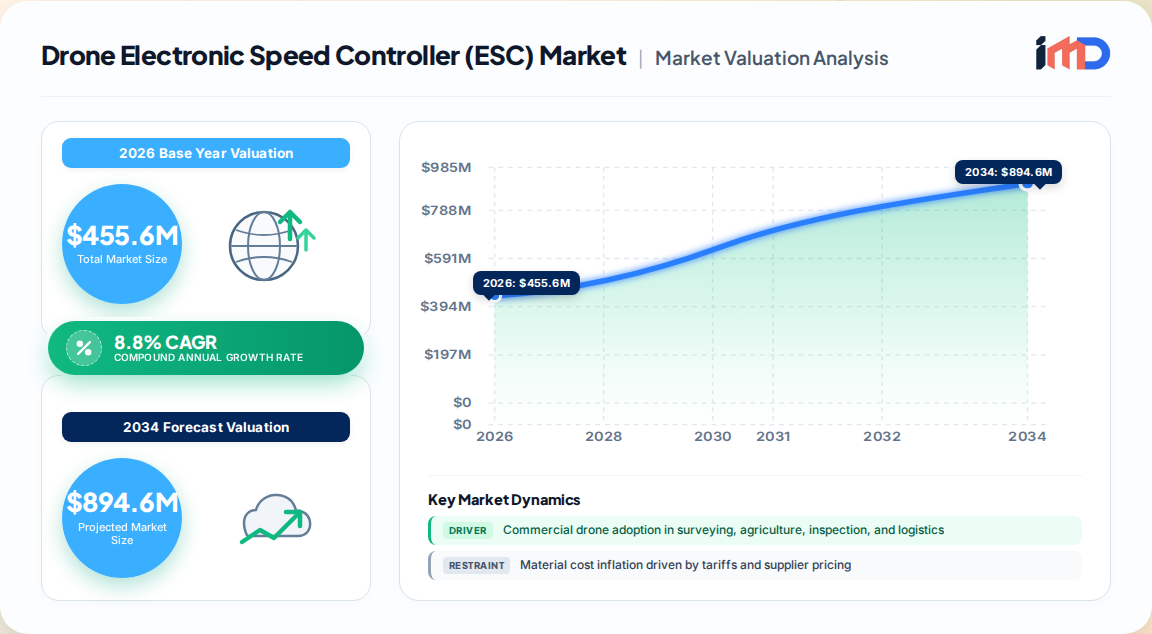
The global Drone Electronic Speed Controller (ESC) Market is estimated at USD 455.6 million in 2026 and is projected to reach approximately USD 973.8 million by 2036, advancing at a CAGR of 8.8% over the decade. This expansion, representing an absolute dollar growth of more than USD 554.8 million, is underpinned by commercial, industrial, and defense drone fleet expansion, rising demand for higher power efficiency, and the transition toward autonomous flight systems requiring precise motor control.

Drone Electronic Speed Controller (ESC) Market Market Size (In Million)

750.0M
600.0M
450.0M
300.0M
150.0M
0
419.0 M
2025
456.0 M
2026
496.0 M
2027
539.0 M
2028
587.0 M
2029
638.0 M
2030
695.0 M
2031
Main Logo

While the broader UAV ecosystem continues to scale, ESCs have evolved from commodity components into intelligent propulsion subsystems. Firmware stability, thermal management, and telemetry integration now rank alongside raw current-handling capability as purchasing criteria. Despite material cost inflation and certification burdens in 2026, ESC manufacturers are sustaining momentum through MOSFET efficiency improvements, FOC-based architectures, and 4-in-1 board designs for compact airframes.

Our proprietary bottom-up modeling, built from drone production volumes, replacement rates, and power-class requirements, indicates that brushless ESCs dominate value share, while consumer-grade drones retain the largest volume share. Asia Pacific remains the growth engine of the market, led by China's manufacturing clusters and India's emerging production base, while North America retains innovation leadership in high-reliability and defense-grade propulsion electronics.

Market Definition & Scope

Electronic speed controllers for drones and UAVs are power-electronics modules that regulate motor speed, direction, and braking based on flight controller commands. They convert throttle signals into precise three-phase AC outputs for brushless motors or DC outputs for brushed motors, and increasingly incorporate regenerative braking, active freewheeling, real-time telemetry (current, temperature, RPM), and protocol support for DShot, Oneshot, and Multishot.

In scope: ESCs for multi-rotor and fixed-wing UAVs, segmented by classification, application, power rating, and distribution channel.

Out of scope: ESCs for ground robotics, marine vessels, and electric vehicles; standalone flight controllers, power distribution boards, motors, batteries, and integrated propulsion systems unless bundled with ESC functionality.

Scope Parameter Detail
Base year valuation (2026) USD 455.6 million
Forecast valuation (2036) USD 973.8 million
Forecast CAGR (2026–2036) 8.8%
Largest application Consumer-grade drones (54.0% share)
Fastest-growing segment Commercial UAVs
Leading growth region Asia Pacific

Key Market Drivers

  • Commercial UAV proliferation: Surveying, agriculture, inspection, and logistics operations require ESCs with stable current handling and predictable motor response under continuous duty cycles. Fleet operators are shifting from single-unit purchases to qualified supplier programs.
  • Consumer and prosumer drone demand: Racing, imaging, and FPV platforms drive volume uptake of high-current brushless ESCs, with 32-bit processors and bidirectional DShot becoming standard in mid-range platforms.
  • Defense and government procurement: Military UAV programs demand ruggedized, high-reliability ESCs with redundancy, EMI/EMC resilience, and qualification against aviation safety frameworks.
  • Power efficiency and telemetry: The shift from basic motor control to telemetry-enabled, FOC-based systems enables predictive maintenance and improves endurance per battery cycle.
  • Battery architecture upgrades: Transition to 6S–12S configurations in commercial and industrial platforms is driving demand for 80A–300A continuous-load ESC units with higher average selling prices.

Restraints, Risks & Challenges

  • Material cost inflation: Tariffs and supplier pricing pressures in 2026 are raising bill-of-materials costs, particularly for high-grade MOSFETs, capacitors, and thermally conductive substrates. Manufacturers are implementing selective price increases to protect margins.
  • Certification and qualification burden: Defense and BVLOS-oriented platforms require stricter reliability standards, firmware traceability, and supply-chain documentation, lengthening sales cycles.
  • Component shortages: Power semiconductor lead times remain uneven, constraining high-current ESC output for industrial and heavy-lift platforms.
  • Firmware and protocol fragmentation: Compatibility challenges across flight controllers, ESC firmware baselines, and protocol variants (DShot, BLHeli_32, AM32) raise integration costs for OEMs.
  • Technology substitution risk: All-in-One (AIO) boards combining flight controller and ESC circuitry on a single PCB are compressing the standalone ESC value pool, pressuring single-board ESC producers to differentiate through software and service ecosystems.

Segmentation Analysis

By classification, brushed ESCs account for approximately 26.0% of 2026 demand, concentrated in entry-level consumer drones, educational kits, indoor micro-drones, and lightweight quadcopters where cost efficiency outweighs performance optimization. Brushless ESCs dominate value share, supported by higher efficiency, firmware flexibility, and compatibility with high-performance motors.

By application, consumer-grade drones hold a 54.0% share of 2026 volume, reflecting high unit shipments across recreational, photography, and racing categories. Commercial UAVs represent the fastest-growing application, driven by agricultural spraying, inspection, and mapping. Military UAVs command premium pricing and stricter qualification requirements.

Segment Dimension Leading Segment Estimated Share Growth Character
Classification Brushless ESC ~74% value share High growth; efficiency and FOC adoption
Classification Brushed ESC 26.0% Stable; educational and micro-drone niches
Application Consumer-grade Drones 54.0% Volume-led; refresh-driven
Application Commercial UAVs Fastest growing Mid-period expansion; redundancy and telemetry
Application Military UAVs High value Later-period expansion; qualification-led
Power Rating Medium Power Largest volume Balanced by consumer and commercial demand
Power Rating High Power Highest value density Heavy-lift and defense applications
Distribution Offline Majority of revenue OEM and distributor-led qualification
Distribution Online Fast-growing FPV, hobby, and replacement demand

Regional Outlook

Asia Pacific leads global growth, anchored by China's integrated electronics supply chain and drone manufacturing clusters, with domestic UAV deployment expanding across smart agriculture, logistics, and infrastructure inspection. India is emerging as a secondary growth engine, supported by production-linked incentives and agricultural drone adoption.

Drone Electronic Speed Controller (ESC) Market Regional Market Share

Loading chart...
Main Logo

China is projected to grow at approximately 11.9% CAGR, India at 11.0%, Germany at 10.1%, and Brazil at 9.2%. The United States at around 8.4% and the United Kingdom at 7.5% remain technology-led but more replacement-oriented, shaped by mature fleets, regulatory oversight, and longer platform life cycles.

North America retains innovation leadership in defense-grade and high-reliability propulsion electronics. Europe's growth is shaped by inspection and industrial UAV adoption, while Latin America's upside is concentrated in agricultural spraying applications. The Middle East and Africa present incremental opportunities in surveillance and infrastructure monitoring.

Competitive Landscape & Strategic Alignments

The competitive field comprises specialized propulsion-electronics manufacturers with deep firmware expertise, low-cost volume suppliers, and integrated systems providers. Leading participants include Embention S.L., Hobbywing Technology Co., Ltd., Aikon Electronics, T-MOTOR, and MED Motor, alongside ecosystem players such as DJI Innovations, ZTW Technology, DYS Technology, and Kiss ESC (Flyduino).

Key strategic themes observed in 2026 include:

  • Firmware as a differentiator: Suppliers are investing in firmware development and validation to strengthen OEM qualification beyond hardware specifications. Stable protocol support and secure update channels are increasingly evaluated during procurement.
  • Telemetry and FOC adoption: Portfolios are migrating toward telemetry-enabled and multi-channel ESC architectures to capture higher unit value in commercial and defense platforms.
  • OEM co-development: Closer collaboration with airframe OEMs on application-specific ESC tuning is replacing commoditized controller supply, reinforced by thermal design margins and system-level integration.
  • Regional manufacturing alignment: Suppliers are prioritizing Asia Pacific sourcing and production partnerships to stay aligned with regional UAV production scale.
  • Productization of AIO and 4-in-1 boards: Compact airframe designs are driving adoption of integrated ESC boards, reshaping the value chain and pressuring standalone producers to offer after-sales support and tuning ecosystems.

Value Chain Analysis

The ESC value chain spans semiconductor supply (MOSFETs, gate drivers, 32-bit MCUs, sensors), PCB and thermal-substrate fabrication, assembly and firmware flashing, and integration into drone platforms. Value migration is occurring from hardware assembly toward firmware, thermal design, and systems integration.

  • Upstream: Power semiconductors and MCUs are the highest-leverage inputs; supply concentration and tariffs create margin volatility.
  • Midstream: ESC manufacturers compete on thermal design margins, current-handling density, and protocol compatibility; AIO board integration is compressing the standalone ESC pool.
  • Downstream: Drone OEMs and integrators qualify ESCs through multi-stage validation covering firmware stability, EMI/EMC, and fault tolerance; after-sales tuning and replacement cycles provide recurring revenue.

Strategic White-Space & Investment Assessment

The most attractive white spaces include high-current, high-voltage ESCs (12S–20S) for heavy-lift and defense platforms; liquid-cooled ESC architectures for sustained high-thrust operation; and firmware ecosystems that support OTA updates and predictive maintenance analytics. Integrated propulsion-control modules with embedded diagnostics offer higher unit value and stickier OEM relationships, particularly in commercial inspection and agricultural spraying fleets.

Investment priorities should balance qualification-led defense procurement with volume-oriented consumer refresh cycles. Suppliers that combine thermal design capabilities, firmware validation infrastructure, and regional manufacturing footprints are best positioned to capture the incremental USD 554.8 million of absolute growth projected through 2036.

Drone Electronic Speed Controller (ESC) Market Regional Market Share

Higher Coverage
Lower Coverage
No Coverage

Drone Electronic Speed Controller (ESC) Market REPORT HIGHLIGHTS

AspectsDetails
Study Period2020-2034
Base Year2026
Estimated Year2026
Forecast Period2026-2034
Historical Period2020-2025
Growth RateCAGR of 8.8% from 2020-2034
Segmentation
  • By Classification

    • Brushed ESC
    • Brushless ESC
  • By Application

    • Consumer Grade Drones

Table of Contents

  1. 1. Drone Electronic Speed Controller (ESC) Market Introduction
    • 1.1. Research Scope
    • 1.2. Market Segmentation
    • 1.3. Research Objective
    • 1.4. Definitions and Assumptions
  2. 2. Drone Electronic Speed Controller (ESC) Market Executive Summary
    • 2.1. Market Snapshot
  3. 3. Drone Electronic Speed Controller (ESC) Market Dynamics
    • 3.1. Market Drivers
      • 3.1.1. Commercial drone adoption in surveying, agriculture, inspection, and logistics
      • 3.1.2. Consumer and prosumer drone growth across racing, imaging, and FPV categories
      • 3.1.3. Military UAV demand for ruggedized, high-reliability ESCs with redundancy
      • 3.1.4. Rising demand for higher power efficiency and autonomous flight precision
      • 3.1.5. Government investment in drone infrastructure and BVLOS regulatory frameworks
    • 3.2. Market Trends
      • 3.2.1. FOC-based ESC architectures improving efficiency and enabling predictive maintenance
      • 3.2.2. Telemetry-enabled ESCs with real-time current, temperature, and RPM feedback
      • 3.2.3. 4-in-1 and AIO ESC boards for compact airframe designs
      • 3.2.4. Transition to 6S–12S battery configurations driving high-current ESC demand
      • 3.2.5. Firmware stability and protocol compatibility (DShot, BLHeli_32, AM32) as key differentiators
    • 3.3. Market Restraints
      • 3.3.1. Material cost inflation driven by tariffs and supplier pricing
Author
Shyam Pawar

Shyam Pawar

Research Associate

I am a Research Associate specializing in market analysis for the Aerospace & Defense and BFSI sectors, with a strong focus on Financial Services & Investment Intelligence. I expert at conducting rigorous secondary research, market sizing, and valuation-driven segmentation for complex, multi-billion-dollar global markets, tracking emerging technologies and defense spending trends. Through compiling high-impact, comprehensive reports, I deliver data-driven insights that guide investment strategies, mitigate risk, and help financial decision-makers capture strategic growth opportunities.

Get In Touch
WHY IMD

Verified research

Analyst-reviewed data

Updated Nov 06, 2026

sponsor image
sponsor image
sponsor image
sponsor image
sponsor image
sponsor image
sponsor image
sponsor image
sponsor image
sponsor image
sponsor image
sponsor image
sponsor image
sponsor image
sponsor image
sponsor image
sponsor image
sponsor image
sponsor image
sponsor image
CUSTOM INTELLIGENCE

Tailored for you

  • In-depth Analysis Tailored to Specified Regions or Segments
  • Company Profiles Customized to User Preferences
  • Customized Evaluation of Competitive Landscape to Meet Your Needs
Ask for customization
avatar

Analyst at Providence Strategic Partners at Petaling Jaya

Jared Wan

I have received the report already. Thanks you for your help.it has been a pleasure working with you. Thank you again for a good quality report

avatar

Internationalization Director

Santiago Mejia Molina

Yes, as a matter of fact we are totally satisfied with both reports that we have purchased and will continue to do so during this process of the internationalization of our brand.

avatar

Head of Product Management and Marketing

Olaf Gleibe

We are using your report, and it gave us valuable information."

avatar

Regional Director, Marketing and Business Development

Lina Lim

We've received the report and have reviewed the content. Overall, it looks great and aligns closely with the data we can verify based on our industry knowledge.

avatar

VP of Sales

DIGGLE Representative

Thank you very much for sharing the report. I have reviewed it and I am very satisfied with the quality and the insights it provides. It will certainly be valuable for our internal discussions.

Business Address

Head Office

Ansec House 3 rd floor Tank Road, Yerwada, Pune, Maharashtra 411014

Contact Information

Craig Francis

Business Development Head

+12315155523

[email protected]

Secure Payment Partners

payment image
RetailLogisticsPackagingAutomotiveHealthcareAgricultureEnergy & PowerFood & BeverageAerospace & DefenseChemicals & MaterialsHospitality and TourismConsumer Goods and ServicesAnimal Nutrition & WellnessReal Estate and ConstructionHome and Property ImprovementTechnology, Media and TelecomManufacturing Products and ServicesFinancial Services and Investment Intelligence

© 2026 PRDUA Research & Media Private Limited, All rights reserved

Privacy Policy•Terms and Conditions•FAQ
Commercial UAVs
  • Military UAVs
  • By Power Rating

    • Low Power
    • Medium Power
    • High Power
  • By Distribution Channel

    • Online
    • Offline
  • By Component Type

    • Motor Driver
    • BEC
    • Fault-Detection Analytics
    • Integrated ESC Modules
  • By Geography
    • Asia Pacific

      • China
      • India
      • Japan
      • South Korea
      • Australia
    • North America

      • United States
      • Canada
      • Mexico
    • Europe

      • Germany
      • United Kingdom
      • France
    • Latin America

      • Brazil
      • Argentina
    • Middle East & Africa

  • 3.3.2. Component shortages in power semiconductors and MOSFETs
  • 3.3.3. High certification and qualification costs for defense and BVLOS platforms
  • 3.3.4. Firmware and protocol fragmentation raising integration costs
  • 3.4. Market Challenges
    • 3.4.1. AIO board integration compressing the standalone ESC value pool
    • 3.4.2. Balancing thermal management with rising current-handling requirements
    • 3.4.3. Securing long-term OEM qualification amid firmware and supply-chain volatility
    • 3.4.4. Managing tariff exposure and regional supply-chain diversification
  • 4. Drone Electronic Speed Controller (ESC) Market Factor Analysis
    • 4.1. Porters Five Forces
      • 4.1.1. Bargaining Power of Suppliers
      • 4.1.2. Bargaining Power of Buyers
      • 4.1.3. Threat of New Entrants
      • 4.1.4. Threat of Substitutes
      • 4.1.5. Competitive Rivalry
    • 4.2. PESTEL analysis
    • 4.3. BCG Analysis
      • 4.3.1. Stars (High Growth, High Market Share)
      • 4.3.2. Cash Cows (Low Growth, High Market Share)
      • 4.3.3. Question Mark (High Growth, Low Market Share)
      • 4.3.4. Dogs (Low Growth, Low Market Share)
    • 4.4. Ansoff Matrix Analysis
    • 4.5. Supply Chain Analysis
    • 4.6. Regulatory Landscape
    • 4.7. Current Market Potential and Opportunity Assessment (TAM–SAM–SOM Framework)
    • 4.8. IMD Analyst Note
  • 5. Drone Electronic Speed Controller (ESC) Market Analysis, Insights and Forecast, 2020-2034
    • 5.1. Analysis, Insights and Forecast - by Classification
      • 5.1.1. Brushed ESC
      • 5.1.2. Brushless ESC
    • 5.2. Analysis, Insights and Forecast - by Application
      • 5.2.1. Consumer Grade Drones
      • 5.2.2. Commercial UAVs
      • 5.2.3. Military UAVs
    • 5.3. Analysis, Insights and Forecast - by Power Rating
      • 5.3.1. Low Power
      • 5.3.2. Medium Power
      • 5.3.3. High Power
    • 5.4. Analysis, Insights and Forecast - by Distribution Channel
      • 5.4.1. Online
      • 5.4.2. Offline
    • 5.5. Analysis, Insights and Forecast - by Component Type
      • 5.5.1. Motor Driver
      • 5.5.2. BEC
      • 5.5.3. Fault-Detection Analytics
      • 5.5.4. Integrated ESC Modules
    • 5.6. Analysis, Insights and Forecast - by Region
      • 5.6.1. Asia Pacific
      • 5.6.2. North America
      • 5.6.3. Europe
      • 5.6.4. Latin America
      • 5.6.5. Middle East & Africa
  • 6. Drone Electronic Speed Controller (ESC) Market Asia Pacific Analysis, Insights and Forecast, 2020-2034
    • 6.1. Analysis, Insights and Forecast - by Classification
      • 6.1.1. Brushed ESC
      • 6.1.2. Brushless ESC
    • 6.2. Analysis, Insights and Forecast - by Application
      • 6.2.1. Consumer Grade Drones
      • 6.2.2. Commercial UAVs
      • 6.2.3. Military UAVs
    • 6.3. Analysis, Insights and Forecast - by Power Rating
      • 6.3.1. Low Power
      • 6.3.2. Medium Power
      • 6.3.3. High Power
    • 6.4. Analysis, Insights and Forecast - by Distribution Channel
      • 6.4.1. Online
      • 6.4.2. Offline
    • 6.5. Analysis, Insights and Forecast - by Component Type
      • 6.5.1. Motor Driver
      • 6.5.2. BEC
      • 6.5.3. Fault-Detection Analytics
      • 6.5.4. Integrated ESC Modules
  • 7. Drone Electronic Speed Controller (ESC) Market North America Analysis, Insights and Forecast, 2020-2034
    • 7.1. Analysis, Insights and Forecast - by Classification
      • 7.1.1. Brushed ESC
      • 7.1.2. Brushless ESC
    • 7.2. Analysis, Insights and Forecast - by Application
      • 7.2.1. Consumer Grade Drones
      • 7.2.2. Commercial UAVs
      • 7.2.3. Military UAVs
    • 7.3. Analysis, Insights and Forecast - by Power Rating
      • 7.3.1. Low Power
      • 7.3.2. Medium Power
      • 7.3.3. High Power
    • 7.4. Analysis, Insights and Forecast - by Distribution Channel
      • 7.4.1. Online
      • 7.4.2. Offline
    • 7.5. Analysis, Insights and Forecast - by Component Type
      • 7.5.1. Motor Driver
      • 7.5.2. BEC
      • 7.5.3. Fault-Detection Analytics
      • 7.5.4. Integrated ESC Modules
  • 8. Drone Electronic Speed Controller (ESC) Market Europe Analysis, Insights and Forecast, 2020-2034
    • 8.1. Analysis, Insights and Forecast - by Classification
      • 8.1.1. Brushed ESC
      • 8.1.2. Brushless ESC
    • 8.2. Analysis, Insights and Forecast - by Application
      • 8.2.1. Consumer Grade Drones
      • 8.2.2. Commercial UAVs
      • 8.2.3. Military UAVs
    • 8.3. Analysis, Insights and Forecast - by Power Rating
      • 8.3.1. Low Power
      • 8.3.2. Medium Power
      • 8.3.3. High Power
    • 8.4. Analysis, Insights and Forecast - by Distribution Channel
      • 8.4.1. Online
      • 8.4.2. Offline
    • 8.5. Analysis, Insights and Forecast - by Component Type
      • 8.5.1. Motor Driver
      • 8.5.2. BEC
      • 8.5.3. Fault-Detection Analytics
      • 8.5.4. Integrated ESC Modules
  • 9. Drone Electronic Speed Controller (ESC) Market Latin America Analysis, Insights and Forecast, 2020-2034
    • 9.1. Analysis, Insights and Forecast - by Classification
      • 9.1.1. Brushed ESC
      • 9.1.2. Brushless ESC
    • 9.2. Analysis, Insights and Forecast - by Application
      • 9.2.1. Consumer Grade Drones
      • 9.2.2. Commercial UAVs
      • 9.2.3. Military UAVs
    • 9.3. Analysis, Insights and Forecast - by Power Rating
      • 9.3.1. Low Power
      • 9.3.2. Medium Power
      • 9.3.3. High Power
    • 9.4. Analysis, Insights and Forecast - by Distribution Channel
      • 9.4.1. Online
      • 9.4.2. Offline
    • 9.5. Analysis, Insights and Forecast - by Component Type
      • 9.5.1. Motor Driver
      • 9.5.2. BEC
      • 9.5.3. Fault-Detection Analytics
      • 9.5.4. Integrated ESC Modules
  • 10. Drone Electronic Speed Controller (ESC) Market Middle East & Africa Analysis, Insights and Forecast, 2020-2034
    • 10.1. Analysis, Insights and Forecast - by Classification
      • 10.1.1. Brushed ESC
      • 10.1.2. Brushless ESC
    • 10.2. Analysis, Insights and Forecast - by Application
      • 10.2.1. Consumer Grade Drones
      • 10.2.2. Commercial UAVs
      • 10.2.3. Military UAVs
    • 10.3. Analysis, Insights and Forecast - by Power Rating
      • 10.3.1. Low Power
      • 10.3.2. Medium Power
      • 10.3.3. High Power
    • 10.4. Analysis, Insights and Forecast - by Distribution Channel
      • 10.4.1. Online
      • 10.4.2. Offline
    • 10.5. Analysis, Insights and Forecast - by Component Type
      • 10.5.1. Motor Driver
      • 10.5.2. BEC
      • 10.5.3. Fault-Detection Analytics
      • 10.5.4. Integrated ESC Modules
  • 11. Drone Electronic Speed Controller (ESC) Market Competitive Analysis
    • 11.1. Company Profiles
      • 11.1.1. Embention S.L.
        • 11.1.1.1. Company Overview
        • 11.1.1.2. Products
        • 11.1.1.3. Company Financials
        • 11.1.1.4. SWOT Analysis
      • 11.1.2. Hobbywing Technology Co. Ltd.
        • 11.1.2.1. Company Overview
        • 11.1.2.2. Products
        • 11.1.2.3. Company Financials
        • 11.1.2.4. SWOT Analysis
      • 11.1.3. Aikon Electronics
        • 11.1.3.1. Company Overview
        • 11.1.3.2. Products
        • 11.1.3.3. Company Financials
        • 11.1.3.4. SWOT Analysis
      • 11.1.4. T-MOTOR
        • 11.1.4.1. Company Overview
        • 11.1.4.2. Products
        • 11.1.4.3. Company Financials
        • 11.1.4.4. SWOT Analysis
      • 11.1.5. MED Motor
        • 11.1.5.1. Company Overview
        • 11.1.5.2. Products
        • 11.1.5.3. Company Financials
        • 11.1.5.4. SWOT Analysis
      • 11.1.6. DJI Innovations
        • 11.1.6.1. Company Overview
        • 11.1.6.2. Products
        • 11.1.6.3. Company Financials
        • 11.1.6.4. SWOT Analysis
      • 11.1.7. ZTW Technology
        • 11.1.7.1. Company Overview
        • 11.1.7.2. Products
        • 11.1.7.3. Company Financials
        • 11.1.7.4. SWOT Analysis
      • 11.1.8. DYS Technology
        • 11.1.8.1. Company Overview
        • 11.1.8.2. Products
        • 11.1.8.3. Company Financials
        • 11.1.8.4. SWOT Analysis
      • 11.1.9. Kiss ESC (Flyduino)
        • 11.1.9.1. Company Overview
        • 11.1.9.2. Products
        • 11.1.9.3. Company Financials
        • 11.1.9.4. SWOT Analysis
      • 11.1.10. BLHeli (SimonK/BLHeli Developers)
        • 11.1.10.1. Company Overview
        • 11.1.10.2. Products
        • 11.1.10.3. Company Financials
        • 11.1.10.4. SWOT Analysis
    • 11.2. Market Entropy
      • 11.2.1. Company's Key Areas Served
      • 11.2.2. Recent Developments
    • 11.3. Company Market Share Analysis, 2026
      • 11.3.1. Top 5 Companies Market Share Analysis
      • 11.3.2. Top 3 Companies Market Share Analysis
    • 11.4. List of Potential Customers
  • List of Figures

    1. Figure 1: Global Drone Electronic Speed Controller (ESC) Market Revenue Breakdown (Million, %) by Region 2026 & 2034
    2. Figure 2: Asia Pacific Drone Electronic Speed Controller (ESC) Market Revenue (Million), by Classification 2026 & 2034
    3. Figure 3: Asia Pacific Drone Electronic Speed Controller (ESC) Market Revenue Share (%), by Classification 2026 & 2034
    4. Figure 4: Asia Pacific Drone Electronic Speed Controller (ESC) Market Revenue (Million), by Application 2026 & 2034
    5. Figure 5: Asia Pacific Drone Electronic Speed Controller (ESC) Market Revenue Share (%), by Application 2026 & 2034
    6. Figure 6: Asia Pacific Drone Electronic Speed Controller (ESC) Market Revenue (Million), by Power Rating 2026 & 2034
    7. Figure 7: Asia Pacific Drone Electronic Speed Controller (ESC) Market Revenue Share (%), by Power Rating 2026 & 2034
    8. Figure 8: Asia Pacific Drone Electronic Speed Controller (ESC) Market Revenue (Million), by Distribution Channel 2026 & 2034
    9. Figure 9: Asia Pacific Drone Electronic Speed Controller (ESC) Market Revenue Share (%), by Distribution Channel 2026 & 2034
    10. Figure 10: Asia Pacific Drone Electronic Speed Controller (ESC) Market Revenue (Million), by Component Type 2026 & 2034
    11. Figure 11: Asia Pacific Drone Electronic Speed Controller (ESC) Market Revenue Share (%), by Component Type 2026 & 2034
    12. Figure 12: Asia Pacific Drone Electronic Speed Controller (ESC) Market Revenue (Million), by Country 2026 & 2034
    13. Figure 13: Asia Pacific Drone Electronic Speed Controller (ESC) Market Revenue Share (%), by Country 2026 & 2034
    14. Figure 14: North America Drone Electronic Speed Controller (ESC) Market Revenue (Million), by Classification 2026 & 2034
    15. Figure 15: North America Drone Electronic Speed Controller (ESC) Market Revenue Share (%), by Classification 2026 & 2034
    16. Figure 16: North America Drone Electronic Speed Controller (ESC) Market Revenue (Million), by Application 2026 & 2034
    17. Figure 17: North America Drone Electronic Speed Controller (ESC) Market Revenue Share (%), by Application 2026 & 2034
    18. Figure 18: North America Drone Electronic Speed Controller (ESC) Market Revenue (Million), by Power Rating 2026 & 2034
    19. Figure 19: North America Drone Electronic Speed Controller (ESC) Market Revenue Share (%), by Power Rating 2026 & 2034
    20. Figure 20: North America Drone Electronic Speed Controller (ESC) Market Revenue (Million), by Distribution Channel 2026 & 2034
    21. Figure 21: North America Drone Electronic Speed Controller (ESC) Market Revenue Share (%), by Distribution Channel 2026 & 2034
    22. Figure 22: North America Drone Electronic Speed Controller (ESC) Market Revenue (Million), by Component Type 2026 & 2034
    23. Figure 23: North America Drone Electronic Speed Controller (ESC) Market Revenue Share (%), by Component Type 2026 & 2034
    24. Figure 24: North America Drone Electronic Speed Controller (ESC) Market Revenue (Million), by Country 2026 & 2034
    25. Figure 25: North America Drone Electronic Speed Controller (ESC) Market Revenue Share (%), by Country 2026 & 2034
    26. Figure 26: Europe Drone Electronic Speed Controller (ESC) Market Revenue (Million), by Classification 2026 & 2034
    27. Figure 27: Europe Drone Electronic Speed Controller (ESC) Market Revenue Share (%), by Classification 2026 & 2034
    28. Figure 28: Europe Drone Electronic Speed Controller (ESC) Market Revenue (Million), by Application 2026 & 2034
    29. Figure 29: Europe Drone Electronic Speed Controller (ESC) Market Revenue Share (%), by Application 2026 & 2034
    30. Figure 30: Europe Drone Electronic Speed Controller (ESC) Market Revenue (Million), by Power Rating 2026 & 2034
    31. Figure 31: Europe Drone Electronic Speed Controller (ESC) Market Revenue Share (%), by Power Rating 2026 & 2034
    32. Figure 32: Europe Drone Electronic Speed Controller (ESC) Market Revenue (Million), by Distribution Channel 2026 & 2034
    33. Figure 33: Europe Drone Electronic Speed Controller (ESC) Market Revenue Share (%), by Distribution Channel 2026 & 2034
    34. Figure 34: Europe Drone Electronic Speed Controller (ESC) Market Revenue (Million), by Component Type 2026 & 2034
    35. Figure 35: Europe Drone Electronic Speed Controller (ESC) Market Revenue Share (%), by Component Type 2026 & 2034
    36. Figure 36: Europe Drone Electronic Speed Controller (ESC) Market Revenue (Million), by Country 2026 & 2034
    37. Figure 37: Europe Drone Electronic Speed Controller (ESC) Market Revenue Share (%), by Country 2026 & 2034
    38. Figure 38: Latin America Drone Electronic Speed Controller (ESC) Market Revenue (Million), by Classification 2026 & 2034
    39. Figure 39: Latin America Drone Electronic Speed Controller (ESC) Market Revenue Share (%), by Classification 2026 & 2034
    40. Figure 40: Latin America Drone Electronic Speed Controller (ESC) Market Revenue (Million), by Application 2026 & 2034
    41. Figure 41: Latin America Drone Electronic Speed Controller (ESC) Market Revenue Share (%), by Application 2026 & 2034
    42. Figure 42: Latin America Drone Electronic Speed Controller (ESC) Market Revenue (Million), by Power Rating 2026 & 2034
    43. Figure 43: Latin America Drone Electronic Speed Controller (ESC) Market Revenue Share (%), by Power Rating 2026 & 2034
    44. Figure 44: Latin America Drone Electronic Speed Controller (ESC) Market Revenue (Million), by Distribution Channel 2026 & 2034
    45. Figure 45: Latin America Drone Electronic Speed Controller (ESC) Market Revenue Share (%), by Distribution Channel 2026 & 2034
    46. Figure 46: Latin America Drone Electronic Speed Controller (ESC) Market Revenue (Million), by Component Type 2026 & 2034
    47. Figure 47: Latin America Drone Electronic Speed Controller (ESC) Market Revenue Share (%), by Component Type 2026 & 2034
    48. Figure 48: Latin America Drone Electronic Speed Controller (ESC) Market Revenue (Million), by Country 2026 & 2034
    49. Figure 49: Latin America Drone Electronic Speed Controller (ESC) Market Revenue Share (%), by Country 2026 & 2034
    50. Figure 50: Middle East & Africa Drone Electronic Speed Controller (ESC) Market Revenue (Million), by Classification 2026 & 2034
    51. Figure 51: Middle East & Africa Drone Electronic Speed Controller (ESC) Market Revenue Share (%), by Classification 2026 & 2034
    52. Figure 52: Middle East & Africa Drone Electronic Speed Controller (ESC) Market Revenue (Million), by Application 2026 & 2034
    53. Figure 53: Middle East & Africa Drone Electronic Speed Controller (ESC) Market Revenue Share (%), by Application 2026 & 2034
    54. Figure 54: Middle East & Africa Drone Electronic Speed Controller (ESC) Market Revenue (Million), by Power Rating 2026 & 2034
    55. Figure 55: Middle East & Africa Drone Electronic Speed Controller (ESC) Market Revenue Share (%), by Power Rating 2026 & 2034
    56. Figure 56: Middle East & Africa Drone Electronic Speed Controller (ESC) Market Revenue (Million), by Distribution Channel 2026 & 2034
    57. Figure 57: Middle East & Africa Drone Electronic Speed Controller (ESC) Market Revenue Share (%), by Distribution Channel 2026 & 2034
    58. Figure 58: Middle East & Africa Drone Electronic Speed Controller (ESC) Market Revenue (Million), by Component Type 2026 & 2034
    59. Figure 59: Middle East & Africa Drone Electronic Speed Controller (ESC) Market Revenue Share (%), by Component Type 2026 & 2034
    60. Figure 60: Middle East & Africa Drone Electronic Speed Controller (ESC) Market Revenue (Million), by Country 2026 & 2034
    61. Figure 61: Middle East & Africa Drone Electronic Speed Controller (ESC) Market Revenue Share (%), by Country 2026 & 2034

    List of Tables

    1. Table 1: Global Drone Electronic Speed Controller (ESC) Market Revenue Million Forecast, by Classification 2020 & 2034
    2. Table 2: Global Drone Electronic Speed Controller (ESC) Market Revenue Million Forecast, by Application 2020 & 2034
    3. Table 3: Global Drone Electronic Speed Controller (ESC) Market Revenue Million Forecast, by Power Rating 2020 & 2034
    4. Table 4: Global Drone Electronic Speed Controller (ESC) Market Revenue Million Forecast, by Distribution Channel 2020 & 2034
    5. Table 5: Global Drone Electronic Speed Controller (ESC) Market Revenue Million Forecast, by Component Type 2020 & 2034
    6. Table 6: Global Drone Electronic Speed Controller (ESC) Market Revenue Million Forecast, by Region 2020 & 2034
    7. Table 7: Asia Pacific Drone Electronic Speed Controller (ESC) Market Revenue Million Forecast, by Classification 2020 & 2034
    8. Table 8: Asia Pacific Drone Electronic Speed Controller (ESC) Market Revenue Million Forecast, by Application 2020 & 2034
    9. Table 9: Asia Pacific Drone Electronic Speed Controller (ESC) Market Revenue Million Forecast, by Power Rating 2020 & 2034
    10. Table 10: Asia Pacific Drone Electronic Speed Controller (ESC) Market Revenue Million Forecast, by Distribution Channel 2020 & 2034
    11. Table 11: Asia Pacific Drone Electronic Speed Controller (ESC) Market Revenue Million Forecast, by Component Type 2020 & 2034
    12. Table 12: Asia Pacific Drone Electronic Speed Controller (ESC) Market Revenue Million Forecast, by Country 2020 & 2034
    13. Table 13: China Drone Electronic Speed Controller (ESC) Market Revenue (Million) Forecast, by Application 2020 & 2034
    14. Table 14: India Drone Electronic Speed Controller (ESC) Market Revenue (Million) Forecast, by Application 2020 & 2034
    15. Table 15: Japan Drone Electronic Speed Controller (ESC) Market Revenue (Million) Forecast, by Application 2020 & 2034
    16. Table 16: South Korea Drone Electronic Speed Controller (ESC) Market Revenue (Million) Forecast, by Application 2020 & 2034
    17. Table 17: Australia Drone Electronic Speed Controller (ESC) Market Revenue (Million) Forecast, by Application 2020 & 2034
    18. Table 18: North America Drone Electronic Speed Controller (ESC) Market Revenue Million Forecast, by Classification 2020 & 2034
    19. Table 19: North America Drone Electronic Speed Controller (ESC) Market Revenue Million Forecast, by Application 2020 & 2034
    20. Table 20: North America Drone Electronic Speed Controller (ESC) Market Revenue Million Forecast, by Power Rating 2020 & 2034
    21. Table 21: North America Drone Electronic Speed Controller (ESC) Market Revenue Million Forecast, by Distribution Channel 2020 & 2034
    22. Table 22: North America Drone Electronic Speed Controller (ESC) Market Revenue Million Forecast, by Component Type 2020 & 2034
    23. Table 23: North America Drone Electronic Speed Controller (ESC) Market Revenue Million Forecast, by Country 2020 & 2034
    24. Table 24: United States Drone Electronic Speed Controller (ESC) Market Revenue (Million) Forecast, by Application 2020 & 2034
    25. Table 25: Canada Drone Electronic Speed Controller (ESC) Market Revenue (Million) Forecast, by Application 2020 & 2034
    26. Table 26: Mexico Drone Electronic Speed Controller (ESC) Market Revenue (Million) Forecast, by Application 2020 & 2034
    27. Table 27: Europe Drone Electronic Speed Controller (ESC) Market Revenue Million Forecast, by Classification 2020 & 2034
    28. Table 28: Europe Drone Electronic Speed Controller (ESC) Market Revenue Million Forecast, by Application 2020 & 2034
    29. Table 29: Europe Drone Electronic Speed Controller (ESC) Market Revenue Million Forecast, by Power Rating 2020 & 2034
    30. Table 30: Europe Drone Electronic Speed Controller (ESC) Market Revenue Million Forecast, by Distribution Channel 2020 & 2034
    31. Table 31: Europe Drone Electronic Speed Controller (ESC) Market Revenue Million Forecast, by Component Type 2020 & 2034
    32. Table 32: Europe Drone Electronic Speed Controller (ESC) Market Revenue Million Forecast, by Country 2020 & 2034
    33. Table 33: Germany Drone Electronic Speed Controller (ESC) Market Revenue (Million) Forecast, by Application 2020 & 2034
    34. Table 34: United Kingdom Drone Electronic Speed Controller (ESC) Market Revenue (Million) Forecast, by Application 2020 & 2034
    35. Table 35: France Drone Electronic Speed Controller (ESC) Market Revenue (Million) Forecast, by Application 2020 & 2034
    36. Table 36: Latin America Drone Electronic Speed Controller (ESC) Market Revenue Million Forecast, by Classification 2020 & 2034
    37. Table 37: Latin America Drone Electronic Speed Controller (ESC) Market Revenue Million Forecast, by Application 2020 & 2034
    38. Table 38: Latin America Drone Electronic Speed Controller (ESC) Market Revenue Million Forecast, by Power Rating 2020 & 2034
    39. Table 39: Latin America Drone Electronic Speed Controller (ESC) Market Revenue Million Forecast, by Distribution Channel 2020 & 2034
    40. Table 40: Latin America Drone Electronic Speed Controller (ESC) Market Revenue Million Forecast, by Component Type 2020 & 2034
    41. Table 41: Latin America Drone Electronic Speed Controller (ESC) Market Revenue Million Forecast, by Country 2020 & 2034
    42. Table 42: Brazil Drone Electronic Speed Controller (ESC) Market Revenue (Million) Forecast, by Application 2020 & 2034
    43. Table 43: Argentina Drone Electronic Speed Controller (ESC) Market Revenue (Million) Forecast, by Application 2020 & 2034
    44. Table 44: Middle East & Africa Drone Electronic Speed Controller (ESC) Market Revenue Million Forecast, by Classification 2020 & 2034
    45. Table 45: Middle East & Africa Drone Electronic Speed Controller (ESC) Market Revenue Million Forecast, by Application 2020 & 2034
    46. Table 46: Middle East & Africa Drone Electronic Speed Controller (ESC) Market Revenue Million Forecast, by Power Rating 2020 & 2034
    47. Table 47: Middle East & Africa Drone Electronic Speed Controller (ESC) Market Revenue Million Forecast, by Distribution Channel 2020 & 2034
    48. Table 48: Middle East & Africa Drone Electronic Speed Controller (ESC) Market Revenue Million Forecast, by Component Type 2020 & 2034
    49. Table 49: Middle East & Africa Drone Electronic Speed Controller (ESC) Market Revenue Million Forecast, by Country 2020 & 2034

    Frequently Asked Questions

    1What is the size of the Drone Electronic Speed Controller (ESC) market in 2026?

    The global Drone ESC market is estimated at USD 455.6 million in 2026, projected to reach USD 973.8 million by 2036 at a CAGR of 8.8%, representing absolute dollar growth of more than USD 554.8 million.

    2Which application segment dominates drone ESC demand?

    Consumer-grade drones account for approximately 54.0% of 2026 volume demand, driven by recreational, photography, and racing platforms, while commercial UAVs represent the fastest-growing application segment.

    3Which region is growing fastest in the drone ESC market?

    Asia Pacific leads growth, with China projected at 11.9% CAGR and India at 11.0%, supported by expanding drone manufacturing clusters and commercial UAV adoption. North America retains innovation leadership in defense-grade propulsion electronics.

    4What are the leading companies in the drone ESC market?

    Leading participants include Embention S.L., Hobbywing Technology Co., Ltd., Aikon Electronics, T-MOTOR, and MED Motor, alongside ecosystem players such as DJI Innovations, ZTW Technology, DYS Technology, and Kiss ESC.

    5What is the difference between brushed and brushless ESCs in drones?

    Brushed ESCs, holding about 26.0% share in 2026, serve entry-level, educational, and micro-drone platforms where cost efficiency dominates. Brushless ESCs dominate value share through higher efficiency, firmware flexibility, and compatibility with high-performance motors used in commercial and defense UAVs.

    6What key trends are shaping the drone ESC market through 2036?

    FOC-based ESC architectures, telemetry-enabled predictive maintenance, 4-in-1 integrated boards for compact designs, and transition to 6S–12S battery configurations are the dominant technology trends, alongside growing firmware compatibility requirements across flight controller ecosystems.

    Methodology

    Our rigorous research methodology combines multi-layered approaches with comprehensive quality assurance, ensuring precision, accuracy, and reliability in every market analysis.

    Primary Research

    • 70–30 research split: 70–80% of findings derive from primary research, with 20–30% from secondary benchmarking and trade data validation.
    • Interview program: We conduct structured interviews with ESC manufacturers, power-electronics component suppliers, drone OEMs and system integrators, propulsion engineers, and defense procurement specialists across Asia Pacific, North America, Europe, Latin America, and the Middle East & Africa.
    • Company types covered: ESC and propulsion-electronics manufacturers; power semiconductor and MOSFET suppliers; drone OEMs and airframe integrators; commercial fleet operators and service bureaus; defense and government procurement agencies.
    • Stakeholder roles interviewed: Chief Technology Officers and Heads of Propulsion Engineering; Drone Platform Integration Leads; Procurement and Supply Chain Directors; UAV Program Managers in defense and agriculture.
    • Industry associations and regulatory bodies referenced: US Federal Aviation Administration (FAA) UAS frameworks, European Union Aviation Safety Agency (EASA) U-Space initiative, International Civil Aviation Organization (ICAO) unmanned aircraft systems guidance, and the Dronecode Foundation Pixhawk standards.

    Key Stakeholders Interviewed

    Main Logo
    Key Stakeholders Interviewed
    Stakeholder RoleInterview Share (%)
    CTO / Head of Propulsion Engineering35%
    Drone Platform Integration Lead28%
    Procurement & Supply Chain Director22%
    UAV Program Manager (Defense/Agriculture)15%

    Industry Ecosystem Breakdown

    Main Logo
    Industry Ecosystem Breakdown
    Company TypeRepresentation (%)
    ESC & Propulsion Electronics Manufacturers40%
    Power Semiconductor & MOSFET Suppliers15%
    Drone OEMs & Airframe Integrators25%
    Commercial Fleet Operators & Service Bureaus12%
    Defense & Government Procurement Agencies8%

    Secondary Research & Industry Benchmarking

    • Government and multilateral sources: FAA drone registration and remote pilot statistics, EASA multirotor fleet data, US International Trade Commission trade flows, UN Comtrade electronics trade data, and OECD industrial production indicators. Sources are referenced via official .gov and .org domains, including https://www.faa.gov and https://www.easa.europa.eu.
    • Financial and corporate databases: Bloomberg, Factiva, Hoovers, and PitchBook for supplier financials, funding events, and M&A activity.
    • Technical standards and trade associations: Dronecode Foundation, ASTM International unmanned aircraft standards, and recognized non-profit propulsion and power-electronics technical bodies.
    • Data validation: Drone shipment statistics, manufacturer shipment records, and component consumption patterns are cross-checked against trade datasets to reconstruct demand by power class and airframe type.

    Demand Modeling & Market Estimation

    • Hybrid top-down and bottom-up approach: Demand is reconstructed bottom-up from drone production volumes, ESC replacement rates, and power-class requirements, then validated top-down against supplier revenue and trade flows.
    • Quantitative metrics used: Global drone unit shipments by weight and application class; average ESC units per airframe (typically four for multirotors); ESC replacement and retrofit rates; average selling price by current rating (20A–300A) and voltage class (3S–20S).
    • Multi-level triangulation: Segment-level estimates are triangulated across manufacturer shipments, OEM bill-of-materials data, and component trade values, with variance checks applied before finalization.
    • Forecast horizon: A ten-year forecast from 2026 to 2036 with scenario sensitivities around defense procurement, BVLOS regulatory timelines, and material cost inflation.

    Data Accuracy & Quality Check

    • Accuracy level: Guaranteed estimated data accuracy of 85–90%, achieved through structured peer review and anomaly screening.
    • Quality process: Outputs undergo multi-stage validation including variance checks across production and trade datasets, firmware and hardware specification verification, and cross-regional consistency review.
    • Update cycle: Every report is updated to the date of purchase, incorporating the latest FAA and EASA regulatory developments, supplier announcements, and procurement activity.
    • Transparency and traceability: All estimates are documented with source hierarchies and assumptions, and no reliance is placed on speculative third-party estimates; findings are anchored in verifiable UAV fleet expansion and component consumption patterns.
    artwork spiralartwork spiralRelated Reports
    artwork underline

    Drone Frame Industry Market Report | 2025-2033 Forecast

    Global drone frame market to reach $4.21B by 2033, growing at 6.2% CAGR. Expert analysis of materials, applications, and regional trends.

    Nov 2026|246 pages
    $2900.00View report

    Satellite-based methane detection market to grow at 16.68% CAGR, reaching USD 1.22 Billion by 2032 from USD 481.26 Million in 2026.

    Nov 2026|213 pages
    $2900.00

    The global military drone/UAV market reaches $33.97B by 2035 at 7.8% CAGR, driven by autonomy, surveillance demand and defense modernization.

    Nov 2026|254 pages
    $2900.00

    Drone facade cleaning service market to reach $13.2B by 2030, growing at 16.9% CAGR. Explore market size, trends, key players, and regional analysis.

    Nov 2026|245 pages
    $2900.00

    UK flexible office space market valued at USD 4.19B in 2026, projected to reach USD 6.48B by 2031 at 9.15% CAGR. Enterprises hold 52.65% share.

    Nov 2026|242 pages
    $2900.00
    Satellite-Based Methane Detection Market | 2026-2032
    View report
    Military Drone/UAV Market: $33.97B by 2035 at 7.8% CAGR
    View report
    Drone Facade Cleaning Service Market Size, Growth & Forecast 2035
    View report
    UK Flexible Working Space Market Size, Growth Forecast 2031
    View report