1What is the current size of the discount retail market?
The global discount retail market was valued at **USD 764.34 Billion in 2026** and is projected to reach **USD 997.78 Billion by 2032**, growing at a **CAGR of 3.87%**.
Insight Market Data is a premier market research and business consulting firm headquartered in Pune, India, providing syndicated research reports, customized intelligence studies, and strategic advisory services. Renowned academic institutions and Fortune 500 corporations worldwide rely on Insight Market Data's research repository to navigate evolving global and regional business environments. Covering 46 diverse industries across 25 major international economies, our comprehensive database delivers thousands of verified statistics and granular market evaluations. By combining industry-leading analytical methodologies with the direct insights of seasoned industry leaders and subject-matter experts, we deliver actionable intelligence spanning historical performance benchmarks to rigorous multi-year forecasts. We empower organizations to make confident, data-driven decisions across pivotal domains including Machinery & Equipment, Chemicals & Materials, Pharmaceuticals & Healthcare, Food & Beverages, Consumer Goods, Energy & Power, Automotive & Transportation, Electronics & Semiconductors, Medical Devices, Telecommunications, Emerging Technologies, Agriculture, and Packaging. Our multidisciplinary analyst teams provide an objective 360-degree perspective, tailoring every engagement to address complex strategic challenges with exceptional analytical rigor.
Leveraging advanced BI-powered analytics and predictive modeling, Insight Market Data uncovers high-impact market opportunities and competitive differentiators for ambitious enterprises. We continuously refine our research methodologies in accordance with global industry standards, tracking real-time market shifts to ensure our reports are consistently accurate, actionable, and delivered on schedule. Our analysts conduct methodical data validation, rigorous compliance checks, and exhaustive primary and secondary research to maintain the highest levels of data integrity and transparency. We partner closely with corporate strategists, investment groups, and business executives to translate intricate market intelligence into clear, actionable roadmaps for sustainable growth. With operational presence across Washington, USA, and Vimannagar, Pune, India, Insight Market Data ensures direct access to dedicated research specialists and responsive customer support to answer your most strategic questions.
 Discount Retail Market
 by Store Format (Hard Discount, Soft Discount, Dollar/Variety, Online), by Product Category (Food and Grocery, Apparel, Household, Consumer Electronics, Health and Beauty), by Business Model (Private Label-Led, Branded Clearance, Omnichannel Value), by Europe (Germany, UK, France, Poland, Netherlands), by North America (USA, Canada, Mexico), by Asia-Pacific (China, Japan, India, Australia), by South America (Brazil, Argentina, Colombia), by Middle East & Africa (UAE, Saudi Arabia, South Africa) Forecast 2026-2034

Research Analyst


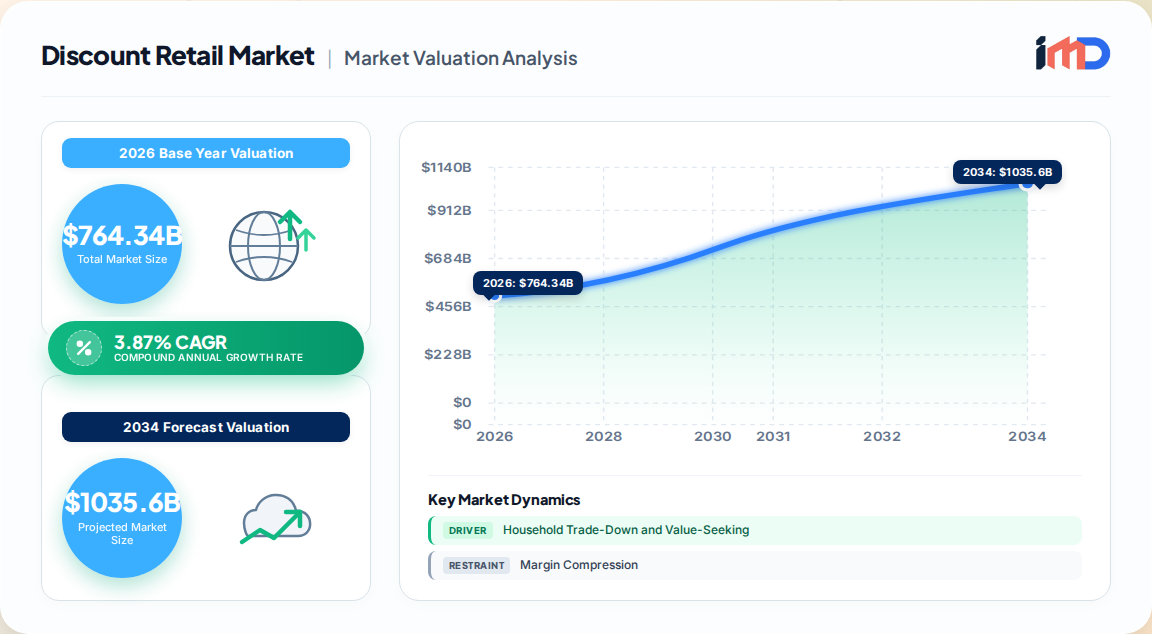
The global discount retail market represents a highly resilient and rapidly evolving segment of the consumer goods landscape. Our proprietary primary research estimates the market at USD 764.34 Billion in 2026, with projections indicating a rise to USD 997.78 Billion by 2032, reflecting a steady CAGR of 3.87% during the forecast period (2027-2032). This growth is underpinned by structural shifts in consumer behavior, where value-seeking extends beyond low-income demographics to encompass a broad cross-section of households facing persistent inflationary pressures.
Discount retailing is no longer merely about low prices; it is a sophisticated model combining private-label innovation, supply chain efficiency, and targeted store expansion in underserved catchments. The market remains highly fragmented, with a low concentration of players, allowing regional champions to thrive alongside global giants. Europe currently dominates the landscape, holding a 33.94% share in 2026, while Asia-Pacific emerges as the fastest-growing region with a projected CAGR of 5.63% through 2032.
Drivers
Restraints
By Store Format
By Product Category
By Business Model
By Payment Options
Europe remains the largest market, holding a 33.94% share in 2026, driven by a dense discount store network and strong consumer acceptance of private labels. Countries like Germany, the Netherlands, and Poland are key growth engines.
North America follows closely, with the U.S. market valued at USD 192.3 Billion in 2024 within the discount department store segment. The region is characterized by high competition and a strong omnichannel presence.
Asia-Pacific is the fastest-growing region, with a projected CAGR of 5.63%, fueled by urbanization, rising middle-class consumption, and store network expansion in countries like China and India.
South America and the Middle East & Africa offer untapped potential, with increasing penetration of hard discount formats and growing informal retail sectors.
The market is characterized by intense competition among global, regional, and local players. Key strategies include:
The discount retail value chain is characterized by high-volume, low-margin operations, requiring efficient sourcing and logistics. Key components include:
Supply Chain Risks
| Aspects | Details |
|---|---|
| Study Period | 2020-2034 |
| Base Year | 2026 |
| Estimated Year | 2026 |
| Forecast Period | 2026-2034 |
| Historical Period | 2020-2025 |
| Growth Rate | CAGR of 3.87% from 2020-2034 |
| Segmentation |
|
By Business Model
| By Geography |
|
The global discount retail market was valued at **USD 764.34 Billion in 2026** and is projected to reach **USD 997.78 Billion by 2032**, growing at a **CAGR of 3.87%**.
Europe leads the market with a **33.94% share in 2026**, driven by a strong discount culture and widespread private-label adoption. Asia-Pacific is the fastest-growing region with a **CAGR of 5.63%**.
Food and grocery account for the largest share (**46.75% in 2026**), followed by apparel, household goods, and consumer electronics. Private-label products are most prevalent in food and household segments.
The market is fragmented with key players including Biedronka, Save, Trader Joe's, X5 Retail, Lidl, Grocery Outlet, Lot, Mercadona, and Ahold Delhaize, among others. These companies compete on price, private-label offerings, and store expansion.
Household trade-down and value-seeking behavior, private-label expansion, store network growth in underserved areas, and omnichannel integration are the primary growth drivers, collectively contributing over **3% to CAGR**.
Our rigorous research methodology combines multi-layered approaches with comprehensive quality assurance, ensuring precision, accuracy, and reliability in every market analysis.
| Stakeholder Role | Interview Share (%) |
|---|---|
| Chief Merchandising Officer | 30% |
| VP of Supply Chain | 25% |
| Store Operations Director | 25% |
| Procurement Manager | 20% |
| Company Type | Representation (%) |
|---|---|
| Discount Retail Chains | 40% |
| Private-Label Manufacturers | 25% |
| Logistics Providers | 15% |
| Retail Technology Vendors | 12% |
| Industry Associations | 8% |
 Related Reports
