1What is the digital healthcare supply chain management market size?
The market was valued at USD 3.5 billion in 2025 and is projected to reach USD 6.7 billion by 2033, growing at a CAGR of 8.4% from 2026 to 2033.
Insight Market Data is a premier market research and business consulting firm headquartered in Pune, India, providing syndicated research reports, customized intelligence studies, and strategic advisory services. Renowned academic institutions and Fortune 500 corporations worldwide rely on Insight Market Data's research repository to navigate evolving global and regional business environments. Covering 46 diverse industries across 25 major international economies, our comprehensive database delivers thousands of verified statistics and granular market evaluations. By combining industry-leading analytical methodologies with the direct insights of seasoned industry leaders and subject-matter experts, we deliver actionable intelligence spanning historical performance benchmarks to rigorous multi-year forecasts. We empower organizations to make confident, data-driven decisions across pivotal domains including Machinery & Equipment, Chemicals & Materials, Pharmaceuticals & Healthcare, Food & Beverages, Consumer Goods, Energy & Power, Automotive & Transportation, Electronics & Semiconductors, Medical Devices, Telecommunications, Emerging Technologies, Agriculture, and Packaging. Our multidisciplinary analyst teams provide an objective 360-degree perspective, tailoring every engagement to address complex strategic challenges with exceptional analytical rigor.
Leveraging advanced BI-powered analytics and predictive modeling, Insight Market Data uncovers high-impact market opportunities and competitive differentiators for ambitious enterprises. We continuously refine our research methodologies in accordance with global industry standards, tracking real-time market shifts to ensure our reports are consistently accurate, actionable, and delivered on schedule. Our analysts conduct methodical data validation, rigorous compliance checks, and exhaustive primary and secondary research to maintain the highest levels of data integrity and transparency. We partner closely with corporate strategists, investment groups, and business executives to translate intricate market intelligence into clear, actionable roadmaps for sustainable growth. With operational presence across Washington, USA, and Vimannagar, Pune, India, Insight Market Data ensures direct access to dedicated research specialists and responsive customer support to answer your most strategic questions.
 Digital Healthcare Supply Chain Management Market
 by Product (Hardware, Software, Services), by Deployment (Web-Based, Cloud-Based, On-Premises), by End Use (Medical Device, Pharmaceutical, Hospitals, Biotechnology, Others), by Function (Procurement Management, Inventory Management, Forecasting and Planning, Internal Logistics and Operations, Warehousing and Distribution, Reverse and Extended Logistics, Others), by Model (Make-To-Stock, Build-To-Order, Continuous Replenishment, Chain Assembly, Others), by North America (USA, Canada, Mexico), by Europe (Germany, UK, France, Italy, Spain, Rest of Europe), by Asia Pacific (China, Japan, India, South Korea, Australia, Rest of APAC), by Latin America (Brazil, Argentina, Rest of LATAM), by Middle East & Africa (South Africa, Saudi Arabia, UAE, Rest of MEA) Forecast 2026-2034

Research Associate


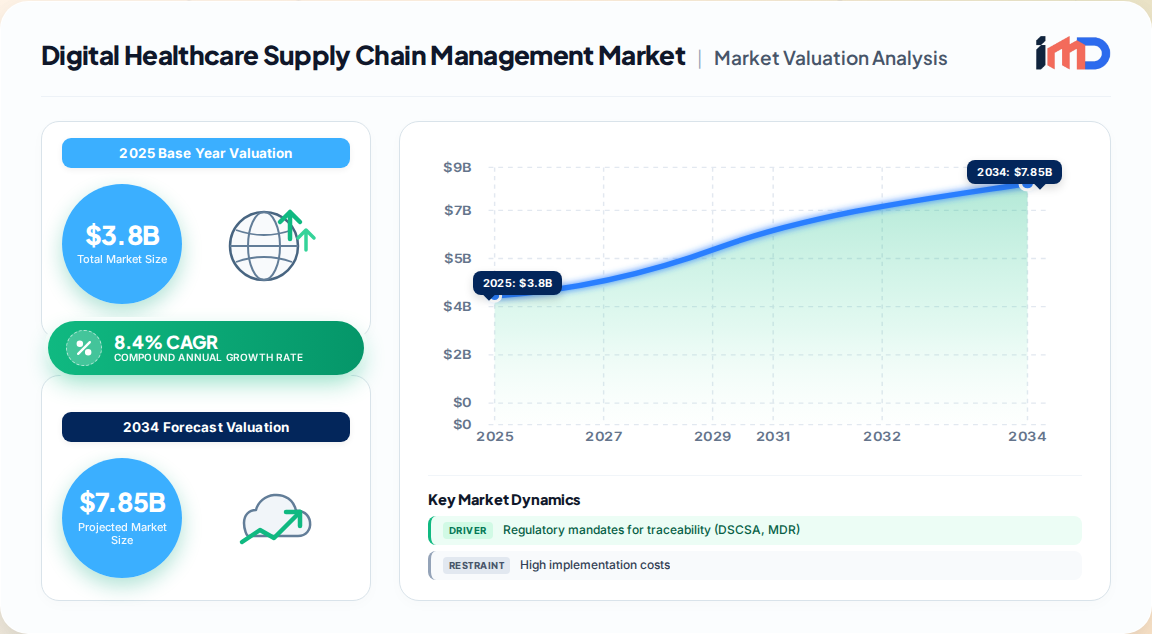
The digital healthcare supply chain management market is experiencing a structural transformation, moving from back-office cost center to a strategic pillar of clinical and financial resilience. Our proprietary primary research estimates the global market at USD 3.8 billion in 2026, projected to reach USD 6.7 billion by 2033, expanding at a CAGR of 8.4%. This growth is not merely a continuation of pre-pandemic digitization but a fundamental re-platforming of how healthcare organizations source, track, and deploy critical supplies.
The market's evolution is defined by a decisive shift from on-premises, transactional procurement systems to cloud-native, intelligence-led orchestration platforms. North America remains the dominant region, accounting for 32.8% of 2025 revenue, yet the strategic center of gravity for future growth is unmistakably shifting toward Asia Pacific, which we project to be the fastest-growing region through 2033. The competitive landscape is intensifying as enterprise software incumbents, specialized healthcare exchange platforms, and workflow automation specialists converge on a shared vision of real-time, end-to-end supply chain visibility.
The market's expansion is propelled by a confluence of operational, regulatory, and technological forces. However, significant headwinds persist, particularly for smaller provider organizations.
The market's structure reveals clear preferences for cloud-native delivery and intelligence-rich software layers.
| Segment | Leading Category | 2025/2026 Share | Fastest-Growing Category | Growth Indicator |
|---|---|---|---|---|
| Product | Software | ~65% of revenue | Services | 9.6% CAGR (services) |
| Deployment | Cloud-Based | 59.4% (2025) | Cloud-Based | 10.3% CAGR |
| End Use | Pharmaceutical & Biotech | 35.7% (2025) | Pharmaceutical & Biotech | 9.9% CAGR |
| Function | Procurement Management | 31.8% (2025) | Inventory Management | 10.7% CAGR |
Software remains the largest product segment, accounting for roughly two-thirds of revenue, as organizations prioritize the analytics, orchestration, and traceability layers that sit atop legacy ERP systems. However, services (implementation, training, managed services) are growing faster, reflecting the complexity of integrating modern platforms into heterogeneous hospital IT environments. Within deployment, cloud-based solutions are dominant and accelerating, driven by their scalability, lower upfront costs, and continuous feature updates. The pharmaceutical end-use segment leads due to stringent track-and-trace regulations and the high value of drug inventory. Notably, inventory management is growing faster than procurement management, signaling a shift from transactional buying efficiency toward continuous stock visibility and point-of-care responsiveness.
North America's leadership is underpinned by advanced healthcare IT infrastructure, high regulatory compliance requirements, and widespread cloud adoption. The U.S., in particular, is the single largest country market, with nearly 70% of U.S. hospitals on track to adopt cloud-based supply chain management by 2026. Europe follows as a mature but steadily growing market, driven by the EU MDR and increasing cross-border supply chain coordination. The Asia Pacific region is the clear growth engine, with our analysis pointing to a CAGR of over 11% through 2033, fueled by rapid healthcare infrastructure development, rising medical device and pharmaceutical manufacturing, and increasing government initiatives to modernize medical supply chains. Latin America and the Middle East & Africa, while smaller, are expected to show accelerating adoption as public health systems invest in digital infrastructure and seek to reduce counterfeit product penetration.
The market is characterized by high innovation and high M&A activity, with leading players actively consolidating to offer end-to-end platforms. Strategic moves in 2024-2026 illustrate the direction of travel:
These developments underscore a competitive race to build intelligence-native, interoperable ecosystems that combine procurement, inventory management, and predictive analytics. Vendors that can demonstrate measurable ROI—through reduced stockouts, lower emergency sourcing costs, and improved compliance—are best positioned to win share.
The digital healthcare supply chain management value chain spans several distinct stages, each with specific digital requirements and decision-makers:
Our primary interviews with procurement directors, hospital CIOs, supply chain VPs, and pharmaceutical operations leaders confirm that purchasing decisions are increasingly driven by cross-functional teams that include clinical, IT, and finance stakeholders.
Several underpenetrated areas present high-growth opportunities for investors and vendors:
While the digital healthcare supply chain management market is software-centric and not a tradable commodity, its demand is closely tied to global flows of pharmaceuticals and medical devices. According to official multilateral supply-and-use data from the OECD, import dependency for medical and pharmaceutical products remains high in many OECD economies, underscoring the need for resilient, traceable supply chains. The growth of cross-border e-pharmacy and direct-to-patient logistics has further increased the complexity of tracking and authentication, creating a direct demand signal for digital SCM platforms. We note that the COVID-19 pandemic exposed significant vulnerabilities in medical supply chains, and subsequent investments in digital control towers and dual-sourcing strategies have become a lasting tailwind for this market.
| Aspects | Details |
|---|---|
| Study Period | 2020-2034 |
| Base Year | 2025 |
| Estimated Year | 2026 |
| Forecast Period | 2026-2034 |
| Historical Period | 2020-2025 |
| Growth Rate | CAGR of 8.4% from 2020-2034 |
| Segmentation |
|
By End Use
By Function
By Model
| By Geography |
|
The market was valued at USD 3.5 billion in 2025 and is projected to reach USD 6.7 billion by 2033, growing at a CAGR of 8.4% from 2026 to 2033.
North America held the largest revenue share of 32.8% in 2025, driven by advanced healthcare IT infrastructure and stringent regulatory mandates.
Key trends include the shift to cloud-based platforms, integration of AI and analytics for real-time inventory visibility, and increasing adoption of control towers and digital twin technology.
The pharmaceutical segment held the largest share of 35.7% in 2025, owing to stringent track-and-trace regulations and the high value of drug inventory.
Major companies include Oracle, SAP SE, GHX, Inc., McKesson Corporation, Tecsys Inc., Cardinal Health, AmerisourceBergen, and Owens & Minor.
Our rigorous research methodology combines multi-layered approaches with comprehensive quality assurance, ensuring precision, accuracy, and reliability in every market analysis.
| Stakeholder Role | Interview Share (%) |
|---|---|
| Procurement Director | 30% |
| Hospital CIO | 25% |
| Supply Chain VP | 25% |
| Pharmaceutical Operations Leader | 20% |
| Company Type | Representation (%) |
|---|---|
| Cloud-based SCM Software Vendors | 30% |
| Healthcare Distributors | 20% |
| Hospital & Health System Procurement | 25% |
| Pharmaceutical & Medical Device Manufacturers | 15% |
| Third-Party Logistics Providers | 10% |
 Related Reports
