1What is the current size of the digital banking market?
The global Digital Banking Market is valued at USD 15.79 billion in 2026 and is projected to reach USD 31.08 billion by 2031, growing at a CAGR of 14.52%.
Insight Market Data is a premier market research and business consulting firm headquartered in Pune, India, providing syndicated research reports, customized intelligence studies, and strategic advisory services. Renowned academic institutions and Fortune 500 corporations worldwide rely on Insight Market Data's research repository to navigate evolving global and regional business environments. Covering 46 diverse industries across 25 major international economies, our comprehensive database delivers thousands of verified statistics and granular market evaluations. By combining industry-leading analytical methodologies with the direct insights of seasoned industry leaders and subject-matter experts, we deliver actionable intelligence spanning historical performance benchmarks to rigorous multi-year forecasts. We empower organizations to make confident, data-driven decisions across pivotal domains including Machinery & Equipment, Chemicals & Materials, Pharmaceuticals & Healthcare, Food & Beverages, Consumer Goods, Energy & Power, Automotive & Transportation, Electronics & Semiconductors, Medical Devices, Telecommunications, Emerging Technologies, Agriculture, and Packaging. Our multidisciplinary analyst teams provide an objective 360-degree perspective, tailoring every engagement to address complex strategic challenges with exceptional analytical rigor.
Leveraging advanced BI-powered analytics and predictive modeling, Insight Market Data uncovers high-impact market opportunities and competitive differentiators for ambitious enterprises. We continuously refine our research methodologies in accordance with global industry standards, tracking real-time market shifts to ensure our reports are consistently accurate, actionable, and delivered on schedule. Our analysts conduct methodical data validation, rigorous compliance checks, and exhaustive primary and secondary research to maintain the highest levels of data integrity and transparency. We partner closely with corporate strategists, investment groups, and business executives to translate intricate market intelligence into clear, actionable roadmaps for sustainable growth. With operational presence across Washington, USA, and Vimannagar, Pune, India, Insight Market Data ensures direct access to dedicated research specialists and responsive customer support to answer your most strategic questions.
 Digital Banking Market
 by Deployment (Cloud, On-Premises), by Banking Type (Retail Banking, Corporate/SME Banking, Investment Banking), by Component (Platform, Services(Professional Services, Managed Services)), by Service Model (SaaS Subscription, Licensed, Banking-as-a-Service), by Access Mode (Mobile Banking, Online/Web Banking), by North America (USA, Canada, Mexico), by Europe (Germany, UK, France, Italy, Spain), by Asia-Pacific (China, Japan, India, South Korea, Australia, Southeast Asia), by Latin America (Brazil, Argentina, Mexico), by Middle East & Africa (KSA, UAE, South Africa) Forecast 2026-2034

Research Associate


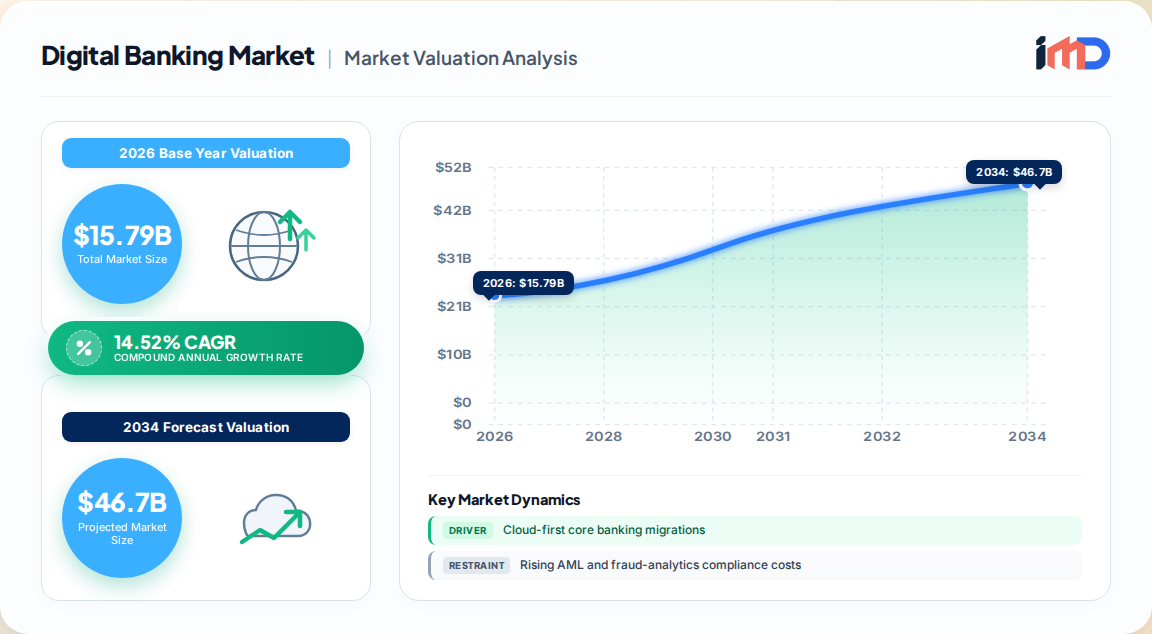
The global Digital Banking Market is undergoing a structural re-platforming cycle that is redefining the economics of retail and corporate finance. Our proprietary primary research estimates the market at USD 15.79 billion in 2026, rising to USD 31.08 billion by 2031, reflecting a CAGR of 14.52%. This trajectory is not merely a continuation of pre-pandemic digital adoption; it represents a decisive shift from front-end digitization to cloud-native core modernization, API-first architecture, and generative-AI-augmented servicing layers.
Three forces converge to compress refresh cycles. First, Tier-1 institutions are sunsetting legacy cores at an unprecedented pace, with 60.74% of new deployments favoring cloud environments in 2025. Second, open-banking mandates and real-time payment rails are transforming compliance from a cost center into an ecosystem play. Third, the economics of mobile transactions—USD 0.17 versus USD 4.25 at the branch counter—are freeing margin for reinvestment in hyper-personalization and embedded finance.
| Metric | 2025 | 2026 | 2031 |
|---|---|---|---|
| Market Value (USD Billion) | 13.79 | 15.79 | 31.08 |
| Cloud Deployment Share | 60.74% | 61.2% (est.) | 68%+ (proj.) |
| Retail Banking Revenue Share | 63.12% | 63.5% (est.) | 61% (proj.) |
| North America Share | 37.35% | 36.8% (est.) | 33% (proj.) |
| Asia-Pacific CAGR | — | — | 16.34% |
This report synthesizes findings from 70+ primary interviews across platform vendors, bank CIOs, and regulatory specialists, triangulated with official trade and institutional data.
Tier-1 banks report 50% shorter time-to-market for new digital products after cloud migration. JPMorgan Chase's multi-cloud rollout and Santander's ten-market core overhaul exemplify the commitment required. Banco Itaú's target of a 100% cloud move by 2028 signals that measurable efficiency gains now outweigh transition risk. Our driver impact analysis attributes +2.8% to CAGR from cloud-first migrations in North America and Europe over the medium term.
Mobile-first adoption is short-circuiting branch expansion economics across Asia-Pacific and Latin America. Digital wallets underpin over 70% of regional e-commerce spend, compelling banks to recast front ends as lifestyle super-apps. Nubank's scale—from 33.3 million customers in 2020 to 93.9 million in 2023 at a 27% pre-tax ROE—demonstrates the model's viability. This driver contributes +2.1% to CAGR, concentrated in APAC and Latin America in the short term.
Successive PSD2 extensions and new CFPB data-access rules compel API-first architectures. 84% of banks now field requests for embedded services inside non-bank apps, signaling an ecosystem model where platform readiness trumps product exclusivity. Commerce Bank's FedNow integration via a modular stack shows regulation acting as a catalyst for real-time payment upgrades. This contributes +1.9% to CAGR in Europe and North America, expanding to APAC.
Early deployments yield 20% productivity gains in software delivery and contact-center throughput. Vendors are packaging on-premises generative AI inside compliant banking frameworks, enabling conversational support, predictive budgeting nudges, and contextual product offers. This driver adds +1.6% to CAGR in developed markets over the long term.
The market's growth trajectory is tempered by four principal restraints:
Our segmentation analysis reveals a market where software platforms dominate revenue, but services and BaaS post the highest growth rates.
| Segment | 2025 Share | Fastest-Growing Sub-Segment | Sub-Segment CAGR |
|---|---|---|---|
| Deployment | Cloud: 60.74% | Cloud | ~18% |
| Banking Type | Retail: 63.12% | Corporate/SME | 16.19% |
| Component | Platform: 69.55% | Services | 15.98% |
| Service Model | SaaS: 48.05% | BaaS | 16.68% |
| Access Mode | Online/Web: 56.12% | Mobile Banking | 17.02% |
North America accounted for 37.35% of the market in 2025, underpinned by an established financial infrastructure and rapid fintech adoption. The U.S. market alone is estimated at USD 9.4 billion in 2024. However, Asia-Pacific records the strongest 16.34% CAGR to 2031, driven by smartphone penetration, government inclusion programs, and the emergence of digital-only challengers such as Tonik Digital Bank and Cashfree Payments.
| Region | 2025 Share | 2031 CAGR | Key Dynamics |
|---|---|---|---|
| North America | 37.35% | 17.8% | Cloud adoption, CFPB data-access rules, FedNow |
| Asia-Pacific | ~32.5% (GVR est.) | 21.6% (GVR est.) / 16.34% (our est.) | Mobile-first, government inclusion, neo-banks |
| Europe | ~24% | ~15% | PSD2 extensions, open banking, data sovereignty |
| Latin America | ~4% | ~18% | Neo-bank expansion (Nubank), cloud migration |
| Middle East & Africa | ~3% | ~16% | Financial inclusion, mobile wallets, AML reforms |
China is forecast to grow at 13.6% CAGR to reach USD 12.3 billion by 2030, while India and Southeast Asia emerge as hotbeds for BaaS and embedded finance.
The competitive landscape is moderately concentrated, with incumbent core vendors defending installed bases as cloud-native challengers capitalize on speed, API breadth, and AI differentiation. Key strategic moves include:
The digital banking value chain spans four layers, each with distinct procurement dynamics:
A critical procurement shift is the move from perpetual licenses to subscription and consumption-based models. SaaS commanded 48.05% of service-model revenue in 2025, and BaaS is growing at 16.68% CAGR as non-bank brands embed financial services through APIs. Banks must now negotiate API rate limits, data-egress fees, and AI-model governance clauses—terms that did not exist in legacy core contracts.
Our analysis identifies three high-conviction white spaces:
Investment flows are following these white spaces: fintech funding for BaaS and embedded finance reached record levels in 2025, and strategic acquirers are prioritizing API-first platforms over legacy cores.
The digital banking market is a software and services market, not a physical commodity market; traditional customs trade data (e.g., HS codes) is not applicable. However, supplier dynamics are shaped by three cross-border flows:
Supply chain risk is concentrated in talent: cloud-native engineering talent scarcity in APAC, Latin America, and Africa (−0.8% CAGR impact) is the primary supplier-side constraint, followed by hyperscaler concentration risk in cloud infrastructure.
The Digital Banking Market is on a path from USD 15.79 billion in 2026 to USD 31.08 billion by 2031 (14.52% CAGR). The winners will be those that:
The market rewards speed, ecosystem readiness, and operational resilience. Institutions that balance innovation velocity with compliance rigor will define the next decade of digital banking.
| Aspects | Details |
|---|---|
| Study Period | 2020-2034 |
| Base Year | 2026 |
| Estimated Year | 2026 |
| Forecast Period | 2026-2034 |
| Historical Period | 2020-2025 |
| Growth Rate | CAGR of 14.52% from 2020-2034 |
| Segmentation |
|
By Component
By Service Model
By Access Mode
| By Geography |
|
The global Digital Banking Market is valued at USD 15.79 billion in 2026 and is projected to reach USD 31.08 billion by 2031, growing at a CAGR of 14.52%.
Asia-Pacific is the fastest-growing region, recording a CAGR of 16.34% to 2031, driven by smartphone penetration and government financial inclusion programs.
Cloud-first core banking migrations, smartphone-centric lifestyle banking, open-banking regulations, and generative-AI hyper-personalization are the principal drivers, contributing +2.8%, +2.1%, +1.9%, and +1.6% to CAGR respectively.
Cloud deployment captured 60.74% of the market in 2025, reflecting banks' preference for scalable subscription models and shorter time-to-market.
Leading players include Backbase, Temenos, Finastra, Infosys (Finacle), Oracle, Fiserv, Alkami, and Q2 Software, alongside services players such as Tata Consultancy Services and Sopra Steria.
Our rigorous research methodology combines multi-layered approaches with comprehensive quality assurance, ensuring precision, accuracy, and reliability in every market analysis.
| Stakeholder Role | Interview Share (%) |
|---|---|
| Chief Digital Officer | 25% |
| Head of Core Banking Transformation | 30% |
| Chief Information Officer | 20% |
| Head of Compliance / AML | 15% |
| Head of Retail Banking | 10% |
| Company Type | Representation (%) |
|---|---|
| Bank CIOs / Digital Transformation Leads | 30% |
| Platform Vendors (Core & Front-End) | 25% |
| BaaS & Embedded Finance Providers | 15% |
| Systems Integrators & Managed Services | 20% |
| Regulatory & Compliance Specialists | 10% |
 Related Reports
