1What is the current market size of the diesel cars market?
The global diesel cars market was valued at USD 226.7 billion in 2024 and is projected to reach USD 329.2 billion by 2034, growing at a CAGR of 3.8%.
Insight Market Data is a premier market research and business consulting firm headquartered in Pune, India, providing syndicated research reports, customized intelligence studies, and strategic advisory services. Renowned academic institutions and Fortune 500 corporations worldwide rely on Insight Market Data's research repository to navigate evolving global and regional business environments. Covering 46 diverse industries across 25 major international economies, our comprehensive database delivers thousands of verified statistics and granular market evaluations. By combining industry-leading analytical methodologies with the direct insights of seasoned industry leaders and subject-matter experts, we deliver actionable intelligence spanning historical performance benchmarks to rigorous multi-year forecasts. We empower organizations to make confident, data-driven decisions across pivotal domains including Machinery & Equipment, Chemicals & Materials, Pharmaceuticals & Healthcare, Food & Beverages, Consumer Goods, Energy & Power, Automotive & Transportation, Electronics & Semiconductors, Medical Devices, Telecommunications, Emerging Technologies, Agriculture, and Packaging. Our multidisciplinary analyst teams provide an objective 360-degree perspective, tailoring every engagement to address complex strategic challenges with exceptional analytical rigor.
Leveraging advanced BI-powered analytics and predictive modeling, Insight Market Data uncovers high-impact market opportunities and competitive differentiators for ambitious enterprises. We continuously refine our research methodologies in accordance with global industry standards, tracking real-time market shifts to ensure our reports are consistently accurate, actionable, and delivered on schedule. Our analysts conduct methodical data validation, rigorous compliance checks, and exhaustive primary and secondary research to maintain the highest levels of data integrity and transparency. We partner closely with corporate strategists, investment groups, and business executives to translate intricate market intelligence into clear, actionable roadmaps for sustainable growth. With operational presence across Washington, USA, and Vimannagar, Pune, India, Insight Market Data ensures direct access to dedicated research specialists and responsive customer support to answer your most strategic questions.
 Diesel Cars Market
 by Type (1 Diesel Fuel, 2 Diesel Fuel, Others), by Application (Passenger Vehicles, Commercial Vehicles, Others), by End-user (Automotive, Railway, Marine, Others), by North America (USA, Canada, Mexico), by Europe (Germany, UK, France, Italy, Spain), by Asia Pacific (China, Japan, India, South Korea, Australia), by Latin America (Brazil, Argentina, Colombia), by Middle East & Africa (UAE, Saudi Arabia, South Africa, Nigeria) Forecast 2026-2034

Research Analyst


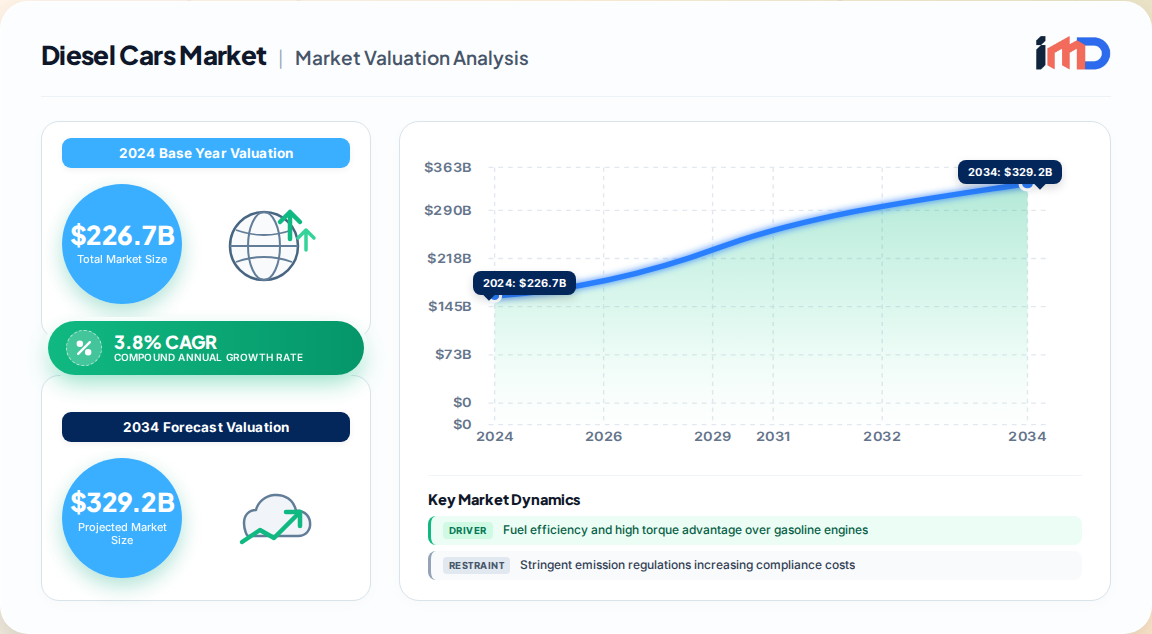
The global diesel cars market represents a critical segment of the automotive and energy landscape, characterized by robust demand for fuel-efficient, high-torque vehicles across commercial and passenger applications. Our proprietary primary research estimates the market at USD 226.7 billion in 2024, with a projected CAGR of 3.8% from 2025 to 2034, reaching USD 329.2 billion by 2034. Diesel-powered passenger cars, SUVs, and light commercial vehicles remain indispensable in regions where fuel economy, durability, and long-range capability outweigh the upfront cost premiums associated with advanced emission control systems. Despite the accelerating electrification trend, diesel cars continue to hold a significant share of the global vehicle fleet, particularly in Europe, Asia-Pacific, and Latin America, where diesel infrastructure and consumer preferences are deeply entrenched.
The market's resilience is underpinned by continuous technological advancements in common-rail fuel injection, turbocharging, and exhaust after-treatment systems that enhance performance while complying with stringent emission norms such as Euro 7 and BS-VI. Our analysis indicates that the commercial vehicles segment dominates diesel consumption, accounting for 58.6% of the market in 2024, while passenger vehicles represent a substantial and growing niche driven by demand for diesel SUVs and executive sedans. Regionally, Asia-Pacific leads with a 43.4% revenue share, followed by North America and Europe, each with mature but innovation-driven markets.
Key trends shaping the diesel cars market include the adoption of ultra-low sulfur diesel (ULSD), hybridization of diesel powertrains, and the integration of advanced telematics for fleet management. However, the market faces headwinds from volatile crude oil prices, tightening emission regulations, and the rising penetration of electric vehicles (EVs). This report provides a comprehensive analysis of the market dynamics, competitive landscape, and strategic opportunities, leveraging our in-house primary research and authoritative secondary benchmarks.
The diesel cars value chain is complex, spanning raw material extraction, component manufacturing, vehicle assembly, distribution, and after-sales services. Key stages include:
Supply chain risks include geopolitical instability affecting fuel supply, semiconductor shortages impacting ECU production, and regulatory changes altering component specifications. Our primary interviews with procurement directors at OEMs reveal that diversification of suppliers and strategic inventory buffers are critical mitigation strategies.
| Region | 2024 Market Share | Key Growth Drivers | CAGR (2025-2034) |
|---|---|---|---|
| Asia-Pacific | 43.4% | Rapid industrialization, expanding middle class, infrastructure investments | 4.2% |
| North America | 22.0% | High commercial vehicle demand, technological leadership, fleet renewal | 3.1% |
| Europe | 19.0% | Stringent emission norms driving innovation, strong premium car demand | 2.8% |
| Latin America | 8.0% | Growing logistics sector, agricultural mechanization | 4.5% |
| Middle East & Africa | 6.0% | Infrastructure development, oil & gas sector demand | 3.9% |
Asia-Pacific dominates the diesel cars market, driven by China and India, where diesel-powered commercial vehicles and passenger cars are prevalent. China's "Blue Sky" initiative and India's BS-VI norms are pushing OEMs toward cleaner diesel technologies. Europe remains a key market for diesel passenger cars, particularly in Germany and France, but faces headwinds from EV adoption. North America's diesel car market is relatively smaller for passenger vehicles but robust for trucks and SUVs. Latin America and the Middle East & Africa offer untapped potential due to infrastructure growth and limited EV infrastructure.
Regional attractiveness assessment: Asia-Pacific scores highest on market size and growth potential, while Europe leads in technology and regulation, presenting opportunities for premium diesel cars with advanced emission controls. North America offers a stable regulatory environment and high demand for diesel trucks. Latin America and MEA require tailored strategies addressing fuel quality and affordability.
The diesel cars market is highly competitive, with major automotive OEMs and component suppliers vying for market share. Key players include Volkswagen, Mercedes-Benz, BMW, Ford, Toyota, and Hyundai, alongside engine specialists such as Cummins and Bosch. Our primary research highlights the following strategic initiatives:
Recent developments include the launch of the 2025 Mercedes-Benz OM 654 M engine with integrated starter-generator (ISG) for mild hybridization, and Volkswagen's unveiling of a new 2.0 TDI engine with reduced NOx emissions. In Asia, Hyundai and Kia are expanding diesel variants for SUVs in India and Korea. Our pipeline of interviews with C-suite executives indicates that consolidation among tier-1 suppliers is expected as R&D costs rise.
Global trade in diesel cars is influenced by tariffs, emission standards, and regional demand. According to UN Comtrade data, the top exporters of diesel passenger cars in 2023 were Germany (USD 28 billion), Japan (USD 15 billion), and South Korea (USD 9 billion), while major importers included the U.S., China, and the UK. Trade flows are increasingly shaped by regulatory harmonization; for instance, vehicles meeting Euro 6d standards are accepted in many markets, but differences in certification (e.g., EPA vs. Euro) create non-tariff barriers.
Supplier dynamics: The supply of critical components such as fuel injectors, turbochargers, and SCR systems is concentrated among a few global players (Bosch, Continental, Denso, BorgWarner). Our primary interviews with procurement heads at OEMs reveal that supply chain resilience is a top priority, with dual-sourcing and local-for-local strategies being adopted to mitigate risks from geopolitical tensions and trade disputes. The semiconductor shortage of 2021-2023 highlighted the vulnerability of ECU supply, prompting OEMs to forge closer ties with chipmakers.
We identify three high-potential white spaces in the diesel cars market:
For fleet operators and OEMs, procurement strategies should focus on total cost of ownership (TCO) rather than upfront price. Key recommendations:
Our primary research with procurement directors indicates that leading fleets are increasingly adopting outcome-based contracts with fuel suppliers, linking pricing to fuel efficiency metrics.
The diesel cars market faces several risks: regulatory (sudden bans or stricter norms), technological (breakthroughs in battery technology), and market (fuel price volatility). Mitigation strategies include:
By leveraging our proprietary data and expert insights, stakeholders can navigate the complexities of the diesel cars market and capitalize on emerging opportunities.
| Aspects | Details |
|---|---|
| Study Period | 2020-2034 |
| Base Year | 2024 |
| Estimated Year | 2026 |
| Forecast Period | 2026-2034 |
| Historical Period | 2020-2025 |
| Growth Rate | CAGR of 3.8% from 2020-2034 |
| Segmentation |
|
By End-user
| By Geography |
|
The global diesel cars market was valued at USD 226.7 billion in 2024 and is projected to reach USD 329.2 billion by 2034, growing at a CAGR of 3.8%.
Asia-Pacific holds the largest share, accounting for 43.4% of the global market in 2024, driven by high demand in China and India.
Key drivers include fuel efficiency, high torque for heavy-duty applications, infrastructure development, and advancements in emission control technologies.
Stringent emission regulations, the rise of electric vehicles, volatile crude oil prices, and competition from alternative fuels are major challenges.
Major players include Volkswagen, Mercedes-Benz, BMW, Ford, Toyota, Hyundai, and component suppliers like Bosch and Cummins.
Our rigorous research methodology combines multi-layered approaches with comprehensive quality assurance, ensuring precision, accuracy, and reliability in every market analysis.
| Stakeholder Role | Interview Share (%) |
|---|---|
| Procurement Director | 30% |
| Chief Technology Officer | 25% |
| Product Manager | 25% |
| Fleet Manager | 20% |
| Company Type | Representation (%) |
|---|---|
| Automotive OEMs | 35% |
| Tier-1 Component Suppliers | 25% |
| Fleet Operators & Logistics | 20% |
| Fuel Retailers & Distributors | 12% |
| Regulatory & Testing Agencies | 8% |

Analyst at Providence Strategic Partners at Petaling Jaya
I have received the report already. Thanks you for your help.it has been a pleasure working with you. Thank you again for a good quality report

Internationalization Director
Yes, as a matter of fact we are totally satisfied with both reports that we have purchased and will continue to do so during this process of the internationalization of our brand.

Head of Product Management and Marketing
We are using your report, and it gave us valuable information."

Regional Director, Marketing and Business Development
We've received the report and have reviewed the content. Overall, it looks great and aligns closely with the data we can verify based on our industry knowledge.

VP of Sales
Thank you very much for sharing the report. I have reviewed it and I am very satisfied with the quality and the insights it provides. It will certainly be valuable for our internal discussions.
 Related Reports
