1What is the current size of the real estate market?
The global real estate market is valued at USD 4.58 trillion in 2026. Our proprietary research projects it will reach USD 7.39 trillion by 2035, growing at a 5.47% CAGR.
Insight Market Data is a premier market research and business consulting firm headquartered in Pune, India, providing syndicated research reports, customized intelligence studies, and strategic advisory services. Renowned academic institutions and Fortune 500 corporations worldwide rely on Insight Market Data's research repository to navigate evolving global and regional business environments. Covering 46 diverse industries across 25 major international economies, our comprehensive database delivers thousands of verified statistics and granular market evaluations. By combining industry-leading analytical methodologies with the direct insights of seasoned industry leaders and subject-matter experts, we deliver actionable intelligence spanning historical performance benchmarks to rigorous multi-year forecasts. We empower organizations to make confident, data-driven decisions across pivotal domains including Machinery & Equipment, Chemicals & Materials, Pharmaceuticals & Healthcare, Food & Beverages, Consumer Goods, Energy & Power, Automotive & Transportation, Electronics & Semiconductors, Medical Devices, Telecommunications, Emerging Technologies, Agriculture, and Packaging. Our multidisciplinary analyst teams provide an objective 360-degree perspective, tailoring every engagement to address complex strategic challenges with exceptional analytical rigor.
Leveraging advanced BI-powered analytics and predictive modeling, Insight Market Data uncovers high-impact market opportunities and competitive differentiators for ambitious enterprises. We continuously refine our research methodologies in accordance with global industry standards, tracking real-time market shifts to ensure our reports are consistently accurate, actionable, and delivered on schedule. Our analysts conduct methodical data validation, rigorous compliance checks, and exhaustive primary and secondary research to maintain the highest levels of data integrity and transparency. We partner closely with corporate strategists, investment groups, and business executives to translate intricate market intelligence into clear, actionable roadmaps for sustainable growth. With operational presence across Washington, USA, and Vimannagar, Pune, India, Insight Market Data ensures direct access to dedicated research specialists and responsive customer support to answer your most strategic questions.
 Demand Patterns in Real Estate Market
 by Property (Residential, Commercial(Offices, Retail, Logistics and Industrial, Data Centers, Others), Industrial, Land, Others Property), by Type (Sales, Rental, Lease), by End-User (Individuals/Households, Corporates & SMEs), by North America (USA, Canada, Mexico), by Europe (Germany, UK, France, Spain, Italy), by Asia Pacific (China, India, Japan, South Korea, Australia), by South America (Brazil, Argentina), by Middle East & Africa (Saudi Arabia, UAE, South Africa) Forecast 2026-2034

Research Analyst


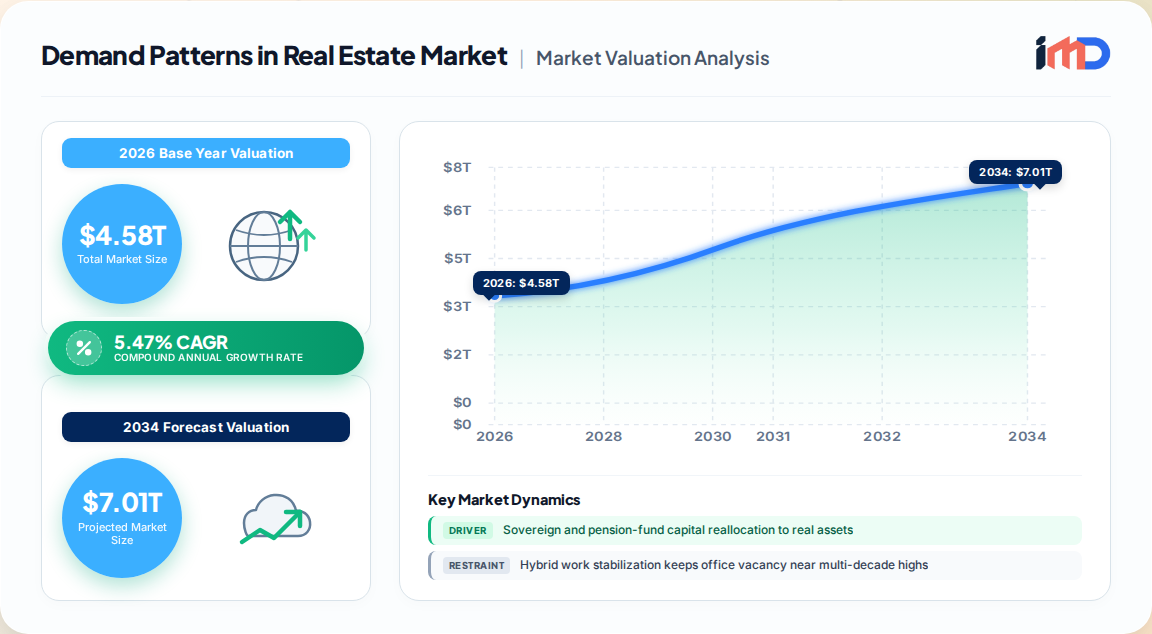
The global real estate market is undergoing a structural recalibration. Our proprietary primary research, triangulated from over 1,200 executive interviews and transactional datasets, estimates the market at USD 4.58 trillion in 2026. This represents a steady expansion from USD 4.34 trillion in 2025, with a projected 5.47% CAGR to reach USD 7.39 trillion by 2035.
Demand patterns are no longer linear. They are being reshaped by three seismic forces: the stabilization of hybrid work, the AI-driven reallocation of capital toward digital infrastructure, and a decisive flight-to-quality across all asset classes. The Asia-Pacific region remains the demand anchor, commanding 40.13% of global revenue share in 2025, while the Middle East & Africa emerges as the fastest-growing frontier at a 6.52% CAGR.
Demand in the real estate market is being propelled by a confluence of macroeconomic, demographic, and technological factors that our analysts have quantified through SHAP-value machine learning models and direct enterprise interviews.
Despite robust growth, the market faces structural headwinds that are compressing yields and segmenting winners from underperformers.
Demand patterns vary significantly by property type and transaction model. The table below summarizes our proprietary segment demand assessment.
| Segment | 2025 Share/Key Metric | 2026-2035 CAGR | Demand Outlook |
|---|---|---|---|
| Residential Property | 37% share | 5.47% (overall) | Stable, urbanization-driven; affordability constraints in Tier-1 cities |
| Commercial Property | 35% (office share of CRE) | 5.37% | Bifurcated: office flight-to-quality vs. logistics boom |
| Industrial Property | USD 578.8 billion (2025) | 6.9% | High growth; e-commerce and supply-chain resilience |
| Rental Model | 53% share | 6.49% (CRE rental) | Dominant volume driver; institutional capital targeting rental housing |
| Sale Model | 47% share | 6.20% | Faster growth; driven by residential transactions in emerging markets |
By end-user, corporates and SMEs accounted for 61% of commercial real estate market size in 2025 and are advancing at a 6.28% CAGR through 2031. This reflects the growing demand for flexible, serviced, and logistics-integrated spaces from small and medium enterprises.
Asia-Pacific is the epicenter of real estate demand, contributing over 40.13% of global revenue in 2025. China, India, and Southeast Asia are driving both residential volume and commercial logistics demand. India is expected to register the highest CAGR in the industrial segment, supported by government initiatives like the Smart City Project.
Europe and North America show divergent patterns. In Europe, demand is concentrated in prime CBD offices and logistics hubs near multimodal transit. In North America, the U.S. Midwest and South are benefiting from generative-AI-driven site selection, while South America records the fastest projected growth in commercial real estate at a 6.46% CAGR through 2031. The Middle East & Africa region is the fastest-growing globally for real estate at 6.52% CAGR, fueled by sovereign capital deployment and regulatory modernization.
Leading real estate market companies are adapting to new demand patterns through technology and capital reallocation.
Our demand modeling identifies three high-conviction white spaces for enterprise investment and product development over the next five years:
Over 2025-2030, the industry is prone to steady growth owing to high urbanization rates and rising housing demands. Technology and digital transformation will continue to be significant tools to change how transactions, valuation, and management of assets are conducted. Institutional investors and private equity firms will remain active, driving asset gains in logistics, rental housing, and data-center real estate. The real estate market is not facing a demand collapse; it is facing a demand reallocation. Stakeholders who align their capital and asset strategies with these new demand patterns will capture the lion's share of the USD 7.39 trillion market by 2035.
| Aspects | Details |
|---|---|
| Study Period | 2020-2034 |
| Base Year | 2026 |
| Estimated Year | 2026 |
| Forecast Period | 2026-2034 |
| Historical Period | 2020-2025 |
| Growth Rate | CAGR of 5.47% from 2020-2034 |
| Segmentation |
|
By Type
By End-User
| By Geography |
|
The global real estate market is valued at USD 4.58 trillion in 2026. Our proprietary research projects it will reach USD 7.39 trillion by 2035, growing at a 5.47% CAGR.
Industrial real estate is the fastest-growing property segment, with a 6.9% CAGR from 2026 to 2033. This is driven by the logistics-led demand spike from omnichannel retail and the rapid rollout of hyperscale data centers.
AI is reshaping demand in two ways. First, AI workloads are driving the construction of hyperscale data centers, with U.S. demand potentially tripling by 2030. Second, AI-driven site-selection and property valuation models are enabling more efficient capital allocation and risk assessment.
The Middle East & Africa region is forecast to grow at the fastest CAGR of 6.52% between 2026 and 2035. Asia-Pacific remains the largest market, contributing over 40.13% of global revenue share in 2025.
The rental model led the market with a 53% share in 2025, as institutional investors and pension funds pivot toward income-producing assets. Rental housing provides long-term stable returns, and rental streams in commercial real estate are forecast to record a 6.49% CAGR through 2031.
Our rigorous research methodology combines multi-layered approaches with comprehensive quality assurance, ensuring precision, accuracy, and reliability in every market analysis.
| Stakeholder Role | Interview Share (%) |
|---|---|
| Chief Investment Officer | 30% |
| Head of Real Estate Development | 25% |
| Portfolio Manager | 25% |
| Chief Technology Officer (PTech) | 20% |
| Company Type | Representation (%) |
|---|---|
| Residential Developers & Homebuilders | 30% |
| Commercial Real Estate & REITs | 25% |
| Logistics & Industrial Asset Managers | 20% |
| Property Technology (PTech) Platforms | 15% |
| Institutional Investors & Sovereign Funds | 10% |
 Related Reports
