Insight Market Data is a premier market research and business consulting firm headquartered in Pune, India, providing syndicated research reports, customized intelligence studies, and strategic advisory services. Renowned academic institutions and Fortune 500 corporations worldwide rely on Insight Market Data's research repository to navigate evolving global and regional business environments. Covering 46 diverse industries across 25 major international economies, our comprehensive database delivers thousands of verified statistics and granular market evaluations. By combining industry-leading analytical methodologies with the direct insights of seasoned industry leaders and subject-matter experts, we deliver actionable intelligence spanning historical performance benchmarks to rigorous multi-year forecasts. We empower organizations to make confident, data-driven decisions across pivotal domains including Machinery & Equipment, Chemicals & Materials, Pharmaceuticals & Healthcare, Food & Beverages, Consumer Goods, Energy & Power, Automotive & Transportation, Electronics & Semiconductors, Medical Devices, Telecommunications, Emerging Technologies, Agriculture, and Packaging. Our multidisciplinary analyst teams provide an objective 360-degree perspective, tailoring every engagement to address complex strategic challenges with exceptional analytical rigor.
Leveraging advanced BI-powered analytics and predictive modeling, Insight Market Data uncovers high-impact market opportunities and competitive differentiators for ambitious enterprises. We continuously refine our research methodologies in accordance with global industry standards, tracking real-time market shifts to ensure our reports are consistently accurate, actionable, and delivered on schedule. Our analysts conduct methodical data validation, rigorous compliance checks, and exhaustive primary and secondary research to maintain the highest levels of data integrity and transparency. We partner closely with corporate strategists, investment groups, and business executives to translate intricate market intelligence into clear, actionable roadmaps for sustainable growth. With operational presence across Washington, USA, and Vimannagar, Pune, India, Insight Market Data ensures direct access to dedicated research specialists and responsive customer support to answer your most strategic questions.
Demand Patterns in Pet Fashion Market
Retail / MARKET REPORT
Demand Patterns in Pet Fashion Market | Insight Market Data
Demand Patterns in Pet Fashion Market by Product (Tops, Shirts and Dresses, Coats, Sweaters and Hoodies, Others), by Pet Type (Dogs, Cats, Others), by Distribution Channel (Supermarkets & Hypermarkets, Specialty Pet Stores, Online, Others), by North America (USA, Canada, Mexico), by Europe (Germany, UK, France, Italy, Spain), by Asia Pacific (China, Japan, India, Australia), by South America (Brazil, Argentina), by Middle East & Africa (South Africa, UAE) Forecast 2026-2034
Executive Overview: Decoding Demand in the Pet Fashion Market
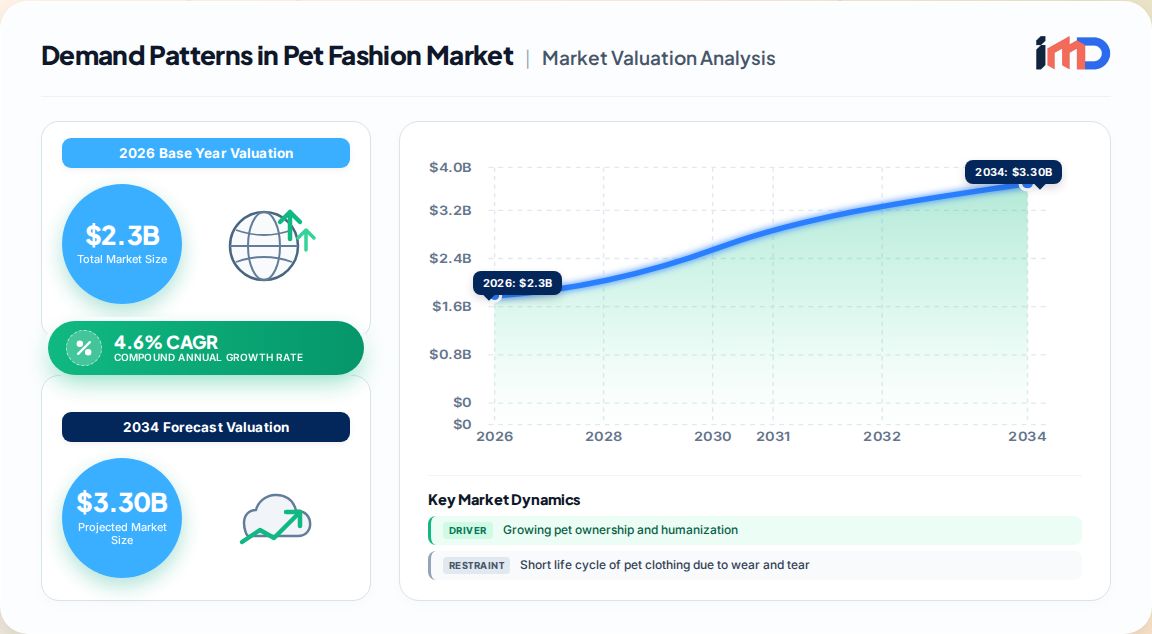
The global pet fashion market is experiencing a structural shift from a niche accessory category to a mainstream lifestyle segment. Our proprietary primary research estimates the market at USD 2.3 billion in 2026, projected to reach USD 3.2 billion by 2033, reflecting a CAGR of 4.6%. This growth is not merely an extension of the human apparel market but is driven by distinct demand patterns rooted in pet humanization, functional necessity, and digital influence.
Demand Patterns in Pet Fashion Market Market Size (In Billion)
3.0B
2.0B
1.0B
0
2.199 B
2025
2.300 B
2026
2.406 B
2027
2.516 B
2028
2.632 B
2029
2.753 B
2030
2.880 B
2031
Demand is increasingly bifurcated. On one side, a fashion-forward segment seeks trend-driven, personalized, and luxury items that mirror human couture. On the other, a functionality-first cohort prioritizes performance apparel offering thermal regulation, UV protection, and durability. Understanding these divergent demand patterns is critical for stakeholders across the value chain, from raw material suppliers to specialty retailers.
Base Year (2025) Market Size: USD 2.2 Billion
Forecast Year (2033) Market Size: USD 3.2 Billion
CAGR (2026-2033): 4.6%
Dominant Product Segment: Tops, Shirts, and Dresses (approx. 50.0% share)
Dominant Pet Type: Dogs (approx. 65.0% share)
Fastest-Growing Region: Asia Pacific
Key Demand Drivers & Restraints
The evolution of pet fashion demand is propelled by several interconnected factors, with the humanization of pets acting as the primary catalyst. Pets are increasingly viewed as integral family members, prompting owners to allocate discretionary spending toward premium products that enhance comfort, appearance, and quality of life. This shift has transformed pet apparel from a functional afterthought into a medium for self-expression and lifestyle signaling.
Functionality is emerging as an equally potent driver. Pet owners are demanding apparel that addresses specific environmental challenges: thermal insulation for winter, UV-blocking fabrics for summer, water resistance for rainy seasons, and high-visibility materials for safety during outdoor activities. This has spurred investment in advanced textiles and performance fabrics that combine durability, comfort, and style.
Digital influence, particularly through social media platforms like Instagram and TikTok, has accelerated demand by showcasing pet influencers and celebrity pets in premium clothing. Viral content and influencer collaborations shape purchasing decisions, creating rapid demand spikes for specific styles. The expansion of organized retail and e-commerce further supports market growth by providing access to extensive product assortments and personalized recommendations.
However, the market faces notable restraints. The short life cycle of pet clothing due to wear and tear, chewing, or rough play makes price a significant consideration for average pet owners. Additionally, concerns from animal rights groups regarding pet safety and comfort, as some clothing can restrict movement or cause distress, pose a challenge to unfettered growth. These factors necessitate a balanced approach to product design and marketing.
Driver: Humanization of pets driving premiumization.
Driver: Rising demand for functional and protective apparel.
Driver: Social media and influencer marketing amplifying trends.
Restraint: Short product life cycle and price sensitivity.
Restraint: Animal welfare concerns regarding comfort and safety.
Value Chain and Supply Dynamics
The pet fashion value chain is characterized by a fragmented supply base transitioning toward consolidation. Raw material suppliers provide textiles ranging from basic cotton and polyester to advanced performance fabrics. Manufacturers, often concentrated in low-cost regions, face pressure from raw material cost volatility and the need for quality consistency. Brand owners and designers occupy the higher-value segments, focusing on innovation, branding, and marketing.
Distribution channels are diversifying. Offline retail, particularly specialty pet stores, remains dominant, accounting for an estimated 68.0% of distribution in 2026. These stores offer experiential shopping and expert advice. However, online channels are growing rapidly, driven by convenience and broader product reach. Omnichannel strategies are becoming essential for brands to remain competitive.
Supply chain risks include raw material price fluctuations, logistics disruptions, and the challenge of managing inventory for short-lifecycle fashion products. Brands are increasingly adopting nearshoring or multi-sourcing strategies to mitigate these risks and improve responsiveness to demand trends.
Value Chain Stage
Key Activities
Demand Pattern Implications
Raw Materials
Textile production, performance fabric innovation
Demand for sustainable and functional materials is rising
Manufacturing
Cutting, sewing, finishing
Flexibility required to handle small batch, trend-driven orders
Branding & Design
Trend forecasting, product design, marketing
Differentiation through style, function, and brand story
Distribution
Wholesale, retail, e-commerce
Omnichannel integration critical for reach and customer engagement
Segmentation Analysis: Product, Pet Type, and Distribution
Product segmentation reveals that tops, shirts, and dresses dominate, capturing approximately 50.0% of revenue in 2025. This leadership is driven by pet owners' desire to express personal style and mirror human fashion trends. The availability of diverse styles, colors, and designs caters to a wide spectrum of tastes, from casual t-shirts to elegant dresses for special occasions. Coats, sweaters, and hoodies are expected to witness the fastest CAGR, fueled by demand for functional outerwear that provides protection against cold weather.
By pet type, dogs hold the largest share at approximately 65.0% in 2025, reflecting their global popularity as companion animals. However, the cat segment is gaining traction, particularly in urban markets where space constraints favor smaller pets. Demand for cat apparel is often driven by fashion and photo opportunities rather than functional necessity.
Distribution channel analysis shows specialty pet stores leading with around 40.0% share in 2025, as they offer curated selections and expert guidance. Online channels are the fastest-growing, benefiting from the proliferation of e-commerce platforms and direct-to-consumer brands. Supermarkets and hypermarkets maintain a presence but face competition from specialized retailers and online players.
Pet Type Insights: Dogs (65.0% share, 2025); Cats (growing niche).
Distribution Channel Insights: Specialty pet stores (40.0% share, 2025); Online (fastest-growing).
Regional Demand Patterns and Growth Hotspots
North America dominates the global pet fashion market, accounting for 55.0% revenue share in 2025. This preeminence is underpinned by high pet ownership rates, strong spending capacity, and a mature retail infrastructure. The U.S. market exhibits demand for premium and customized products, with a growing emphasis on sustainability. Seasonal demand spikes during holidays and winter months drive sales of themed outfits and functional outerwear.
Demand Patterns in Pet Fashion Market Regional Market Share
Loading chart...
Asia Pacific is the fastest-growing region, projected to register the highest CAGR from 2026 to 2033. Rising disposable incomes, urbanization, and the increasing humanization of pets in countries like China and India are key growth drivers. The region's large pet population and expanding e-commerce ecosystem present significant opportunities for brands. Demand patterns here are shifting from basic apparel to fashion-forward and branded products.
Europe represents a significant market, with countries like Germany and the UK showing strong demand for eco-friendly and sustainable pet clothing. Regulatory emphasis on product safety and quality is shaping demand patterns. Latin America and the Middle East & Africa are emerging markets with growing pet care awareness, although price sensitivity remains a key factor.
Region
2025 Share
Growth Outlook (CAGR)
Key Demand Pattern
North America
55.0%
Moderate
Premiumization, seasonal fashion, sustainability
Europe
27.0%
Moderate
Eco-consciousness, quality, comfort
Asia Pacific
18.0%
High
Fashion-forward, rapid urbanization, e-commerce
Latin America
5.0%
Moderate
Price-sensitive, growing middle class
Middle East & Africa
6.0%
Moderate
Emerging demand, climate-specific needs
Competitive Landscape and Strategic Developments
The pet fashion market is characterized by a mix of established apparel brands, specialized pet clothing companies, and luxury fashion houses entering the space. Key players include Ruffwear, Fabdog, Foggy Mountain Dog Coats, Hurtta, and Kurgo, each with distinct positioning. Ruffwear focuses on performance gear for outdoor adventures, while Fabdog emphasizes fashion-forward designs and collaborations.
Strategic developments include product line expansions to address seasonal demand and functional needs. For instance, in May 2025, Canada Pooch expanded its seasonal portfolio with lightweight t-shirts, cooling tops, and summer dresses, and introduced cooling vests and lightweight apparel engineered to regulate body temperature. Such innovations reflect the industry's response to demand for comfort and functionality during warm-weather activities.
Luxury brands like Gucci Pet, Louis Vuitton, Versace, and Hermès have launched pet collections, capitalizing on the humanization trend and demand for status symbols. These entries elevate the category's profile and drive premiumization. Simultaneously, sustainable brands like Beana are gaining traction by offering eco-friendly products made from recycled materials, aligning with consumer demand for sustainability.
Product Innovation: Focus on performance fabrics, seasonal collections, and personalized designs.
Brand Collaborations: Partnerships with influencers and celebrity pets to drive visibility.
Sustainability Initiatives: Use of recycled materials, plastic-free packaging, and ethical sourcing.
Import/Export & Supplier Dynamics
Global trade in pet clothing is significant, with major exporting countries including China, Vietnam, and India supplying to developed markets. Official trade statistics from UN Comtrade indicate that the global trade value of pet apparel has grown steadily, mirroring overall market expansion. China remains the largest exporter, leveraging its manufacturing scale and cost competitiveness. However, rising labor costs and trade tensions are prompting brands to diversify sourcing to Southeast Asian countries.
On the import side, North America and Europe are the largest importers, reflecting high consumption levels. The U.S. alone accounts for a substantial share of global imports, with demand for both functional and fashion pet clothing. Trade data shows seasonal peaks ahead of winter and major holidays.
Supply chain dynamics are influenced by raw material availability, particularly for cotton and synthetic fibers. Price volatility in these commodities impacts manufacturing costs and, consequently, retail prices. Brands are increasingly adopting sustainable sourcing practices to appeal to eco-conscious consumers and comply with regulations.
Leading Exporters: China, Vietnam, India.
Leading Importers: United States, Germany, United Kingdom.
Key Trade Pattern: Seasonal surges in Q3 and Q4 for winter and holiday apparel.
Strategic Outlook and Future Demand Patterns
The pet fashion market is poised for sustained growth, with demand patterns evolving toward greater sophistication. The humanization of pets will continue to drive premiumization, with owners seeking unique, personalized, and high-quality products. Functional innovation will remain critical, as consumers demand apparel that enhances pet health and safety across varying environmental conditions.
Sustainability is expected to become a mainstream demand driver, not just a niche preference. Brands that integrate eco-friendly materials and transparent supply chains will be better positioned to capture the growing segment of environmentally conscious pet owners. Digital marketing and influencer collaborations will further amplify trends, creating short-term demand spikes that require agile supply chains.
In terms of regional opportunities, Asia Pacific stands out as the most promising frontier, offering untapped potential in emerging economies. North America and Europe will remain value growth markets, with replacement purchases and upgrades driving revenue. The competitive landscape will see continued consolidation, with brands leveraging scale and innovation to gain market share.
Key Strategic Imperatives: Agile supply chains, sustainability, digital engagement, and product differentiation.
Future Demand Pattern: Shift from aesthetics-only to integrated fashion and function.
Investment Hotspots: Asia Pacific manufacturing and e-commerce platforms.
Demand Patterns in Pet Fashion Market Regional Market Share
Higher Coverage
Lower Coverage
No Coverage
Demand Patterns in Pet Fashion Market REPORT HIGHLIGHTS
Aspects
Details
Study Period
2020-2034
Base Year
2026
Estimated Year
2026
Forecast Period
2026-2034
Historical Period
2020-2025
Growth Rate
CAGR of 4.6% from 2020-2034
Segmentation
By Product
Tops
Shirts and Dresses
Coats
Sweaters and Hoodies
Others
By Pet Type
Table of Contents
1. Demand Patterns in Pet Fashion Market Introduction
1.1. Research Scope
1.2. Market Segmentation
1.3. Research Objective
1.4. Definitions and Assumptions
2. Demand Patterns in Pet Fashion Market Executive Summary
2.1. Market Snapshot
3. Demand Patterns in Pet Fashion Market Dynamics
3.1. Market Drivers
3.1.1. Growing pet ownership and humanization
3.1.2. Increasing demand for seasonal and occasion-specific outfits
3.1.3. Expansion of organized retail and e-commerce
3.1.4. Product innovation in performance fabrics
3.2. Market Trends
3.2.1. Humanization of pets driving premium and fashion-forward apparel
3.2.2. Rising demand for functional and protective clothing
3.2.3. Social media and influencer marketing shaping trends
3.2.4. Sustainability and eco-friendly materials gaining traction
3.3. Market Restraints
3.3.1. Short life cycle of pet clothing due to wear and tear
3.3.2. Price sensitivity among average pet owners
3.3.3. Animal welfare concerns regarding comfort and safety
3.4. Market Challenges
3.4.1. Raw material cost volatility
3.4.2. Supply chain disruptions
Dogs
Cats
Others
By Distribution Channel
Supermarkets & Hypermarkets
Specialty Pet Stores
Online
Others
By Geography
North America
USA
Canada
Mexico
Europe
Germany
UK
France
Italy
Spain
Asia Pacific
China
Japan
India
Australia
South America
Brazil
Argentina
Middle East & Africa
South Africa
UAE
3.4.3. Balancing fashion with functionality and comfort
4. Demand Patterns in Pet Fashion Market Factor Analysis
4.1. Porters Five Forces
4.1.1. Bargaining Power of Suppliers
4.1.2. Bargaining Power of Buyers
4.1.3. Threat of New Entrants
4.1.4. Threat of Substitutes
4.1.5. Competitive Rivalry
4.2. PESTEL analysis
4.3. BCG Analysis
4.3.1. Stars (High Growth, High Market Share)
4.3.2. Cash Cows (Low Growth, High Market Share)
4.3.3. Question Mark (High Growth, Low Market Share)
4.3.4. Dogs (Low Growth, Low Market Share)
4.4. Ansoff Matrix Analysis
4.5. Supply Chain Analysis
4.6. Regulatory Landscape
4.7. Current Market Potential and Opportunity Assessment (TAM–SAM–SOM Framework)
4.8. IMD Analyst Note
5. Demand Patterns in Pet Fashion Market Analysis, Insights and Forecast, 2020-2034
5.1. Analysis, Insights and Forecast - by Product
5.1.1. Tops
5.1.2. Shirts and Dresses
5.1.3. Coats
5.1.4. Sweaters and Hoodies
5.1.5. Others
5.2. Analysis, Insights and Forecast - by Pet Type
5.2.1. Dogs
5.2.2. Cats
5.2.3. Others
5.3. Analysis, Insights and Forecast - by Distribution Channel
5.3.1. Supermarkets & Hypermarkets
5.3.2. Specialty Pet Stores
5.3.3. Online
5.3.4. Others
5.4. Analysis, Insights and Forecast - by Region
5.4.1. North America
5.4.2. Europe
5.4.3. Asia Pacific
5.4.4. South America
5.4.5. Middle East & Africa
6. Demand Patterns in Pet Fashion Market North America Analysis, Insights and Forecast, 2020-2034
6.1. Analysis, Insights and Forecast - by Product
6.1.1. Tops
6.1.2. Shirts and Dresses
6.1.3. Coats
6.1.4. Sweaters and Hoodies
6.1.5. Others
6.2. Analysis, Insights and Forecast - by Pet Type
6.2.1. Dogs
6.2.2. Cats
6.2.3. Others
6.3. Analysis, Insights and Forecast - by Distribution Channel
6.3.1. Supermarkets & Hypermarkets
6.3.2. Specialty Pet Stores
6.3.3. Online
6.3.4. Others
7. Demand Patterns in Pet Fashion Market Europe Analysis, Insights and Forecast, 2020-2034
7.1. Analysis, Insights and Forecast - by Product
7.1.1. Tops
7.1.2. Shirts and Dresses
7.1.3. Coats
7.1.4. Sweaters and Hoodies
7.1.5. Others
7.2. Analysis, Insights and Forecast - by Pet Type
7.2.1. Dogs
7.2.2. Cats
7.2.3. Others
7.3. Analysis, Insights and Forecast - by Distribution Channel
7.3.1. Supermarkets & Hypermarkets
7.3.2. Specialty Pet Stores
7.3.3. Online
7.3.4. Others
8. Demand Patterns in Pet Fashion Market Asia Pacific Analysis, Insights and Forecast, 2020-2034
8.1. Analysis, Insights and Forecast - by Product
8.1.1. Tops
8.1.2. Shirts and Dresses
8.1.3. Coats
8.1.4. Sweaters and Hoodies
8.1.5. Others
8.2. Analysis, Insights and Forecast - by Pet Type
8.2.1. Dogs
8.2.2. Cats
8.2.3. Others
8.3. Analysis, Insights and Forecast - by Distribution Channel
8.3.1. Supermarkets & Hypermarkets
8.3.2. Specialty Pet Stores
8.3.3. Online
8.3.4. Others
9. Demand Patterns in Pet Fashion Market South America Analysis, Insights and Forecast, 2020-2034
9.1. Analysis, Insights and Forecast - by Product
9.1.1. Tops
9.1.2. Shirts and Dresses
9.1.3. Coats
9.1.4. Sweaters and Hoodies
9.1.5. Others
9.2. Analysis, Insights and Forecast - by Pet Type
9.2.1. Dogs
9.2.2. Cats
9.2.3. Others
9.3. Analysis, Insights and Forecast - by Distribution Channel
9.3.1. Supermarkets & Hypermarkets
9.3.2. Specialty Pet Stores
9.3.3. Online
9.3.4. Others
10. Demand Patterns in Pet Fashion Market Middle East & Africa Analysis, Insights and Forecast, 2020-2034
10.1. Analysis, Insights and Forecast - by Product
10.1.1. Tops
10.1.2. Shirts and Dresses
10.1.3. Coats
10.1.4. Sweaters and Hoodies
10.1.5. Others
10.2. Analysis, Insights and Forecast - by Pet Type
10.2.1. Dogs
10.2.2. Cats
10.2.3. Others
10.3. Analysis, Insights and Forecast - by Distribution Channel
10.3.1. Supermarkets & Hypermarkets
10.3.2. Specialty Pet Stores
10.3.3. Online
10.3.4. Others
11. Demand Patterns in Pet Fashion Market Competitive Analysis
11.1. Company Profiles
11.1.1. Ruffwear
11.1.1.1. Company Overview
11.1.1.2. Products
11.1.1.3. Company Financials
11.1.1.4. SWOT Analysis
11.1.2. Fabdog
11.1.2.1. Company Overview
11.1.2.2. Products
11.1.2.3. Company Financials
11.1.2.4. SWOT Analysis
11.1.3. Foggy Mountain Dog Coats
11.1.3.1. Company Overview
11.1.3.2. Products
11.1.3.3. Company Financials
11.1.3.4. SWOT Analysis
11.1.4. Hurtta
11.1.4.1. Company Overview
11.1.4.2. Products
11.1.4.3. Company Financials
11.1.4.4. SWOT Analysis
11.1.5. Kurgo
11.1.5.1. Company Overview
11.1.5.2. Products
11.1.5.3. Company Financials
11.1.5.4. SWOT Analysis
11.1.6. Canada Pooch
11.1.6.1. Company Overview
11.1.6.2. Products
11.1.6.3. Company Financials
11.1.6.4. SWOT Analysis
11.1.7. Beana
11.1.7.1. Company Overview
11.1.7.2. Products
11.1.7.3. Company Financials
11.1.7.4. SWOT Analysis
11.1.8. Gucci Pet
11.1.8.1. Company Overview
11.1.8.2. Products
11.1.8.3. Company Financials
11.1.8.4. SWOT Analysis
11.1.9. Louis Vuitton
11.1.9.1. Company Overview
11.1.9.2. Products
11.1.9.3. Company Financials
11.1.9.4. SWOT Analysis
11.1.10. Versace
11.1.10.1. Company Overview
11.1.10.2. Products
11.1.10.3. Company Financials
11.1.10.4. SWOT Analysis
11.1.11. Hermès
11.1.11.1. Company Overview
11.1.11.2. Products
11.1.11.3. Company Financials
11.1.11.4. SWOT Analysis
11.1.12. Cheshire & Wain
11.1.12.1. Company Overview
11.1.12.2. Products
11.1.12.3. Company Financials
11.1.12.4. SWOT Analysis
11.1.13. Paikka
11.1.13.1. Company Overview
11.1.13.2. Products
11.1.13.3. Company Financials
11.1.13.4. SWOT Analysis
11.1.14. Dsquared2
11.1.14.1. Company Overview
11.1.14.2. Products
11.1.14.3. Company Financials
11.1.14.4. SWOT Analysis
11.2. Market Entropy
11.2.1. Company's Key Areas Served
11.2.2. Recent Developments
11.3. Company Market Share Analysis, 2026
11.3.1. Top 5 Companies Market Share Analysis
11.3.2. Top 3 Companies Market Share Analysis
11.4. List of Potential Customers
List of Figures
Figure 1: Global Demand Patterns in Pet Fashion Market Revenue Breakdown (Billion, %) by Region 2026 & 2034
Figure 2: North America Demand Patterns in Pet Fashion Market Revenue (Billion), by Product 2026 & 2034
Figure 3: North America Demand Patterns in Pet Fashion Market Revenue Share (%), by Product 2026 & 2034
Figure 4: North America Demand Patterns in Pet Fashion Market Revenue (Billion), by Pet Type 2026 & 2034
Figure 5: North America Demand Patterns in Pet Fashion Market Revenue Share (%), by Pet Type 2026 & 2034
Figure 6: North America Demand Patterns in Pet Fashion Market Revenue (Billion), by Distribution Channel 2026 & 2034
Figure 7: North America Demand Patterns in Pet Fashion Market Revenue Share (%), by Distribution Channel 2026 & 2034
Figure 8: North America Demand Patterns in Pet Fashion Market Revenue (Billion), by Country 2026 & 2034
Figure 9: North America Demand Patterns in Pet Fashion Market Revenue Share (%), by Country 2026 & 2034
Figure 10: Europe Demand Patterns in Pet Fashion Market Revenue (Billion), by Product 2026 & 2034
Figure 11: Europe Demand Patterns in Pet Fashion Market Revenue Share (%), by Product 2026 & 2034
Figure 12: Europe Demand Patterns in Pet Fashion Market Revenue (Billion), by Pet Type 2026 & 2034
Figure 13: Europe Demand Patterns in Pet Fashion Market Revenue Share (%), by Pet Type 2026 & 2034
Figure 14: Europe Demand Patterns in Pet Fashion Market Revenue (Billion), by Distribution Channel 2026 & 2034
Figure 15: Europe Demand Patterns in Pet Fashion Market Revenue Share (%), by Distribution Channel 2026 & 2034
Figure 16: Europe Demand Patterns in Pet Fashion Market Revenue (Billion), by Country 2026 & 2034
Figure 17: Europe Demand Patterns in Pet Fashion Market Revenue Share (%), by Country 2026 & 2034
Figure 18: Asia Pacific Demand Patterns in Pet Fashion Market Revenue (Billion), by Product 2026 & 2034
Figure 19: Asia Pacific Demand Patterns in Pet Fashion Market Revenue Share (%), by Product 2026 & 2034
Figure 20: Asia Pacific Demand Patterns in Pet Fashion Market Revenue (Billion), by Pet Type 2026 & 2034
Figure 21: Asia Pacific Demand Patterns in Pet Fashion Market Revenue Share (%), by Pet Type 2026 & 2034
Figure 22: Asia Pacific Demand Patterns in Pet Fashion Market Revenue (Billion), by Distribution Channel 2026 & 2034
Figure 23: Asia Pacific Demand Patterns in Pet Fashion Market Revenue Share (%), by Distribution Channel 2026 & 2034
Figure 24: Asia Pacific Demand Patterns in Pet Fashion Market Revenue (Billion), by Country 2026 & 2034
Figure 25: Asia Pacific Demand Patterns in Pet Fashion Market Revenue Share (%), by Country 2026 & 2034
Figure 26: South America Demand Patterns in Pet Fashion Market Revenue (Billion), by Product 2026 & 2034
Figure 27: South America Demand Patterns in Pet Fashion Market Revenue Share (%), by Product 2026 & 2034
Figure 28: South America Demand Patterns in Pet Fashion Market Revenue (Billion), by Pet Type 2026 & 2034
Figure 29: South America Demand Patterns in Pet Fashion Market Revenue Share (%), by Pet Type 2026 & 2034
Figure 30: South America Demand Patterns in Pet Fashion Market Revenue (Billion), by Distribution Channel 2026 & 2034
Figure 31: South America Demand Patterns in Pet Fashion Market Revenue Share (%), by Distribution Channel 2026 & 2034
Figure 32: South America Demand Patterns in Pet Fashion Market Revenue (Billion), by Country 2026 & 2034
Figure 33: South America Demand Patterns in Pet Fashion Market Revenue Share (%), by Country 2026 & 2034
Figure 34: Middle East & Africa Demand Patterns in Pet Fashion Market Revenue (Billion), by Product 2026 & 2034
Figure 35: Middle East & Africa Demand Patterns in Pet Fashion Market Revenue Share (%), by Product 2026 & 2034
Figure 36: Middle East & Africa Demand Patterns in Pet Fashion Market Revenue (Billion), by Pet Type 2026 & 2034
Figure 37: Middle East & Africa Demand Patterns in Pet Fashion Market Revenue Share (%), by Pet Type 2026 & 2034
Figure 38: Middle East & Africa Demand Patterns in Pet Fashion Market Revenue (Billion), by Distribution Channel 2026 & 2034
Figure 39: Middle East & Africa Demand Patterns in Pet Fashion Market Revenue Share (%), by Distribution Channel 2026 & 2034
Figure 40: Middle East & Africa Demand Patterns in Pet Fashion Market Revenue (Billion), by Country 2026 & 2034
Figure 41: Middle East & Africa Demand Patterns in Pet Fashion Market Revenue Share (%), by Country 2026 & 2034
List of Tables
Table 1: Global Demand Patterns in Pet Fashion Market Revenue Billion Forecast, by Product 2020 & 2034
Table 2: Global Demand Patterns in Pet Fashion Market Revenue Billion Forecast, by Pet Type 2020 & 2034
Table 3: Global Demand Patterns in Pet Fashion Market Revenue Billion Forecast, by Distribution Channel 2020 & 2034
Table 4: Global Demand Patterns in Pet Fashion Market Revenue Billion Forecast, by Region 2020 & 2034
Table 5: North America Demand Patterns in Pet Fashion Market Revenue Billion Forecast, by Product 2020 & 2034
Table 6: North America Demand Patterns in Pet Fashion Market Revenue Billion Forecast, by Pet Type 2020 & 2034
Table 7: North America Demand Patterns in Pet Fashion Market Revenue Billion Forecast, by Distribution Channel 2020 & 2034
Table 8: North America Demand Patterns in Pet Fashion Market Revenue Billion Forecast, by Country 2020 & 2034
Table 9: USA Demand Patterns in Pet Fashion Market Revenue (Billion) Forecast, by Application 2020 & 2034
Table 10: Canada Demand Patterns in Pet Fashion Market Revenue (Billion) Forecast, by Application 2020 & 2034
Table 11: Mexico Demand Patterns in Pet Fashion Market Revenue (Billion) Forecast, by Application 2020 & 2034
Table 12: Europe Demand Patterns in Pet Fashion Market Revenue Billion Forecast, by Product 2020 & 2034
Table 13: Europe Demand Patterns in Pet Fashion Market Revenue Billion Forecast, by Pet Type 2020 & 2034
Table 14: Europe Demand Patterns in Pet Fashion Market Revenue Billion Forecast, by Distribution Channel 2020 & 2034
Table 15: Europe Demand Patterns in Pet Fashion Market Revenue Billion Forecast, by Country 2020 & 2034
Table 16: Germany Demand Patterns in Pet Fashion Market Revenue (Billion) Forecast, by Application 2020 & 2034
Table 17: UK Demand Patterns in Pet Fashion Market Revenue (Billion) Forecast, by Application 2020 & 2034
Table 18: France Demand Patterns in Pet Fashion Market Revenue (Billion) Forecast, by Application 2020 & 2034
Table 19: Italy Demand Patterns in Pet Fashion Market Revenue (Billion) Forecast, by Application 2020 & 2034
Table 20: Spain Demand Patterns in Pet Fashion Market Revenue (Billion) Forecast, by Application 2020 & 2034
Table 21: Asia Pacific Demand Patterns in Pet Fashion Market Revenue Billion Forecast, by Product 2020 & 2034
Table 22: Asia Pacific Demand Patterns in Pet Fashion Market Revenue Billion Forecast, by Pet Type 2020 & 2034
Table 23: Asia Pacific Demand Patterns in Pet Fashion Market Revenue Billion Forecast, by Distribution Channel 2020 & 2034
Table 24: Asia Pacific Demand Patterns in Pet Fashion Market Revenue Billion Forecast, by Country 2020 & 2034
Table 25: China Demand Patterns in Pet Fashion Market Revenue (Billion) Forecast, by Application 2020 & 2034
Table 26: Japan Demand Patterns in Pet Fashion Market Revenue (Billion) Forecast, by Application 2020 & 2034
Table 27: India Demand Patterns in Pet Fashion Market Revenue (Billion) Forecast, by Application 2020 & 2034
Table 28: Australia Demand Patterns in Pet Fashion Market Revenue (Billion) Forecast, by Application 2020 & 2034
Table 29: South America Demand Patterns in Pet Fashion Market Revenue Billion Forecast, by Product 2020 & 2034
Table 30: South America Demand Patterns in Pet Fashion Market Revenue Billion Forecast, by Pet Type 2020 & 2034
Table 31: South America Demand Patterns in Pet Fashion Market Revenue Billion Forecast, by Distribution Channel 2020 & 2034
Table 32: South America Demand Patterns in Pet Fashion Market Revenue Billion Forecast, by Country 2020 & 2034
Table 33: Brazil Demand Patterns in Pet Fashion Market Revenue (Billion) Forecast, by Application 2020 & 2034
Table 34: Argentina Demand Patterns in Pet Fashion Market Revenue (Billion) Forecast, by Application 2020 & 2034
Table 35: Middle East & Africa Demand Patterns in Pet Fashion Market Revenue Billion Forecast, by Product 2020 & 2034
Table 36: Middle East & Africa Demand Patterns in Pet Fashion Market Revenue Billion Forecast, by Pet Type 2020 & 2034
Table 37: Middle East & Africa Demand Patterns in Pet Fashion Market Revenue Billion Forecast, by Distribution Channel 2020 & 2034
Table 38: Middle East & Africa Demand Patterns in Pet Fashion Market Revenue Billion Forecast, by Country 2020 & 2034
Table 39: South Africa Demand Patterns in Pet Fashion Market Revenue (Billion) Forecast, by Application 2020 & 2034
Table 40: UAE Demand Patterns in Pet Fashion Market Revenue (Billion) Forecast, by Application 2020 & 2034
Frequently Asked Questions
1What is the current size of the global pet fashion market?
The global pet fashion market was valued at approximately USD 2.2 billion in 2025 and is projected to reach USD 2.3 billion in 2026, growing at a CAGR of 4.6% to reach USD 3.2 billion by 2033.
2Which product segment dominates pet fashion demand?
Tops, shirts, and dresses account for the largest share, approximately 50.0% of the market in 2025, driven by pet owners' desire to express style and mirror human fashion trends.
3Why is Asia Pacific the fastest-growing region for pet clothing?
Asia Pacific is growing rapidly due to rising disposable incomes, urbanization, and increasing pet humanization, particularly in China and India, supported by expanding e-commerce ecosystems.
4What are the main challenges facing the pet fashion market?
Key challenges include the short life cycle of pet clothing due to wear and tear, price sensitivity among average pet owners, and concerns from animal rights groups regarding pet comfort and safety.
5Which pet type generates the highest demand for clothing?
Dogs dominate the market with an estimated 65.0% share in 2025, reflecting their global popularity and the strong emotional bond between dogs and their owners.
Methodology
Our rigorous research methodology combines multi-layered approaches with comprehensive quality assurance, ensuring precision, accuracy, and reliability in every market analysis.
Primary Research
Our proprietary data is derived from 70–80% primary research, including structured interviews with 360+ industry stakeholders across the pet fashion value chain.
Targeted respondents include product managers at pet apparel brands, procurement directors at specialty retail chains, founders of boutique pet fashion labels, and e-commerce category managers.
We also interview veterinary behaviorists and animal welfare specialists to assess comfort and safety considerations.
Primary research is conducted quarterly to capture evolving demand patterns and seasonal trends.
Key Stakeholders Interviewed
Key Stakeholders Interviewed
Stakeholder Role
Interview Share (%)
Procurement Director
35%
Product Manager
30%
E-commerce Category Manager
20%
Brand Founder/CEO
15%
Industry Ecosystem Breakdown
Industry Ecosystem Breakdown
Company Type
Representation (%)
Pet Apparel Brands & Manufacturers
40%
Specialty Pet Retailers
25%
E-commerce Platforms
20%
Raw Material Suppliers
10%
Animal Welfare & Veterinary Experts
5%
Secondary Research & Industry Benchmarking
Secondary research accounts for 20–30% of our data inputs, drawing from official trade statistics (UN Comtrade, Eurostat), regulatory filings, and non-profit trade associations such as the Pet Food Institute and American Pet Products Association.
We benchmark against public financial databases including Bloomberg, Factiva, Hoovers, and PitchBook to validate company-level data.
All secondary sources are carefully vetted to exclude commercial market research reports; only government and recognized non-profit sources are used for cross-validation.
Demand Modeling & Market Estimation
We employ a bottom-up approach to estimate market size, aggregating demand from key segments: pet apparel units sold by product type, pet type, and distribution channel.
This is cross-validated with a top-down approach using industry-level production and trade data, ensuring multi-level data triangulation.
Quantitative metrics used in modeling include average annual spend per pet household, pet population by region, apparel penetration rates, and average unit retail prices.
We also incorporate supply-side data from manufacturer production volumes and import/export records to balance demand estimates.
Data Accuracy & Quality Check
Our research process guarantees an estimated data accuracy level of 85–90%, achieved through rigorous validation and triangulation.
Every report is updated to the date of purchase, ensuring users receive the most current insights.
Data is cross-checked against multiple independent sources, and any discrepancies are resolved through follow-up interviews with industry experts.
Final estimates are reviewed by a panel of senior analysts to ensure consistency and reliability.
Surfing apparel and accessories market valued at $10.36B in 2025, growing at 4.8% CAGR to reach $15.81B by 2034. Explore drivers, trends, and regional insights.
RFID in retail market to grow at 13.2% CAGR, reaching $96.98 Billion by 2035. In-depth analysis of item-level tagging, supply chain, and regional trends.
Nov 2026|251 pages
$2900.00
The global men's apparel market is valued at USD 602.8 Billion in 2025 and is projected to reach USD 754.3 Billion by 2034, growing at a CAGR of 2.6%.
Nov 2026|260 pages
$2900.00
Germany luxury goods market to reach US$ 22.78 billion by 2035 at 3.42% CAGR. Explore premium segments, sustainability, and digital commerce trends.
Nov 2026|186 pages
$2900.00
Refillable skincare market to reach $9.17B by 2033 at 9.1% CAGR. Airless pumps and refill pods drive sustainable beauty packaging growth.