1What is the current size of the Data Center UPS market?
The global Data Center UPS market was valued at USD 6.8 Billion in 2025 and is expected to reach USD 14.4 Billion by 2035, growing at a CAGR of 7.9%.
Insight Market Data is a premier market research and business consulting firm headquartered in Pune, India, providing syndicated research reports, customized intelligence studies, and strategic advisory services. Renowned academic institutions and Fortune 500 corporations worldwide rely on Insight Market Data's research repository to navigate evolving global and regional business environments. Covering 46 diverse industries across 25 major international economies, our comprehensive database delivers thousands of verified statistics and granular market evaluations. By combining industry-leading analytical methodologies with the direct insights of seasoned industry leaders and subject-matter experts, we deliver actionable intelligence spanning historical performance benchmarks to rigorous multi-year forecasts. We empower organizations to make confident, data-driven decisions across pivotal domains including Machinery & Equipment, Chemicals & Materials, Pharmaceuticals & Healthcare, Food & Beverages, Consumer Goods, Energy & Power, Automotive & Transportation, Electronics & Semiconductors, Medical Devices, Telecommunications, Emerging Technologies, Agriculture, and Packaging. Our multidisciplinary analyst teams provide an objective 360-degree perspective, tailoring every engagement to address complex strategic challenges with exceptional analytical rigor.
Leveraging advanced BI-powered analytics and predictive modeling, Insight Market Data uncovers high-impact market opportunities and competitive differentiators for ambitious enterprises. We continuously refine our research methodologies in accordance with global industry standards, tracking real-time market shifts to ensure our reports are consistently accurate, actionable, and delivered on schedule. Our analysts conduct methodical data validation, rigorous compliance checks, and exhaustive primary and secondary research to maintain the highest levels of data integrity and transparency. We partner closely with corporate strategists, investment groups, and business executives to translate intricate market intelligence into clear, actionable roadmaps for sustainable growth. With operational presence across Washington, USA, and Vimannagar, Pune, India, Insight Market Data ensures direct access to dedicated research specialists and responsive customer support to answer your most strategic questions.

 Data Center UPS (Uninterruptible Power Supply) Market
 by Component (Solution, Services), by Data Center Size (Small Data Centers, Medium Data Centers, Large Data Centers), by Industry Vertical (IT and Telecommunications, BFSI, Retail, Manufacturing, Healthcare, Government, Other), by Power Rating (Less Than 3 KVA, 3-10 KVA, 10-20 KVA, 20-50 KVA, 50-100 KVA, 100-200 KVA, 200-500 KVA, 500-1000 KVA, Above 1000 KVA), by Organization Size (Small Enterprise, Medium Enterprise, Large Enterprise), by Form Factor (Standalone UPS, Embedded UPS, Containerized UPS Systems), by Phase (Three Phase, Single Phase), by Installation (Rack-Mounted, Tower-Based, Floor Standing, Cabinet UPS, Wall Mounted), by Energy Storage (VRLA, Lithium-Ion, Flywheel-Based UPS, Supercapacitor-Based Systems), by Topology (Line Interactive, Standby/Offline, Online/Double Conversion), by Design (Modular UPS, Conventional Monolithic UPS), by Sales Channel (Direct, Indirect), by North America (USA, Canada, Mexico), by Europe (Germany, UK, France, Netherlands), by Asia Pacific (China, India, Japan, Australia), by Latin America (Brazil, Mexico), by Middle East & Africa (UAE, South Africa, Saudi Arabia) Forecast 2026-2034


Research Analyst
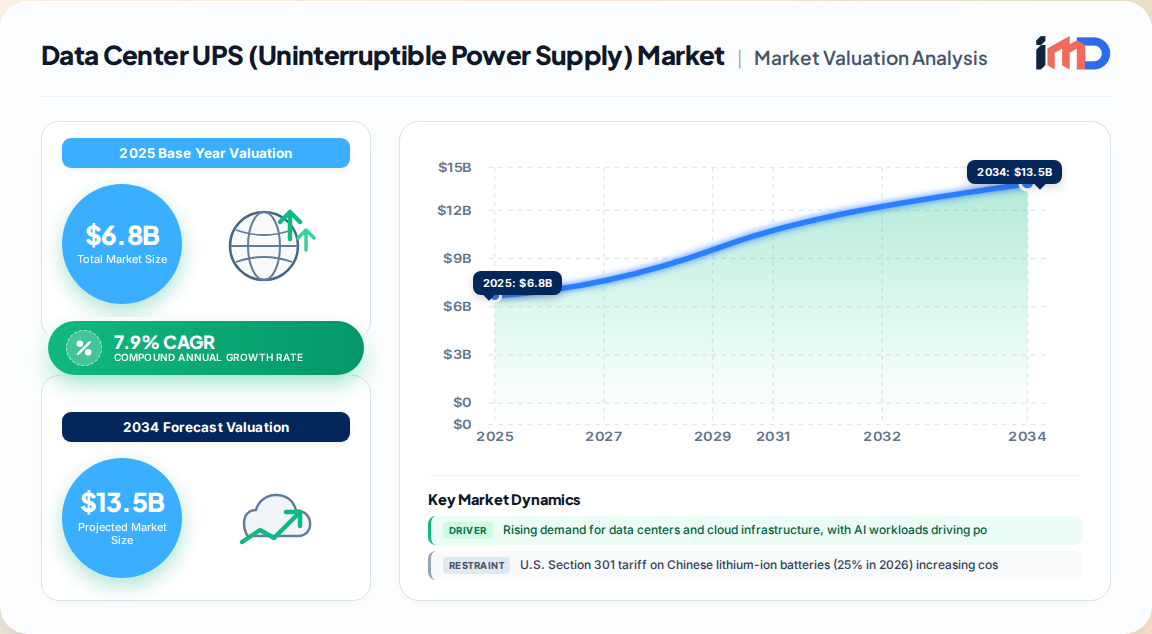
The global Data Center UPS market is experiencing a structural inflection point, driven by the unprecedented power density of AI workloads and the rapid expansion of hyperscale and edge facilities. Our proprietary first-party research estimates the market at USD 6.8 Billion in 2025, with a robust forecast to reach USD 14.4 Billion by 2035, representing a CAGR of 7.9% over the 2026–2035 period. This growth is not merely a function of volume; it reflects a fundamental shift toward higher-capacity, modular, and intelligent power architectures that can support fluctuating loads from GPU clusters.
In 2025, global data center electricity consumption increased by 17%, with AI-focused facilities alone seeing a 50% jump. This surge underscores the criticality of reliable, high-efficiency UPS systems. North America remains the dominant market, holding 37.1% of global revenue in 2025 (approximately USD 2.5 Billion), propelled by the largest concentration of hyperscale operators and enterprise data centers. Meanwhile, Asia Pacific is emerging as the fastest-growing region, fueled by massive infrastructure investments in countries like China and India.
Drivers:
Restraints:
The Data Center UPS value chain is highly specialized and increasingly integrated with broader data center infrastructure ecosystems.
Upstream:
Midstream:
Downstream:
The Data Center UPS market is characterized by significant cross-border trade in finished systems and components, particularly batteries. China remains the dominant exporter of lithium-ion batteries, accounting for over 60% of global supply. The U.S. tariff hike to 25% on non-EV lithium-ion batteries in 2026 is a major risk, prompting UPS OEMs to shift sourcing to Southeast Asia (e.g., Vietnam, Malaysia) or domestic production.
Europe is also impacted by the EU's Carbon Border Adjustment Mechanism (CBAM), which could raise costs for imported UPS components with high embedded carbon. In response, leading OEMs are localizing assembly and investing in circular economy practices.
For data center operators, supply chain resilience is now a key procurement criterion. Dual-sourcing of batteries and modular designs that allow incremental capacity additions are becoming standard. The IEA estimates that global data center battery storage installations could reach 20-25 GW by 2030, further straining battery supply chains and necessitating strategic partnerships between UPS OEMs and battery cell manufacturers.
North America: The largest market, with 37.1% revenue share in 2025. The U.S. dominates with 79.53% of regional share, driven by hyperscale investment and grid reliability concerns. Canada is the fastest-growing sub-region with a 7.15% CAGR, supported by government digitalization initiatives and data center expansions.
Europe: A mature market with a strong focus on energy efficiency and sustainability. The EU Code of Conduct for Data Centres drives adoption of high-efficiency UPS (up to 99% in eco-mode). Germany, the UK, and the Netherlands are key markets.
Asia Pacific: The fastest-growing region, expected to add 4.8 GW of data center supply by 2027, with 78% preleased. China and India are major contributors, with India seeing commitments like AirTrunk's planned 5 GW buildout by 2030. Local players such as Huawei and ABB are gaining share through cost-competitive modular solutions.
Latin America and Middle East & Africa: Emerging markets with growing data center investments, but constrained by grid instability and limited infrastructure. UPS demand is primarily for line-interactive and online double-conversion systems in telecom and commercial sectors.
The market is concentrated, with the top five players (Schneider Electric, Eaton, Vertiv, ABB, Huawei) accounting for 65% of global revenue in 2025. Schneider Electric leads with over 11% market share.
Recent Product Launches:
Strategic Imperatives:
Several untapped opportunities exist in the Data Center UPS market:
Data center operators are increasingly adopting strategic procurement approaches for UPS systems:
Key Procurement Metrics:
Market Penetration: Expand sales of existing UPS products to current data center customers, emphasizing upgrades to higher-efficiency models and service contracts.
Market Development: Enter new geographic markets (e.g., Southeast Asia, Africa) with tailored, cost-effective UPS solutions and localized service networks.
Product Development: Innovate with new technologies such as solid-state transformers, flywheel UPS, and advanced lithium-ion batteries for AI workloads, and integrate AI-driven predictive maintenance software.
Diversification: Move into adjacent markets such as grid-scale energy storage and microgrids, leveraging UPS expertise in power conversion and battery management.
The Data Center UPS market relies on a complex global supply chain. China is the leading exporter of UPS systems and components, particularly batteries and power electronics. However, trade tensions and tariffs are reshaping flows. In 2025, the U.S. imported approximately USD 1.2 Billion worth of UPS systems and components, with over 40% originating from China, according to trade data. The 25% tariff on lithium-ion batteries is expected to reduce Chinese imports by 15-20% by 2027, with Vietnam and Mexico emerging as alternative sources.
Europe is a major importer of UPS systems from China and the U.S., but local production by Schneider Electric, ABB, and others serves a significant portion of demand. The EU's CBAM may further incentivize local manufacturing.
In Asia Pacific, intra-regional trade is strong, with China exporting to Southeast Asia and India. Japan and South Korea are key suppliers of high-end components.
Supplier dynamics: The top five UPS OEMs have global manufacturing footprints, but battery supply is concentrated. Lithium-ion cell suppliers such as CATL, LG Energy Solution, and Samsung SDI play a critical role. UPS OEMs are increasingly forming strategic alliances with battery manufacturers to secure supply and co-develop custom solutions.
The Data Center UPS market is poised for robust growth, driven by AI, cloud, and edge computing. The shift toward modular, high-efficiency, and intelligent UPS systems will create opportunities for suppliers that can innovate and provide lifecycle services. However, supply chain risks and geopolitical tensions require agile sourcing strategies. Our proprietary forecast indicates a CAGR of 7.9% from 2026 to 2035, with the market reaching USD 14.4 Billion by 2035. North America will remain the largest market, but Asia Pacific will offer the highest growth potential. Stakeholders should prioritize investments in scalable architectures, battery technology, and service capabilities to capture value in this dynamic landscape.
| Aspects | Details |
|---|---|
| Study Period | 2020-2034 |
| Base Year | 2025 |
| Estimated Year | 2026 |
| Forecast Period | 2026-2034 |
| Historical Period | 2020-2025 |
| Growth Rate | CAGR of 7.9% from 2020-2034 |
| Segmentation |
|
By Industry Vertical
By Power Rating
By Organization Size
By Form Factor
By Phase
By Installation
By Energy Storage
By Topology
By Design
By Sales Channel
| By Geography |
|
The global Data Center UPS market was valued at USD 6.8 Billion in 2025 and is expected to reach USD 14.4 Billion by 2035, growing at a CAGR of 7.9%.
North America led the market in 2025 with a 37.1% revenue share, equivalent to approximately USD 2.5 Billion, driven by hyperscale investments and grid reliability concerns.
Key drivers include rising AI workloads, grid instability, hyperscale data center expansion, and the integration of battery storage for grid services.
The top five players—Schneider Electric, Eaton, Vertiv, ABB, and Huawei—collectively held 65% of the market in 2025, with Schneider Electric leading at over 11% share.
Challenges include supply chain disruptions, U.S. tariffs on Chinese lithium-ion batteries (25% in 2026), high capital costs, and technical complexity of integrating advanced systems.
Trends include modular and scalable designs, high-efficiency double-conversion (up to 97.5%), lithium-ion batteries, and AI-driven predictive maintenance.
Our rigorous research methodology combines multi-layered approaches with comprehensive quality assurance, ensuring precision, accuracy, and reliability in every market analysis.
| Stakeholder Role | Interview Share (%) |
|---|---|
| Procurement Director | 35% |
| Data Center Facility Manager | 30% |
| Power Systems Engineer | 25% |
| Chief Technology Officer | 10% |
| Company Type | Representation (%) |
|---|---|
| UPS OEMs and System Integrators | 40% |
| Data Center Operators and Hyperscalers | 30% |
| Battery and Component Suppliers | 15% |
| EPC Contractors and Installers | 10% |
| Service and Maintenance Providers | 5% |
 Related Reports
