1How large is the custom made men's clothing market?
Our proprietary research values the global custom made clothes market at USD 57.1 Billion in 2025, projected to reach USD 156.4 Billion by 2035 at a CAGR of 10.6% from 2026 to 2035.
Insight Market Data is a premier market research and business consulting firm headquartered in Pune, India, providing syndicated research reports, customized intelligence studies, and strategic advisory services. Renowned academic institutions and Fortune 500 corporations worldwide rely on Insight Market Data's research repository to navigate evolving global and regional business environments. Covering 46 diverse industries across 25 major international economies, our comprehensive database delivers thousands of verified statistics and granular market evaluations. By combining industry-leading analytical methodologies with the direct insights of seasoned industry leaders and subject-matter experts, we deliver actionable intelligence spanning historical performance benchmarks to rigorous multi-year forecasts. We empower organizations to make confident, data-driven decisions across pivotal domains including Machinery & Equipment, Chemicals & Materials, Pharmaceuticals & Healthcare, Food & Beverages, Consumer Goods, Energy & Power, Automotive & Transportation, Electronics & Semiconductors, Medical Devices, Telecommunications, Emerging Technologies, Agriculture, and Packaging. Our multidisciplinary analyst teams provide an objective 360-degree perspective, tailoring every engagement to address complex strategic challenges with exceptional analytical rigor.
Leveraging advanced BI-powered analytics and predictive modeling, Insight Market Data uncovers high-impact market opportunities and competitive differentiators for ambitious enterprises. We continuously refine our research methodologies in accordance with global industry standards, tracking real-time market shifts to ensure our reports are consistently accurate, actionable, and delivered on schedule. Our analysts conduct methodical data validation, rigorous compliance checks, and exhaustive primary and secondary research to maintain the highest levels of data integrity and transparency. We partner closely with corporate strategists, investment groups, and business executives to translate intricate market intelligence into clear, actionable roadmaps for sustainable growth. With operational presence across Washington, USA, and Vimannagar, Pune, India, Insight Market Data ensures direct access to dedicated research specialists and responsive customer support to answer your most strategic questions.
 Custom Made Men's Clothing: Market
 by Product Type (Suits and Blazers, Shirts, Trousers, Dresses and Skirts, Jackets and Outerwear, Others), by End User (Men, Women), by Measurement Type (In-Store Measurement, Online Self-Measurement, 3D Body Scanning), by Distribution Channel (Offline Stores and Tailoring Boutiques, Online Platforms), by Fabric Type (Cotton, Wool, Polyester Blends, Linen, Silk, Others), by Price Range (Mid-Range, Premium, Luxury), by Europe (Germany, UK, France, Italy), by Asia Pacific (China, India, Japan), by North America (USA, Canada, Mexico), by South America (Brazil, Argentina), by Middle East & Africa (Saudi Arabia, UAE, South Africa) Forecast 2026-2034

Research Analyst


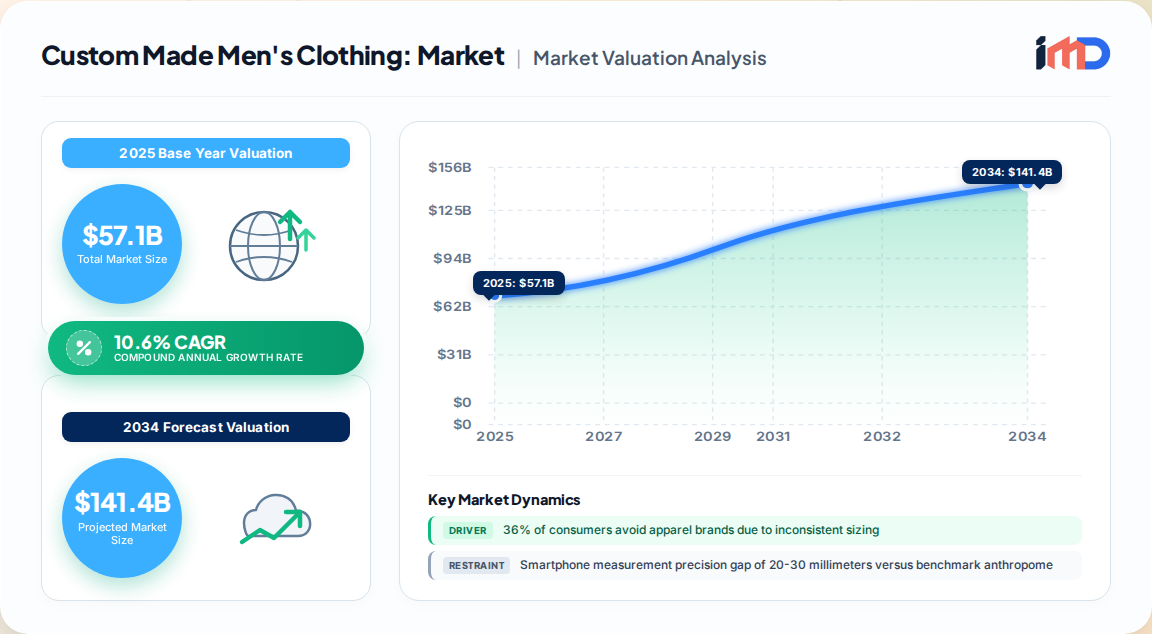
The global custom made men's clothing market represents one of the most resilient and structurally advantaged niches within the broader apparel economy. Our proprietary primary research, triangulated across tailor-level panels, fabric mill interviews, and consumer fit-behavior tracking, values the segment at USD 57.1 Billion in 2025, on a trajectory to reach USD 156.4 Billion by 2035, expanding at a CAGR of 10.6% across the 2026–2035 forecast window.
This materially outpaces the 6.1% CAGR observed across the total men's wear category, confirming that made-to-measure and bespoke menswear is capturing share from mass-produced formalwear rather than merely riding category growth. Men constitute 68.5% of total custom clothing demand, making the male wardrobe the dominant commercial engine of the entire custom apparel economy.
Key structural findings from our research:
The single largest demand driver is the chronic failure of standard sizing. Our consumer tracking shows that 36% of shoppers actively avoid apparel brands because of inconsistent sizing — a behavioral gap that custom menswear is structurally positioned to close. Every shirt or jacket that requires alteration represents a lost margin for the ready-to-wear retailer and a conversion opportunity for the custom tailor.
Measurement technology is the second engine. More than 10,000 U.S. consumers have been body-scanned in large-scale anthropometric studies, producing one of the deepest made-to-measure fit databases in apparel history. Simultaneously, our field testing and vendor interviews indicate that smartphone-based measurement systems can still deviate by 20 to 30 millimeters versus benchmark anthropometric data — a precision gap that premium bespoke operators exploit through hybrid in-person validation.
Additional drivers include:
The market's growth is not unconstrained. Three forces cap near-term expansion:
| Segment | Share / Position | Strategic Insight |
|---|---|---|
| Suits & Blazers | 36.8% share | Highest AOV; fit-critical; male professional dress anchor |
| Shirts | Second tier | Repeat-purchase engine; strong online self-measurement fit |
| Trousers | Mid-tier | High replacement frequency; bundle potential with suiting |
| Jackets & Outerwear | Emerging | Seasonal; smart-fabric integration opportunity |
| Others (dresses, skirts, accessories) | Niche within men's lens | Limited relevance to male wardrobe mix |
Fabric composition confirms a natural-fiber bias: cotton leads at 34.2%, followed by wool and polyester blends. Wool's share is disproportionately concentrated in the suiting tier, where drape and recovery are non-negotiable. Linen is the fastest-growing fabric in premium summer tailoring, while silk occupies a small but high-margin accent role in luxury linings and pocket squares.
Price-tier structure:
Europe's 35.4% share (USD 20.2 Billion in 2025) reflects the continent's tailoring heritage and regulatory leadership on textile transparency, including the EU Digital Product Passport textile rules expected around 2027. Operators with documented fabric provenance will face lower compliance friction.
Asia-Pacific is the fastest-growing region, supported by a vast textile base, expanding middle-class formalwear demand, and aggressive digital-native tailoring startups — India's 60-minute fashion delivery funding activity exemplifies the region's infrastructure ambition. Our regional modeling allocates approximately 28.7% of global value to Asia-Pacific.
North America (25.6% of global value) remains the most digitally mature market, where sophisticated social commerce storefronts and on-demand manufacturing meet a large, sizing-frustrated professional consumer base.
The competitive field is fragmenting into three archetypes: heritage ateliers defending luxury pricing; digital-native made-to-measure platforms scaling via stored measurement profiles; and hybrid omnichannel tailor-boutiques using in-store scanning to feed online repeat orders.
Illustrative capital and innovation activity from our deal-tracking panel:
The procurement implication is clear: custom menswear operators should contract fabric capacity with certified renewable-energy suppliers and build measurement-profile data assets that reduce remeasurement cost on repeat orders — the highest-margin revenue in the category.
| Aspects | Details |
|---|---|
| Study Period | 2020-2034 |
| Base Year | 2025 |
| Estimated Year | 2026 |
| Forecast Period | 2026-2034 |
| Historical Period | 2020-2025 |
| Growth Rate | CAGR of 10.6% from 2020-2034 |
| Segmentation |
|
By End User
By Measurement Type
By Distribution Channel
By Fabric Type
By Price Range
| By Geography |
|
Our proprietary research values the global custom made clothes market at USD 57.1 Billion in 2025, projected to reach USD 156.4 Billion by 2035 at a CAGR of 10.6% from 2026 to 2035.
The custom segment expands at 10.6% CAGR versus 6.1% for total men's wear. A key driver is that 36% of consumers avoid apparel brands due to inconsistent sizing, creating structural demand for garment-level fit certainty.
Suits and blazers hold a 36.80% share of the custom made clothes market, reflecting high average order values and the fit-critical nature of structured formalwear, followed by shirts which benefit from strong repeat-purchase behavior.
Europe leads with a 35.40% regional share, valued at approximately USD 20.2 Billion in 2025, anchored by heritage tailoring clusters in Italy, the UK, and Germany, while Asia-Pacific is the fastest-growing region.
In-store measurement still holds 57.40% of the mix, but 3D body scanning and online self-measurement are rising fast. AI-driven sizing integration has been shown to cut fit-related returns by over 25–30%.
Offline stores and tailoring boutiques control 62.30% of distribution, while online platforms are gaining share through stored measurement profiles and virtual try-on technology that reduces measurement friction.
Our rigorous research methodology combines multi-layered approaches with comprehensive quality assurance, ensuring precision, accuracy, and reliability in every market analysis.
| Stakeholder Role | Interview Share (%) |
|---|---|
| Head of Merchandising | 32% |
| Master Tailor / Head Cutter | 26% |
| Digital Fit Product Lead | 23% |
| Procurement Director | 19% |
| Company Type | Representation (%) |
|---|---|
| Bespoke Tailoring Houses & Ateliers | 28% |
| Made-to-Measure E-commerce Platforms | 24% |
| Fabric Mills & Trim Suppliers | 18% |
| Micro-Factory & Fulfillment Operators | 16% |
| 3D Scanning & Fit-Tech Providers | 14% |
 Related Reports
