1What is the current size of the cosmeceutical ingredients market?
Our primary research estimates the global cosmeceutical ingredients market at USD 4.7 billion in 2026, with a projected value of USD 8.7 billion by 2035, growing at a CAGR of 7.2%.
Insight Market Data is a premier market research and business consulting firm headquartered in Pune, India, providing syndicated research reports, customized intelligence studies, and strategic advisory services. Renowned academic institutions and Fortune 500 corporations worldwide rely on Insight Market Data's research repository to navigate evolving global and regional business environments. Covering 46 diverse industries across 25 major international economies, our comprehensive database delivers thousands of verified statistics and granular market evaluations. By combining industry-leading analytical methodologies with the direct insights of seasoned industry leaders and subject-matter experts, we deliver actionable intelligence spanning historical performance benchmarks to rigorous multi-year forecasts. We empower organizations to make confident, data-driven decisions across pivotal domains including Machinery & Equipment, Chemicals & Materials, Pharmaceuticals & Healthcare, Food & Beverages, Consumer Goods, Energy & Power, Automotive & Transportation, Electronics & Semiconductors, Medical Devices, Telecommunications, Emerging Technologies, Agriculture, and Packaging. Our multidisciplinary analyst teams provide an objective 360-degree perspective, tailoring every engagement to address complex strategic challenges with exceptional analytical rigor.
Leveraging advanced BI-powered analytics and predictive modeling, Insight Market Data uncovers high-impact market opportunities and competitive differentiators for ambitious enterprises. We continuously refine our research methodologies in accordance with global industry standards, tracking real-time market shifts to ensure our reports are consistently accurate, actionable, and delivered on schedule. Our analysts conduct methodical data validation, rigorous compliance checks, and exhaustive primary and secondary research to maintain the highest levels of data integrity and transparency. We partner closely with corporate strategists, investment groups, and business executives to translate intricate market intelligence into clear, actionable roadmaps for sustainable growth. With operational presence across Washington, USA, and Vimannagar, Pune, India, Insight Market Data ensures direct access to dedicated research specialists and responsive customer support to answer your most strategic questions.
 Cosmeceutical Ingredients Market
 by By Source (Natural, Synthetic), by By Type (Anti-aging, Moisturizers, UV Filters, Skin-lightening Agents, Exfoliators, Antimicrobials, Others), by By Form (Liquid, Powder, Gel, Others), by By Application (Skin Care, Hair Care, Oral Care, Color Cosmetics, Others), by North America (US, Canada, Mexico), by Europe (Germany, France, UK, Italy, Spain), by Asia-Pacific (China, Japan, India, South Korea, Australia), by South America (Brazil, Argentina), by Middle East & Africa (Saudi Arabia, UAE, South Africa) Forecast 2026-2034

Senior Research Analyst


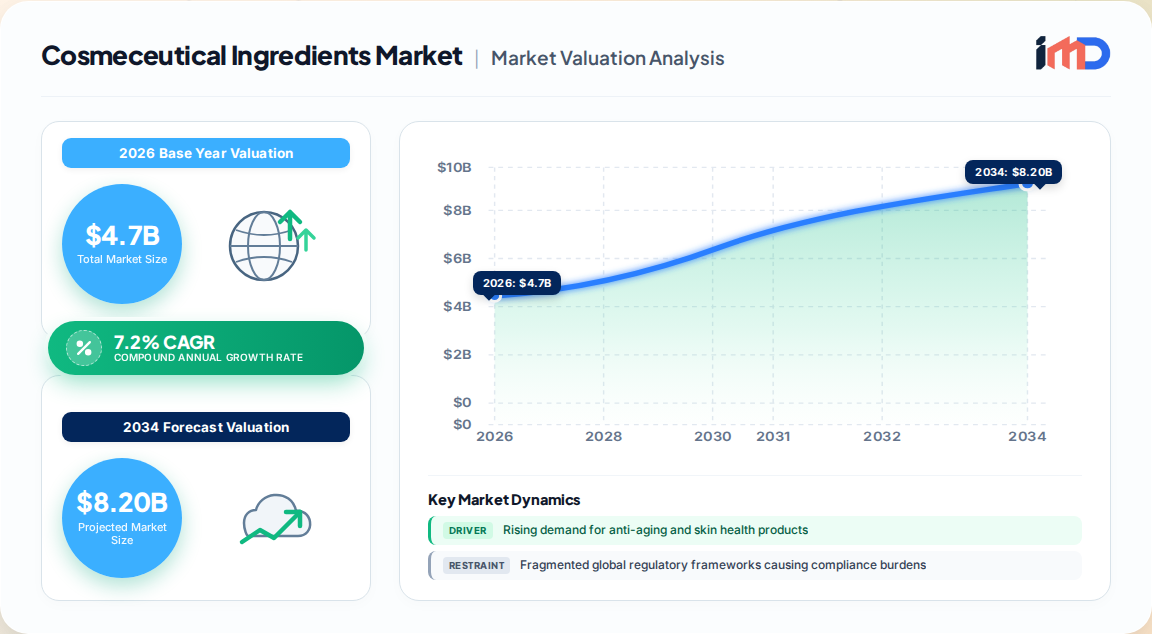
The cosmeceutical ingredients market represents the high-value intersection of personal care and dermatological science. Our proprietary primary research estimates the global market for cosmetic active ingredients at USD 4.7 billion in 2026, on a robust trajectory to reach USD 8.7 billion by 2035, reflecting a compound annual growth rate (CAGR) of 7.2%. This growth is fundamentally decoupled from the broader cosmetic ingredients market (which grows at a more modest 5-6% CAGR) because cosmeceutical actives are purchased for their clinically verifiable performance, not merely their functional or aesthetic properties.
The market is undergoing a structural transformation from a commodity-driven supply model to a science-led, biotechnology-enabled value system. Formulators are shifting from traditional petrochemical and mechanically extracted botanicals toward bio-fermented, lab-engineered, and microbiome-friendly actives. This shift is not merely a trend but a strategic response to three converging forces: a regulatory environment that demands rigorous safety and efficacy substantiation, a consumer base that reads ingredient lists with the scrutiny of a skincare professional, and a sustainability imperative that is reshaping raw material sourcing.
Asia-Pacific dominates the consumption landscape, accounting for approximately 41% of global demand, driven by massive manufacturing hubs in China, Japan, and South Korea. However, North America and Europe remain the value leaders, commanding premium pricing for patented and clinically validated actives. The competitive landscape is moderately consolidated, with the top five players—BASF SE, Croda International Plc, Evonik Industries AG, Ashland Global Holdings Inc., and Clariant AG—collectively holding a 48.8% market share. The remaining market is a fragmented ecosystem of specialized biotechnology firms, botanical extractors, and regional suppliers.
The market is segmented by source, type, form, and application. Our analysis reveals distinct growth dynamics within each.
| Segment | Key Sub-Segments | 2025 Valuation | Growth Outlook (CAGR) |
|---|---|---|---|
| By Source | Natural, Synthetic | Natural: USD 2.5B | Natural: ~8-9%; Synthetic: ~5-6% |
| By Type | Anti-aging, Moisturizers, UV Filters, Skin-lightening, Exfoliators, Antimicrobials | Anti-aging: USD 1.4B | Anti-aging: ~8-9%; UV Filters: ~7-8% |
| By Form | Liquid, Powder, Gel | Powder: USD 1.9B | Powder: ~6-7%; Liquid: ~7-8% |
| By Application | Skin Care, Hair Care, Oral Care, Color Cosmetics | Skin Care: >33% share | Hair Care: ~8-9% |
The market is a battleground for intellectual property and supply chain control. The leading players are pursuing distinct strategies:
Recent developments include:
The cosmeceutical ingredients value chain is complex and increasingly digitized.
Our analysis identifies several under-served opportunities that warrant strategic investment:
For buyers of cosmeceutical ingredients, the market presents both risks and opportunities.
| Strategy | Description | Examples |
|---|---|---|
| Market Penetration | Increasing sales of existing actives to existing customers. | Expanding the use of established anti-aging actives into new product categories like men's grooming. |
| Product Development | Introducing new actives to existing customers. | Launching a novel, bio-fermented hyaluronic acid with enhanced skin penetration. |
| Market Development | Selling existing actives to new markets. | Introducing a proven UV filter to the South American sun care market. |
| Diversification | Creating new actives for new markets. | Developing microbiome-specific actives for the oral care market. |
Our analysis suggests that Product Development and Diversification represent the most significant growth vectors, as they leverage the core scientific capabilities of ingredient suppliers to address unmet needs in high-growth areas.
The cosmeceutical ingredients market is poised for a period of robust, science-driven growth. Success will depend on a company's ability to navigate regulatory complexity, integrate sustainable sourcing, and deliver clinically proven efficacy. The market is not for the faint of heart; it rewards those who invest in biotechnology, transparency, and a deep understanding of dermatological science.
| Aspects | Details |
|---|---|
| Study Period | 2020-2034 |
| Base Year | 2026 |
| Estimated Year | 2026 |
| Forecast Period | 2026-2034 |
| Historical Period | 2020-2025 |
| Growth Rate | CAGR of 7.2% from 2020-2034 |
| Segmentation |
|
By Form
By Application
| By Geography |
|
Our primary research estimates the global cosmeceutical ingredients market at USD 4.7 billion in 2026, with a projected value of USD 8.7 billion by 2035, growing at a CAGR of 7.2%.
Asia-Pacific is the largest market, accounting for approximately 41% of global demand, driven by manufacturing hubs in China, Japan, and South Korea.
The top five players include BASF SE (with a 13.4% market share in 2025), Croda International Plc, Evonik Industries AG, Ashland Global Holdings Inc., and Clariant AG, collectively holding 48.8% of the market.
Major trends include the rising demand for natural and bio-based actives, the adoption of biotechnology and fermentation-derived ingredients, and an increased focus on sustainability and supply chain transparency.
Challenges include fragmented global regulations (like EU REACH and US MoCRA) that vary significantly, the high cost of premium ingredients, and the complexity of sourcing sustainable raw materials.
Our rigorous research methodology combines multi-layered approaches with comprehensive quality assurance, ensuring precision, accuracy, and reliability in every market analysis.
| Stakeholder Role | Interview Share (%) |
|---|---|
| Chief Scientific Officer | 30% |
| Procurement Director | 30% |
| R&D Head | 25% |
| Regulatory Affairs Manager | 15% |
| Company Type | Representation (%) |
|---|---|
| Active Ingredient Manufacturers | 35% |
| Specialty Chemical Distributors | 25% |
| Contract Formulators & Manufacturers | 20% |
| Indie Brand Founders | 15% |
| Regulatory & Certification Consultants | 5% |
 Related Reports
