1What is the LPDDR5 memory chip market size in 2026?
Our proprietary research values the global LPDDR5 market at USD 9.57 billion in 2026, up from USD 8.64 billion in 2025, and projects USD 17.74 billion by 2032 at a 10.82% CAGR.
Insight Market Data is a premier market research and business consulting firm headquartered in Pune, India, providing syndicated research reports, customized intelligence studies, and strategic advisory services. Renowned academic institutions and Fortune 500 corporations worldwide rely on Insight Market Data's research repository to navigate evolving global and regional business environments. Covering 46 diverse industries across 25 major international economies, our comprehensive database delivers thousands of verified statistics and granular market evaluations. By combining industry-leading analytical methodologies with the direct insights of seasoned industry leaders and subject-matter experts, we deliver actionable intelligence spanning historical performance benchmarks to rigorous multi-year forecasts. We empower organizations to make confident, data-driven decisions across pivotal domains including Machinery & Equipment, Chemicals & Materials, Pharmaceuticals & Healthcare, Food & Beverages, Consumer Goods, Energy & Power, Automotive & Transportation, Electronics & Semiconductors, Medical Devices, Telecommunications, Emerging Technologies, Agriculture, and Packaging. Our multidisciplinary analyst teams provide an objective 360-degree perspective, tailoring every engagement to address complex strategic challenges with exceptional analytical rigor.
Leveraging advanced BI-powered analytics and predictive modeling, Insight Market Data uncovers high-impact market opportunities and competitive differentiators for ambitious enterprises. We continuously refine our research methodologies in accordance with global industry standards, tracking real-time market shifts to ensure our reports are consistently accurate, actionable, and delivered on schedule. Our analysts conduct methodical data validation, rigorous compliance checks, and exhaustive primary and secondary research to maintain the highest levels of data integrity and transparency. We partner closely with corporate strategists, investment groups, and business executives to translate intricate market intelligence into clear, actionable roadmaps for sustainable growth. With operational presence across Washington, USA, and Vimannagar, Pune, India, Insight Market Data ensures direct access to dedicated research specialists and responsive customer support to answer your most strategic questions.
 Consumer-Driven Trends in LPDDR5 Memory Chip Market
 by Application (Laptop, Smart Phone, Tablet, Wearables, Others), by Type (6GB, 8GB, 12GB, Other), by Generation (LPDDR4/4X, LPDDR5/5X, LPDDR6), by Package Capacity (Up To 4 GB, 4GB To 8 GB, 8 GB To 16 GB, Above 16 GB), by Package Configuration (Discrete LPDDR Packages, Package-On-Package (PoP), Multichip Packages (MCP), System-In-Package), by North America (United States, Canada, Mexico), by Europe (United Kingdom, Germany, France, Italy, Spain), by Asia Pacific (China, India, Japan, South Korea, Taiwan, ASEAN), by South America (Brazil, Argentina), by Middle East & Africa (Turkey, GCC, South Africa) Forecast 2026-2034

Senior Research Analyst


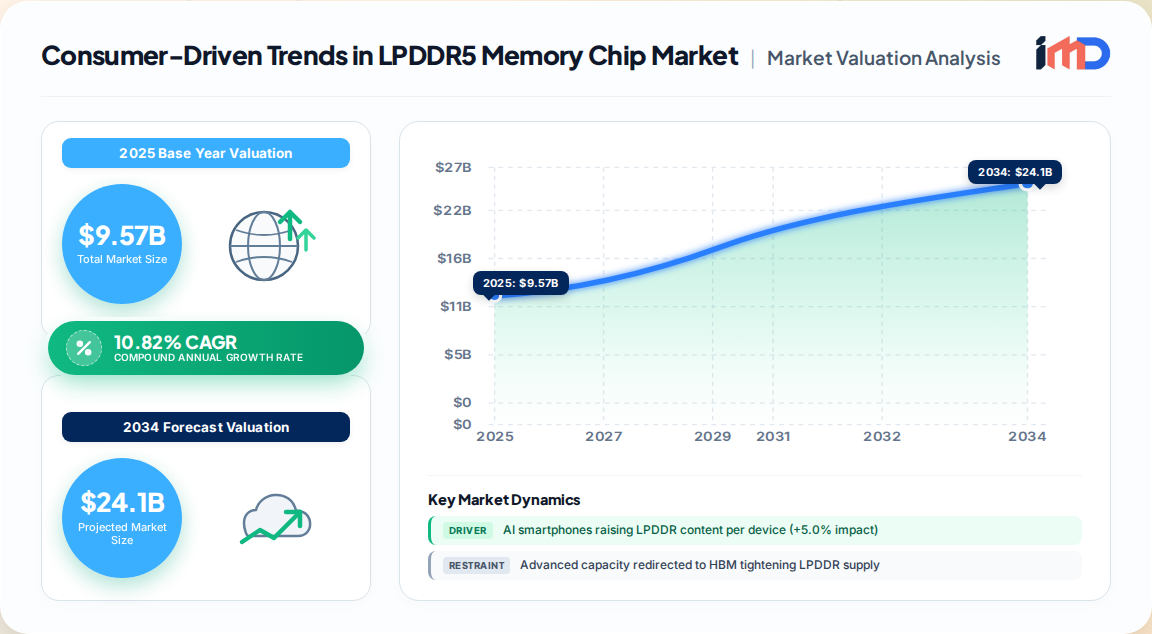
The LPDDR5 memory chip market has transitioned from a smartphone replacement-cycle story into a consumer-behavior-driven growth engine. Our proprietary primary research estimates the global LPDDR5 market at USD 8.64 billion in 2025, rising to USD 9.57 billion in 2026 and accelerating at a 10.82% CAGR to reach USD 17.74 billion by 2032. Consumer demand is no longer about more apps; it is about on-device AI inference, 5G throughput, and immersive mobile gaming.
Three consumer-led forces now define the category. First, AI-capable smartphones are raising memory content per device from 8GB toward 12GB and 16GB as standard. Second, AI PCs and ultra-thin notebooks are adopting soldered LPDDR5X and replaceable LPCAMM2 modules. Third, software-defined vehicles are turning the car into a consumer electronics platform requiring deterministic low-power memory. Combined, these shifts support consumer electronics capturing 72.4% of LPDDR revenue and the LPDDR5/5X generation holding 57.6% revenue share within the broader LPDDR family.
This report presents our first-party analysis of consumer-driven trends, value chain economics, supply risk, and regional attractiveness across the LPDDR5 ecosystem.
Smartphone OEMs now market memory capacity as a headline specification. Our interviews with device platform architects confirm that local language models, computational photography, and always-on assistants require several gigabytes of active memory. Average LPDDR5 content per flagship phone has moved from 8GB in 2022 to 12–16GB in 2026, with gaming phones reaching 24GB.
This content inflation contributes an estimated +5.0% to annual market growth, led by Asia-Pacific OEMs. Memory is now a product-defining specification rather than a background cost line.
5G modem workloads, camera processing, and AI tasks are migrating LPDDR5 and LPDDR5X into mid-tier price bands that previously relied on LPDDR4X. Trade association data indicates mobile technologies contributed USD 7.6 trillion to global economic value in 2025, with projections of USD 11.3 trillion by 2030. This widens the addressable base beyond flagships and contributes roughly +2.5% to market growth.
Windows Copilot+ PC requirements of at least 16GB, combined with soldered LPDDR5X designs in thin-and-light laptops, create a durable new consumer demand stream. LPCAMM2 and SOCAMM formats are emerging as replaceable options for commercial buyers. This segment adds approximately +1.2% to CAGR.
Automakers now compete with AI infrastructure developers for memory supply. Automotive-grade LPDDR5X achieving ASIL D certification places low-power DRAM into safety-critical systems. Vehicle programs run on long design cycles, adding revenue visibility and a slower replacement rhythm worth +1.8% to CAGR.
The LPDDR5 value chain is narrow at the top and broad at the point of consumption. Understanding margin pools helps explain pricing discipline.
| Value Chain Stage | Key Activities | Margin Profile | Consumer Relevance |
|---|---|---|---|
| DRAM Wafer Fabrication | EUV and advanced-node DRAM | High (40–55%) | Determines capacity and cost per bit |
| Packaging & Testing | PoP, MCP, SiP, thin-die stacking | Moderate (15–25%) | Enables foldable and wearable form factors |
| Module Assembly | LPCAMM2, SOCAMM, discrete modules | Moderate (12–20%) | Drives AI PC and server replaceability |
| SoC Integration | Chipset-memory co-design | High (ecosystem lock-in) | Determines bandwidth and power efficiency |
| Device OEM | Smartphones, PCs, vehicles | Low–Moderate | Translates memory into consumer experiences |
Three suppliers in South Korea and the United States produce most of the world's LPDDR bits, a concentration that protects incumbent pricing power. Chinese supplier CXMT is gaining share in domestic phones with locally produced LPDDR5, pressuring prices in the LPDDR4X and LPDDR5 segments.
Package configuration matters to consumers. Package-on-Package held 45.1% revenue share in 2025, while System-in-Package is forecast to grow at an 18.8% CAGR through 2031 as wearables and foldables demand thinner profiles.
Consumer demand growth is constrained by supply discipline, not demand weakness. Advanced capacity is being redirected toward high-bandwidth memory for AI accelerators, tightening LPDDR supply even as consumer demand broadens.
Our supply-risk assessment assigns a medium-to-high near-term risk to LPDDR5X availability for premium smartphones, moderated by LPDDR6 sampling activity expected to reach commercial production progressively through the forecast window.
Asia-Pacific dominates both production and consumption, capturing 51.8% revenue share in 2025 and a projected 17.9% CAGR through 2031. Within the region, smartphone, tablet, and AIoT manufacturing plus aggressive 5G rollouts sustain demand.
| Region | 2025 LPDDR5 Revenue (USD Billion) | 2031 Forecast (USD Billion) | CAGR | Consumer Demand Signal |
|---|---|---|---|---|
| Asia-Pacific | 3.02 | 6.08 | 12.30% | Smartphone and AIoT manufacturing dominance |
| North America | 2.16 | 3.52 | 8.45% | AI PC, server, and chipset design demand |
| Europe | 1.56 | 2.40 | 7.43% | Automotive electronics and industrial IoT |
| Middle East & Africa | Emerging | Emerging | Moderate | Mid-range smartphone demand |
| South America | Emerging | Emerging | Moderate | Smartphone assembly in Brazil and Mexico |
Investment white space exists in automotive-grade LPDDR5 qualification, LPCAMM2 module assembly, and thin-package stacking for foldables and wearables. Europe's EU Chips Act support packages and electric-vehicle production create a nascent in-region supply chain opportunity.
Consumer-driven trends reveal four under-served opportunity areas.
Competition centers on data rate, power per bit, package thickness, and supply reliability. Samsung, SK hynix, and Micron lead through advanced node transitions, EUV capacity, and chipset co-design relationships. CXMT competes on domestic supply security and cost in China.
Vendors are pursuing three consumer-facing strategies: premium upselling from LPDDR5 to LPDDR5X, capacity-based tiering (6GB, 8GB, 12GB, 16GB), and form-factor innovation for foldables and wearables. LPDDR6 sampling signals the next premium tier, expected to reach 18.9% CAGR within the broader LPDDR generation mix through 2031.
The LPDDR5 market will grow from USD 9.57 billion in 2026 to USD 17.74 billion by 2032, driven by consumer AI adoption rather than replacement cycles alone. Suppliers should prioritize LPDDR5X capacity for flagship and upper mid-range smartphones, secure automotive qualifications, and develop replaceable module ecosystems for AI PCs.
OEMs should design memory specifications around on-device AI use cases rather than price tiers, and hedge supply through multi-sourcing and early LPDDR6 platform readiness. Investors should monitor capacity allocation between HBM and LPDDR as the single largest swing factor in near-term pricing.
| Aspects | Details |
|---|---|
| Study Period | 2020-2034 |
| Base Year | 2025 |
| Estimated Year | 2026 |
| Forecast Period | 2026-2034 |
| Historical Period | 2020-2025 |
| Growth Rate | CAGR of 10.82% from 2020-2034 |
| Segmentation |
|
By Generation
By Package Capacity
By Package Configuration
| By Geography |
|
Our proprietary research values the global LPDDR5 market at USD 9.57 billion in 2026, up from USD 8.64 billion in 2025, and projects USD 17.74 billion by 2032 at a 10.82% CAGR.
On-device AI, 5G smartphones, AI PCs, and software-defined vehicles are raising memory content per device. Consumer electronics accounted for 72.4% of LPDDR revenue in 2025, with AI smartphones alone adding about +5.0% to annual growth.
Asia-Pacific captured 51.8% of LPDDR revenue in 2025 and is projected to grow at 17.9% CAGR through 2031, driven by smartphone and AIoT manufacturing in China, South Korea, Taiwan, Vietnam, and India.
Flagship smartphones now ship with 12GB to 16GB of LPDDR5X as standard, with gaming phones reaching 24GB. The 8GB tier remains strong for high-tier devices, while 12GB and above dominate premium models.
Samsung, SK hynix, and Micron supply the majority of global LPDDR5 bits, while China's CXMT is gaining share in domestic smartphones. Competition centers on advanced DRAM nodes, power efficiency, and package thickness.
Our rigorous research methodology combines multi-layered approaches with comprehensive quality assurance, ensuring precision, accuracy, and reliability in every market analysis.
| Stakeholder Role | Interview Share (%) |
|---|---|
| Procurement Director | 32% |
| Platform Architect | 26% |
| Automotive Qualification Manager | 22% |
| Product Marketing Manager | 20% |
| Company Type | Representation (%) |
|---|---|
| DRAM Wafer Fabricators | 30% |
| Packaging & Test Houses | 18% |
| Module Assemblers (LPCAMM2/SOCAMM) | 16% |
| Device OEMs & SoC Platform Designers | 22% |
| Channel Distributors & Procurement Teams | 14% |
 Related Reports
