Insight Market Data is a premier market research and business consulting firm headquartered in Pune, India, providing syndicated research reports, customized intelligence studies, and strategic advisory services. Renowned academic institutions and Fortune 500 corporations worldwide rely on Insight Market Data's research repository to navigate evolving global and regional business environments. Covering 46 diverse industries across 25 major international economies, our comprehensive database delivers thousands of verified statistics and granular market evaluations. By combining industry-leading analytical methodologies with the direct insights of seasoned industry leaders and subject-matter experts, we deliver actionable intelligence spanning historical performance benchmarks to rigorous multi-year forecasts. We empower organizations to make confident, data-driven decisions across pivotal domains including Machinery & Equipment, Chemicals & Materials, Pharmaceuticals & Healthcare, Food & Beverages, Consumer Goods, Energy & Power, Automotive & Transportation, Electronics & Semiconductors, Medical Devices, Telecommunications, Emerging Technologies, Agriculture, and Packaging. Our multidisciplinary analyst teams provide an objective 360-degree perspective, tailoring every engagement to address complex strategic challenges with exceptional analytical rigor.
Leveraging advanced BI-powered analytics and predictive modeling, Insight Market Data uncovers high-impact market opportunities and competitive differentiators for ambitious enterprises. We continuously refine our research methodologies in accordance with global industry standards, tracking real-time market shifts to ensure our reports are consistently accurate, actionable, and delivered on schedule. Our analysts conduct methodical data validation, rigorous compliance checks, and exhaustive primary and secondary research to maintain the highest levels of data integrity and transparency. We partner closely with corporate strategists, investment groups, and business executives to translate intricate market intelligence into clear, actionable roadmaps for sustainable growth. With operational presence across Washington, USA, and Vimannagar, Pune, India, Insight Market Data ensures direct access to dedicated research specialists and responsive customer support to answer your most strategic questions.
Collector Auto Insurance Market Size, Trends & Forecast 2035 | Insight Market Data
Collector Auto Insurance Market
Financial Services and Investment Intelligence / MARKET REPORT
Collector Auto Insurance Market | Insight Market Data
Collector Auto Insurance Market by Vehicle Type (Classic Cars, Antique Cars, Modified Cars, Exotic Cars), by Policy Type (Liability Coverage, Comprehensive Coverage, Collision Coverage, Agreed Value Coverage), by Customer Type (Individual Collectors, Car Clubs, Dealers), by Coverage Need (Full Coverage, Limited Mileage Coverage, Event Coverage), by North America (USA, Canada), by Europe (Germany, UK, France, Italy), by Asia Pacific (China, Japan, Australia), by South America, by Middle East & Africa Forecast 2026-2034
Italy infrastructure investment market to grow at 11.6% CAGR, reaching $25.0B by 2036 from $7.5B in 2025. Get detailed analysis, trends, and forecasts.
Payment aggregation market to grow from USD 11.57B in 2025 to USD 42.34B by 2033 at 17.6% CAGR, driven by digital wallets, embedded finance and omnichannel.
Nov 2026|263 pages
$2900.00
The Poland Life Insurance Industry market is valued at USD 22.58 billion in 2026, growing at a 1.23% CAGR to reach USD 24 billion by 2031.
Nov 2026|271 pages
$2900.00
Wealth Management Market to grow from USD 127.72 trillion in 2026 at 7.21% CAGR to reach USD 180.90 trillion by 2031. Get insights on trends & key players.
Nov 2026|209 pages
$2900.00
Open Banking Market valued at USD 35.3 Billion in 2025, projected to reach USD 137.4 Billion by 2034 at a 15.93% CAGR. Explore trends, drivers & regional outlook.
Executive Overview: The Specialty Niche Protecting Appreciating Assets
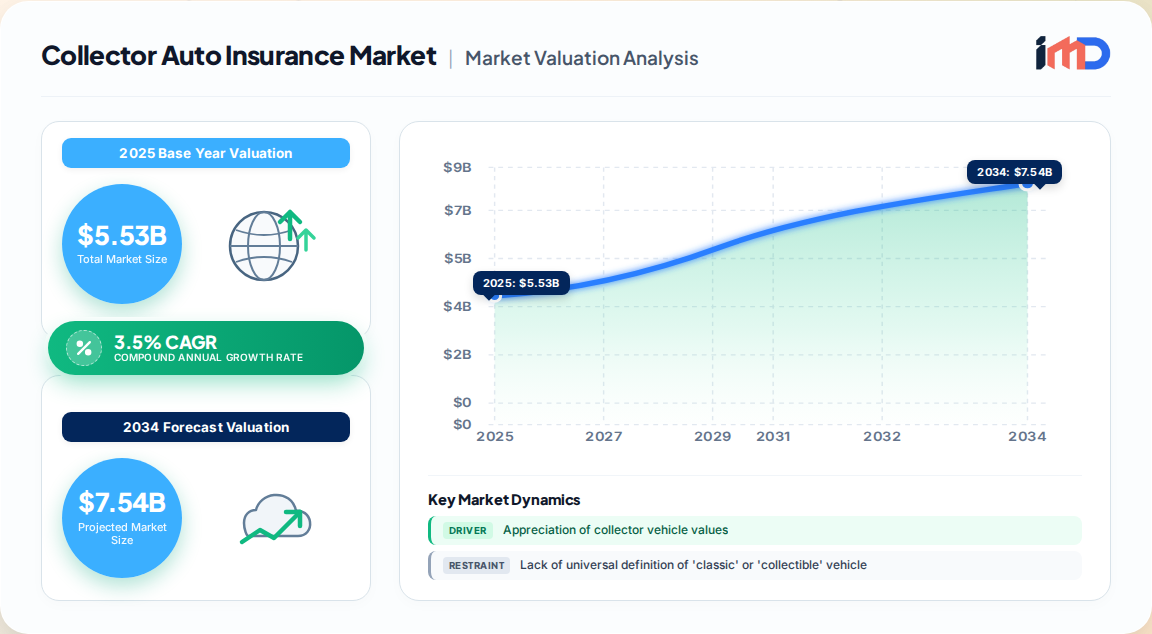
The global collector auto insurance market represents a specialized segment of the broader automotive insurance industry, defined by policies tailored to vehicles that appreciate rather than depreciate. Our proprietary primary research estimates the market at USD 5.53 billion in 2025, projected to reach USD 7.8 billion by 2035, expanding at a steady CAGR of 3.5% . This growth is underpinned by a fundamental shift in collector demographics and a redefinition of what constitutes a 'classic' vehicle.
Collector Auto Insurance Market Market Size (In Billion)
7.5B
6.0B
4.5B
3.0B
1.5B
0
5.530 B
2025
5.724 B
2026
5.924 B
2027
6.131 B
2028
6.346 B
2029
6.568 B
2030
6.798 B
2031
Unlike standard auto policies built around depreciation curves, collector policies utilize agreed value, guaranteed value, or stated value frameworks that protect the owner's investment. The market serves individual collectors, enthusiast clubs, dealerships, and auction houses, with coverage structures ranging from liability and comprehensive to limited-mileage and event-specific policies.
Key Market Metric
2025 Value
2035 Projection
Market Size (USD)
5.53 Billion
7.8 Billion
CAGR (2026–2035)
—
3.5%
Leading Region
North America
North America
Dominant Vehicle Type
Classic Cars
Classic Cars
Fastest-Growing Segment
Exotic/Modified Cars
Exotic/Modified Cars
Market Drivers: Demographics, Asset Appreciation, and Regulatory Mandates
The expansion of the collector auto insurance market is propelled by several converging forces:
Intergenerational Wealth Transfer and Younger Enthusiasts: While baby boomers remain the core collector demographic, our interviews reveal a significant influx of Gen X and millennial collectors with disposable income. This younger cohort is driving demand for 'modern classics' from the 1970s, 1980s, and 1990s, expanding the insurable universe.
Asset Appreciation and Investment Logic: Collector cars are increasingly viewed as alternative investments. As values rise, owners require insurance that accurately reflects market worth. Agreed value coverage—which locks in a predetermined payout—is becoming a baseline expectation, not a luxury.
Regulatory Requirements: In most jurisdictions, proof of insurance is mandatory for registered vehicles, including limited-use collector cars. This creates a steady baseline of demand, even for vehicles driven only occasionally.
Technological Enablement: Insurers are deploying AI-driven valuation tools, telematics for usage-based verification, and digital policy management platforms. These innovations lower acquisition costs and improve risk selection, making specialized coverage more accessible.
Restraints and Challenges: Valuation Complexity and Regulatory Fragmentation
Despite positive fundamentals, the market faces notable headwinds:
Absence of a Universal 'Classic' Definition: There is no industry-wide consensus on what qualifies as a collectible vehicle. Some insurers use a 25-year age threshold; others focus on historical significance, rarity, or enthusiast club recognition. This ambiguity complicates underwriting and creates inconsistent consumer experiences across carriers.
Valuation Volatility: Establishing agreed values requires appraisals, market comparables, and expert interviews. Values can fluctuate based on auction results and economic cycles, exposing insurers to adverse selection and moral hazard.
Regulatory Fragmentation: Insurance is state- or country-regulated, and collector programs must navigate varying filing requirements, mandated coverages, and rate approval processes. In the U.S. alone, the National Association of Insurance Commissioners (NAIC) provides a framework, but each state's department of insurance imposes unique nuances.
Limited Historical Loss Data: Collector vehicles are driven less frequently than daily drivers, resulting in sparse claims data. This makes actuarial pricing more challenging and can lead to conservative rate setting.
Segmentation Analysis: Vehicle Type, Policy Structure, and Customer Profile
Our bottom-up modeling segments the market across several dimensions, revealing distinct growth patterns.
By Vehicle Type
Classic Cars (Pre-1980): The largest segment, accounting for an estimated 45% of premiums. These vehicles benefit from established valuation guides and strong enthusiast club support.
Antique Cars (Pre-1945): A stable but smaller segment, representing about 15% of the market. Owners tend to be highly knowledgeable and risk-averse.
Modified Cars (Hot Rods, Customs): Growing at a faster pace, driven by younger enthusiasts. These vehicles present unique underwriting challenges due to non-standard parts and modifications.
Exotic Cars (Lotus, McLaren, Maserati, etc.): A high-value, high-premium segment with specialized valuation requirements. This segment is expected to outpace overall market growth.
By Policy Type
Agreed Value Coverage: The cornerstone of collector insurance, ensuring policyholders receive a pre-negotiated amount in the event of total loss. This segment is growing as collectors recognize the inadequacy of standard actual cash value policies.
Liability Coverage: Mandatory in most jurisdictions, providing third-party protection. Often bundled with comprehensive coverage.
Comprehensive and Collision: Essential for physical damage protection, with many policies including inflation guard or automatic appreciation clauses.
By Customer Type
Individual Collectors: The dominant customer base, representing over 70% of policies. However, clubs and dealer/auction house segments are growing as institutional collectors formalize their risk management.
By Coverage Need
Full Coverage: For vehicles driven regularly during season.
Limited Mileage Coverage: The most common structure, with annual mileage caps (e.g., 5,000 miles) in exchange for lower premiums.
Event Coverage: Short-term policies for shows, auctions, or rallies, often purchased by dealers or clubs.
Regional Outlook: North America Leads, Europe Follows, Asia-Pacific Emerges
North America remains the undisputed leader in collector auto insurance, commanding an estimated 48% of global premium volume. The region benefits from a deep car culture, a large population of high-net-worth collectors, and the presence of specialized carriers and brokers. The United States alone represents the majority of North American premiums, with Canada contributing a steady niche.
Collector Auto Insurance Market Regional Market Share
Loading chart...
Europe follows with approximately 27% market share, driven by strong classic car traditions in Germany, the UK, France, and Italy. The market here is characterized by a high density of vintage marques and active enthusiast clubs. Regulatory harmonization within the EU remains limited, but cross-border collector events are fostering demand for portable coverage solutions.
Asia-Pacific is the fastest-growing region, albeit from a smaller base. Increasing wealth in China, Japan, and Australia is fueling collector car acquisitions, and insurers are beginning to launch tailored products. We project the region's share to expand meaningfully by 2035, supported by rising auction activity and the maturation of local car cultures.
South America and the Middle East & Africa represent smaller but promising frontiers, with growth tied to economic diversification and the emergence of high-net-worth collector communities.
Region
2025 Share
Growth Outlook
North America
48%
Mature, steady growth
Europe
27%
Moderate, driven by heritage
Asia-Pacific
14%
Fastest-growing
South America
6%
Emerging, niche
Middle East & Africa
5%
Nascent, luxury-driven
Competitive Strategies: Partnerships, Digitalization, and Niche Underwriting
The collector auto insurance landscape is characterized by a mix of specialist carriers, general insurers with dedicated programs, and managing general agents (MGAs). Our competitive intelligence reveals several strategic imperatives:
Strategic Partnerships: Insurers are forming alliances with car clubs, auction houses, and restoration shops to access collector communities. These partnerships provide brand visibility and a pipeline of qualified leads.
Product Innovation: Carriers are enhancing valuation tools, offering inflation guard features, and extending coverage to memorabilia and spare parts. Digital platforms enable instant quotes and policy issuance, meeting the expectations of younger collectors.
Risk Management Services: Leading insurers are bundling valuation advisory, market forecasting, and restoration network access as value-added services. This deepens customer loyalty and differentiates commoditized coverage.
Geographic Expansion: Specialists are seeking growth in underpenetrated markets, particularly in Asia-Pacific and Europe, through local partnerships or acquisitions. Regulatory expertise is a critical success factor.
Value Chain and Distribution Dynamics
The collector auto insurance value chain encompasses underwriting, distribution, valuation, and claims management. Distribution is predominantly intermediated through agents and brokers with specialty expertise, though direct-to-consumer online platforms are gaining ground, particularly for straightforward limited-mileage policies. Auction houses and dealerships serve as important referral channels, often partnering with insurers to offer coverage at point of sale.
Valuation services—including appraisers, auction data providers, and enthusiast club price guides—are integral to the chain. Insurers rely on these inputs to set agreed values and adjudicate total loss claims. Technology providers offering AI-based valuation models and telematics solutions are increasingly pivotal, enabling more accurate risk assessment and usage verification.
Import/Export and Supplier Dynamics: The Global Flow of Collectible Vehicles
While insurance is not a tradable good, the collector vehicle market itself is highly globalized, and cross-border vehicle movements directly influence insurance demand. According to trade statistics from the World Customs Organization (WCO) and national customs agencies, the trade in classic and collectible vehicles (HS code 8703.24 and related categories) has grown steadily, with significant flows from North America and Europe to Asia-Pacific and the Middle East. This creates demand for specialized insurance products that cover vehicles during international transport, restoration, and exhibition.
Insurers operating globally must navigate varying import regulations, homologation requirements, and temporary admission schemes (e.g., carnet de passage). Our research indicates that carriers with expertise in cross-border collector risks enjoy a competitive advantage, particularly in serving high-value vehicles that frequently move between shows and auctions.
Strategic White-Space Analysis
Several underpenetrated opportunities merit attention:
Younger Collectors: Tailored products for 'modern classics' (1980s–2000s) with lower mileage thresholds and digital-first servicing.
Emerging Markets: First-mover advantage in China, India, and the Gulf states, where collector car culture is nascent but growing rapidly.
Bundled Services: Integrating valuation, restoration, and storage solutions into insurance packages to create a holistic collector ecosystem.
Telematics for Classic Cars: Usage-based verification that respects the limited-driving nature of collector vehicles while preventing fraud.
Conclusion: A Resilient Niche with Sustainable Growth
The collector auto insurance market is poised for steady expansion, driven by asset appreciation, demographic shifts, and regulatory mandates. While challenges around valuation and regulation persist, insurers that invest in data analytics, strategic partnerships, and specialized underwriting will be well-positioned to capture growth. With a projected USD 7.8 billion market by 2035, this niche offers attractive returns for carriers willing to understand and serve the passionate collector community.
Collector Auto Insurance Market Regional Market Share
Higher Coverage
Lower Coverage
No Coverage
Collector Auto Insurance Market REPORT HIGHLIGHTS
Aspects
Details
Study Period
2020-2034
Base Year
2025
Estimated Year
2026
Forecast Period
2026-2034
Historical Period
2020-2025
Growth Rate
CAGR of 3.5% from 2020-2034
Segmentation
By Vehicle Type
Classic Cars
Antique Cars
Modified Cars
Exotic Cars
By Policy Type
Table of Contents
1. Collector Auto Insurance Market Introduction
1.1. Research Scope
1.2. Market Segmentation
1.3. Research Objective
1.4. Definitions and Assumptions
2. Collector Auto Insurance Market Executive Summary
2.1. Market Snapshot
3. Collector Auto Insurance Market Dynamics
3.1. Market Drivers
3.1.1. Appreciation of collector vehicle values
3.1.2. Increasing interest from younger demographics
3.1.3. Regulatory mandates for insurance coverage
3.1.4. Technological advancements in underwriting
3.2. Market Trends
3.2.1. Rising popularity of modern classics from the 1970s–1990s
3.2.2. Adoption of AI-driven valuation and telematics
3.2.3. Strategic partnerships with car clubs and auction houses
3.2.4. Growth of digital policy management platforms
3.3. Market Restraints
3.3.1. Lack of universal definition of 'classic' or 'collectible' vehicle
3.3.2. Valuation volatility and appraisal complexity
3.3.3. Regulatory fragmentation across states and countries
3.4. Market Challenges
3.4.1. Limited historical loss data for collector vehicles
3.4.2. Adverse selection and moral hazard risks
Liability Coverage
Comprehensive Coverage
Collision Coverage
Agreed Value Coverage
By Customer Type
Individual Collectors
Car Clubs
Dealers
By Coverage Need
Full Coverage
Limited Mileage Coverage
Event Coverage
By Geography
North America
USA
Canada
Europe
Germany
UK
France
Italy
Asia Pacific
China
Japan
Australia
South America
Middle East & Africa
3.4.3. High cost of specialized valuation services
4. Collector Auto Insurance Market Factor Analysis
4.1. Porters Five Forces
4.1.1. Bargaining Power of Suppliers
4.1.2. Bargaining Power of Buyers
4.1.3. Threat of New Entrants
4.1.4. Threat of Substitutes
4.1.5. Competitive Rivalry
4.2. PESTEL analysis
4.3. BCG Analysis
4.3.1. Stars (High Growth, High Market Share)
4.3.2. Cash Cows (Low Growth, High Market Share)
4.3.3. Question Mark (High Growth, Low Market Share)
4.3.4. Dogs (Low Growth, Low Market Share)
4.4. Ansoff Matrix Analysis
4.5. Supply Chain Analysis
4.6. Regulatory Landscape
4.7. Current Market Potential and Opportunity Assessment (TAM–SAM–SOM Framework)
4.8. IMD Analyst Note
5. Collector Auto Insurance Market Analysis, Insights and Forecast, 2020-2034
5.1. Analysis, Insights and Forecast - by Vehicle Type
5.1.1. Classic Cars
5.1.2. Antique Cars
5.1.3. Modified Cars
5.1.4. Exotic Cars
5.2. Analysis, Insights and Forecast - by Policy Type
5.2.1. Liability Coverage
5.2.2. Comprehensive Coverage
5.2.3. Collision Coverage
5.2.4. Agreed Value Coverage
5.3. Analysis, Insights and Forecast - by Customer Type
5.3.1. Individual Collectors
5.3.2. Car Clubs
5.3.3. Dealers
5.4. Analysis, Insights and Forecast - by Coverage Need
5.4.1. Full Coverage
5.4.2. Limited Mileage Coverage
5.4.3. Event Coverage
5.5. Analysis, Insights and Forecast - by Region
5.5.1. North America
5.5.2. Europe
5.5.3. Asia Pacific
5.5.4. South America
5.5.5. Middle East & Africa
6. Collector Auto Insurance Market North America Analysis, Insights and Forecast, 2020-2034
6.1. Analysis, Insights and Forecast - by Vehicle Type
6.1.1. Classic Cars
6.1.2. Antique Cars
6.1.3. Modified Cars
6.1.4. Exotic Cars
6.2. Analysis, Insights and Forecast - by Policy Type
6.2.1. Liability Coverage
6.2.2. Comprehensive Coverage
6.2.3. Collision Coverage
6.2.4. Agreed Value Coverage
6.3. Analysis, Insights and Forecast - by Customer Type
6.3.1. Individual Collectors
6.3.2. Car Clubs
6.3.3. Dealers
6.4. Analysis, Insights and Forecast - by Coverage Need
6.4.1. Full Coverage
6.4.2. Limited Mileage Coverage
6.4.3. Event Coverage
7. Collector Auto Insurance Market Europe Analysis, Insights and Forecast, 2020-2034
7.1. Analysis, Insights and Forecast - by Vehicle Type
7.1.1. Classic Cars
7.1.2. Antique Cars
7.1.3. Modified Cars
7.1.4. Exotic Cars
7.2. Analysis, Insights and Forecast - by Policy Type
7.2.1. Liability Coverage
7.2.2. Comprehensive Coverage
7.2.3. Collision Coverage
7.2.4. Agreed Value Coverage
7.3. Analysis, Insights and Forecast - by Customer Type
7.3.1. Individual Collectors
7.3.2. Car Clubs
7.3.3. Dealers
7.4. Analysis, Insights and Forecast - by Coverage Need
7.4.1. Full Coverage
7.4.2. Limited Mileage Coverage
7.4.3. Event Coverage
8. Collector Auto Insurance Market Asia Pacific Analysis, Insights and Forecast, 2020-2034
8.1. Analysis, Insights and Forecast - by Vehicle Type
8.1.1. Classic Cars
8.1.2. Antique Cars
8.1.3. Modified Cars
8.1.4. Exotic Cars
8.2. Analysis, Insights and Forecast - by Policy Type
8.2.1. Liability Coverage
8.2.2. Comprehensive Coverage
8.2.3. Collision Coverage
8.2.4. Agreed Value Coverage
8.3. Analysis, Insights and Forecast - by Customer Type
8.3.1. Individual Collectors
8.3.2. Car Clubs
8.3.3. Dealers
8.4. Analysis, Insights and Forecast - by Coverage Need
8.4.1. Full Coverage
8.4.2. Limited Mileage Coverage
8.4.3. Event Coverage
9. Collector Auto Insurance Market South America Analysis, Insights and Forecast, 2020-2034
9.1. Analysis, Insights and Forecast - by Vehicle Type
9.1.1. Classic Cars
9.1.2. Antique Cars
9.1.3. Modified Cars
9.1.4. Exotic Cars
9.2. Analysis, Insights and Forecast - by Policy Type
9.2.1. Liability Coverage
9.2.2. Comprehensive Coverage
9.2.3. Collision Coverage
9.2.4. Agreed Value Coverage
9.3. Analysis, Insights and Forecast - by Customer Type
9.3.1. Individual Collectors
9.3.2. Car Clubs
9.3.3. Dealers
9.4. Analysis, Insights and Forecast - by Coverage Need
9.4.1. Full Coverage
9.4.2. Limited Mileage Coverage
9.4.3. Event Coverage
10. Collector Auto Insurance Market Middle East & Africa Analysis, Insights and Forecast, 2020-2034
10.1. Analysis, Insights and Forecast - by Vehicle Type
10.1.1. Classic Cars
10.1.2. Antique Cars
10.1.3. Modified Cars
10.1.4. Exotic Cars
10.2. Analysis, Insights and Forecast - by Policy Type
10.2.1. Liability Coverage
10.2.2. Comprehensive Coverage
10.2.3. Collision Coverage
10.2.4. Agreed Value Coverage
10.3. Analysis, Insights and Forecast - by Customer Type
10.3.1. Individual Collectors
10.3.2. Car Clubs
10.3.3. Dealers
10.4. Analysis, Insights and Forecast - by Coverage Need
10.4.1. Full Coverage
10.4.2. Limited Mileage Coverage
10.4.3. Event Coverage
11. Collector Auto Insurance Market Competitive Analysis
11.1. Company Profiles
11.1.1. Hagerty
11.1.1.1. Company Overview
11.1.1.2. Products
11.1.1.3. Company Financials
11.1.1.4. SWOT Analysis
11.1.2. Grundy Insurance
11.1.2.1. Company Overview
11.1.2.2. Products
11.1.2.3. Company Financials
11.1.2.4. SWOT Analysis
11.1.3. American Collectors Insurance
11.1.3.1. Company Overview
11.1.3.2. Products
11.1.3.3. Company Financials
11.1.3.4. SWOT Analysis
11.1.4. Nationwide
11.1.4.1. Company Overview
11.1.4.2. Products
11.1.4.3. Company Financials
11.1.4.4. SWOT Analysis
11.1.5. Progressive
11.1.5.1. Company Overview
11.1.5.2. Products
11.1.5.3. Company Financials
11.1.5.4. SWOT Analysis
11.1.6. Liberty Mutual
11.1.6.1. Company Overview
11.1.6.2. Products
11.1.6.3. Company Financials
11.1.6.4. SWOT Analysis
11.1.7. Allstate
11.1.7.1. Company Overview
11.1.7.2. Products
11.1.7.3. Company Financials
11.1.7.4. SWOT Analysis
11.1.8. State Farm
11.1.8.1. Company Overview
11.1.8.2. Products
11.1.8.3. Company Financials
11.1.8.4. SWOT Analysis
11.1.9. Farmers Insurance
11.1.9.1. Company Overview
11.1.9.2. Products
11.1.9.3. Company Financials
11.1.9.4. SWOT Analysis
11.1.10. Classic Insurance
11.1.10.1. Company Overview
11.1.10.2. Products
11.1.10.3. Company Financials
11.1.10.4. SWOT Analysis
11.1.11. J.C. Taylor
11.1.11.1. Company Overview
11.1.11.2. Products
11.1.11.3. Company Financials
11.1.11.4. SWOT Analysis
11.1.12. Aon
11.1.12.1. Company Overview
11.1.12.2. Products
11.1.12.3. Company Financials
11.1.12.4. SWOT Analysis
11.1.13. Chubb Limited
11.1.13.1. Company Overview
11.1.13.2. Products
11.1.13.3. Company Financials
11.1.13.4. SWOT Analysis
11.1.14. American Modern Insurance Group
11.1.14.1. Company Overview
11.1.14.2. Products
11.1.14.3. Company Financials
11.1.14.4. SWOT Analysis
11.1.15. Hiscox
11.1.15.1. Company Overview
11.1.15.2. Products
11.1.15.3. Company Financials
11.1.15.4. SWOT Analysis
11.2. Market Entropy
11.2.1. Company's Key Areas Served
11.2.2. Recent Developments
11.3. Company Market Share Analysis, 2026
11.3.1. Top 5 Companies Market Share Analysis
11.3.2. Top 3 Companies Market Share Analysis
11.4. List of Potential Customers
List of Figures
Figure 1: Global Collector Auto Insurance Market Revenue Breakdown (Billion, %) by Region 2026 & 2034
Figure 2: North America Collector Auto Insurance Market Revenue (Billion), by Vehicle Type 2026 & 2034
Figure 3: North America Collector Auto Insurance Market Revenue Share (%), by Vehicle Type 2026 & 2034
Figure 4: North America Collector Auto Insurance Market Revenue (Billion), by Policy Type 2026 & 2034
Figure 5: North America Collector Auto Insurance Market Revenue Share (%), by Policy Type 2026 & 2034
Figure 6: North America Collector Auto Insurance Market Revenue (Billion), by Customer Type 2026 & 2034
Figure 7: North America Collector Auto Insurance Market Revenue Share (%), by Customer Type 2026 & 2034
Figure 8: North America Collector Auto Insurance Market Revenue (Billion), by Coverage Need 2026 & 2034
Figure 9: North America Collector Auto Insurance Market Revenue Share (%), by Coverage Need 2026 & 2034
Figure 10: North America Collector Auto Insurance Market Revenue (Billion), by Country 2026 & 2034
Figure 11: North America Collector Auto Insurance Market Revenue Share (%), by Country 2026 & 2034
Figure 12: Europe Collector Auto Insurance Market Revenue (Billion), by Vehicle Type 2026 & 2034
Figure 13: Europe Collector Auto Insurance Market Revenue Share (%), by Vehicle Type 2026 & 2034
Figure 14: Europe Collector Auto Insurance Market Revenue (Billion), by Policy Type 2026 & 2034
Figure 15: Europe Collector Auto Insurance Market Revenue Share (%), by Policy Type 2026 & 2034
Figure 16: Europe Collector Auto Insurance Market Revenue (Billion), by Customer Type 2026 & 2034
Figure 17: Europe Collector Auto Insurance Market Revenue Share (%), by Customer Type 2026 & 2034
Figure 18: Europe Collector Auto Insurance Market Revenue (Billion), by Coverage Need 2026 & 2034
Figure 19: Europe Collector Auto Insurance Market Revenue Share (%), by Coverage Need 2026 & 2034
Figure 20: Europe Collector Auto Insurance Market Revenue (Billion), by Country 2026 & 2034
Figure 21: Europe Collector Auto Insurance Market Revenue Share (%), by Country 2026 & 2034
Figure 22: Asia Pacific Collector Auto Insurance Market Revenue (Billion), by Vehicle Type 2026 & 2034
Figure 23: Asia Pacific Collector Auto Insurance Market Revenue Share (%), by Vehicle Type 2026 & 2034
Figure 24: Asia Pacific Collector Auto Insurance Market Revenue (Billion), by Policy Type 2026 & 2034
Figure 25: Asia Pacific Collector Auto Insurance Market Revenue Share (%), by Policy Type 2026 & 2034
Figure 26: Asia Pacific Collector Auto Insurance Market Revenue (Billion), by Customer Type 2026 & 2034
Figure 27: Asia Pacific Collector Auto Insurance Market Revenue Share (%), by Customer Type 2026 & 2034
Figure 28: Asia Pacific Collector Auto Insurance Market Revenue (Billion), by Coverage Need 2026 & 2034
Figure 29: Asia Pacific Collector Auto Insurance Market Revenue Share (%), by Coverage Need 2026 & 2034
Figure 30: Asia Pacific Collector Auto Insurance Market Revenue (Billion), by Country 2026 & 2034
Figure 31: Asia Pacific Collector Auto Insurance Market Revenue Share (%), by Country 2026 & 2034
Figure 32: South America Collector Auto Insurance Market Revenue (Billion), by Vehicle Type 2026 & 2034
Figure 33: South America Collector Auto Insurance Market Revenue Share (%), by Vehicle Type 2026 & 2034
Figure 34: South America Collector Auto Insurance Market Revenue (Billion), by Policy Type 2026 & 2034
Figure 35: South America Collector Auto Insurance Market Revenue Share (%), by Policy Type 2026 & 2034
Figure 36: South America Collector Auto Insurance Market Revenue (Billion), by Customer Type 2026 & 2034
Figure 37: South America Collector Auto Insurance Market Revenue Share (%), by Customer Type 2026 & 2034
Figure 38: South America Collector Auto Insurance Market Revenue (Billion), by Coverage Need 2026 & 2034
Figure 39: South America Collector Auto Insurance Market Revenue Share (%), by Coverage Need 2026 & 2034
Figure 40: South America Collector Auto Insurance Market Revenue (Billion), by Country 2026 & 2034
Figure 41: South America Collector Auto Insurance Market Revenue Share (%), by Country 2026 & 2034
Figure 42: Middle East & Africa Collector Auto Insurance Market Revenue (Billion), by Vehicle Type 2026 & 2034
Figure 43: Middle East & Africa Collector Auto Insurance Market Revenue Share (%), by Vehicle Type 2026 & 2034
Figure 44: Middle East & Africa Collector Auto Insurance Market Revenue (Billion), by Policy Type 2026 & 2034
Figure 45: Middle East & Africa Collector Auto Insurance Market Revenue Share (%), by Policy Type 2026 & 2034
Figure 46: Middle East & Africa Collector Auto Insurance Market Revenue (Billion), by Customer Type 2026 & 2034
Figure 47: Middle East & Africa Collector Auto Insurance Market Revenue Share (%), by Customer Type 2026 & 2034
Figure 48: Middle East & Africa Collector Auto Insurance Market Revenue (Billion), by Coverage Need 2026 & 2034
Figure 49: Middle East & Africa Collector Auto Insurance Market Revenue Share (%), by Coverage Need 2026 & 2034
Figure 50: Middle East & Africa Collector Auto Insurance Market Revenue (Billion), by Country 2026 & 2034
Figure 51: Middle East & Africa Collector Auto Insurance Market Revenue Share (%), by Country 2026 & 2034
List of Tables
Table 1: Global Collector Auto Insurance Market Revenue Billion Forecast, by Vehicle Type 2020 & 2034
Table 2: Global Collector Auto Insurance Market Revenue Billion Forecast, by Policy Type 2020 & 2034
Table 3: Global Collector Auto Insurance Market Revenue Billion Forecast, by Customer Type 2020 & 2034
Table 4: Global Collector Auto Insurance Market Revenue Billion Forecast, by Coverage Need 2020 & 2034
Table 5: Global Collector Auto Insurance Market Revenue Billion Forecast, by Region 2020 & 2034
Table 6: North America Collector Auto Insurance Market Revenue Billion Forecast, by Vehicle Type 2020 & 2034
Table 7: North America Collector Auto Insurance Market Revenue Billion Forecast, by Policy Type 2020 & 2034
Table 8: North America Collector Auto Insurance Market Revenue Billion Forecast, by Customer Type 2020 & 2034
Table 9: North America Collector Auto Insurance Market Revenue Billion Forecast, by Coverage Need 2020 & 2034
Table 10: North America Collector Auto Insurance Market Revenue Billion Forecast, by Country 2020 & 2034
Table 11: USA Collector Auto Insurance Market Revenue (Billion) Forecast, by Application 2020 & 2034
Table 12: Canada Collector Auto Insurance Market Revenue (Billion) Forecast, by Application 2020 & 2034
Table 13: Europe Collector Auto Insurance Market Revenue Billion Forecast, by Vehicle Type 2020 & 2034
Table 14: Europe Collector Auto Insurance Market Revenue Billion Forecast, by Policy Type 2020 & 2034
Table 15: Europe Collector Auto Insurance Market Revenue Billion Forecast, by Customer Type 2020 & 2034
Table 16: Europe Collector Auto Insurance Market Revenue Billion Forecast, by Coverage Need 2020 & 2034
Table 17: Europe Collector Auto Insurance Market Revenue Billion Forecast, by Country 2020 & 2034
Table 18: Germany Collector Auto Insurance Market Revenue (Billion) Forecast, by Application 2020 & 2034
Table 19: UK Collector Auto Insurance Market Revenue (Billion) Forecast, by Application 2020 & 2034
Table 20: France Collector Auto Insurance Market Revenue (Billion) Forecast, by Application 2020 & 2034
Table 21: Italy Collector Auto Insurance Market Revenue (Billion) Forecast, by Application 2020 & 2034
Table 22: Asia Pacific Collector Auto Insurance Market Revenue Billion Forecast, by Vehicle Type 2020 & 2034
Table 23: Asia Pacific Collector Auto Insurance Market Revenue Billion Forecast, by Policy Type 2020 & 2034
Table 24: Asia Pacific Collector Auto Insurance Market Revenue Billion Forecast, by Customer Type 2020 & 2034
Table 25: Asia Pacific Collector Auto Insurance Market Revenue Billion Forecast, by Coverage Need 2020 & 2034
Table 26: Asia Pacific Collector Auto Insurance Market Revenue Billion Forecast, by Country 2020 & 2034
Table 27: China Collector Auto Insurance Market Revenue (Billion) Forecast, by Application 2020 & 2034
Table 28: Japan Collector Auto Insurance Market Revenue (Billion) Forecast, by Application 2020 & 2034
Table 29: Australia Collector Auto Insurance Market Revenue (Billion) Forecast, by Application 2020 & 2034
Table 30: South America Collector Auto Insurance Market Revenue Billion Forecast, by Vehicle Type 2020 & 2034
Table 31: South America Collector Auto Insurance Market Revenue Billion Forecast, by Policy Type 2020 & 2034
Table 32: South America Collector Auto Insurance Market Revenue Billion Forecast, by Customer Type 2020 & 2034
Table 33: South America Collector Auto Insurance Market Revenue Billion Forecast, by Coverage Need 2020 & 2034
Table 34: South America Collector Auto Insurance Market Revenue Billion Forecast, by Country 2020 & 2034
Table 35: Middle East & Africa Collector Auto Insurance Market Revenue Billion Forecast, by Vehicle Type 2020 & 2034
Table 36: Middle East & Africa Collector Auto Insurance Market Revenue Billion Forecast, by Policy Type 2020 & 2034
Table 37: Middle East & Africa Collector Auto Insurance Market Revenue Billion Forecast, by Customer Type 2020 & 2034
Table 38: Middle East & Africa Collector Auto Insurance Market Revenue Billion Forecast, by Coverage Need 2020 & 2034
Table 39: Middle East & Africa Collector Auto Insurance Market Revenue Billion Forecast, by Country 2020 & 2034
Frequently Asked Questions
1What is collector auto insurance and how does it differ from standard auto insurance?
Collector auto insurance is a specialized policy designed for vehicles that appreciate in value, such as classic, antique, modified, and exotic cars. Unlike standard policies that use actual cash value (which depreciates), collector policies typically offer agreed value coverage, ensuring a predetermined payout in case of total loss. They also often include limited mileage restrictions and perks like inflation guard.
2What is the market size of the collector auto insurance industry?
The global collector auto insurance market was valued at USD 5.53 billion in 2025 and is projected to reach USD 7.8 billion by 2035, growing at a compound annual growth rate (CAGR) of 3.5% during the forecast period 2026–2035.
3Which region dominates the collector auto insurance market?
North America leads the collector auto insurance market, holding an estimated 48% share of global premiums in 2025. This is due to a large collector base, strong car culture, and the presence of specialized insurers. Europe follows with approximately 27% market share, while Asia-Pacific is the fastest-growing region.
4What are the key trends shaping the collector auto insurance market?
Key trends include the growing popularity of 'modern classics' from the 1970s–1990s, increased adoption of AI-driven valuation tools and telematics, and strategic partnerships between insurers and car clubs or auction houses. Additionally, younger collectors are entering the market, prompting digital-first policy management and tailored coverage options.
5Who are the major players in the collector auto insurance market?
The market is served by specialized carriers such as Hagerty, Grundy Insurance, and American Collectors Insurance, alongside general insurers like Nationwide, Progressive, and Allstate that offer collector programs. Recent developments include Hagerty's partnership with Liberty Mutual and Nationwide's acquisition of Classic Insurance Partners.
6What types of vehicles are covered under collector auto insurance?
Collector auto insurance covers classic cars (typically 25+ years old), antique cars (pre-1945), modified vehicles (hot rods, customs), and exotic cars (e.g., Ferrari, McLaren). Coverage can be tailored for individual collectors, car clubs, and dealerships, with options for limited mileage, event coverage, and full coverage.
7What are the main challenges in the collector auto insurance market?
Challenges include the lack of a universal definition of 'classic' or 'collectible', valuation volatility, regulatory fragmentation across states and countries, and limited historical loss data. These factors complicate underwriting and pricing, requiring insurers to invest in specialized expertise and data analytics.
8How is technology impacting collector auto insurance?
Technology is transforming the market through AI-driven underwriting and valuation models, telematics for usage verification, and digital platforms for policy issuance and management. These tools enable more accurate risk assessment, personalized coverage, and improved customer experience, particularly for younger collectors.
Methodology
Our rigorous research methodology combines multi-layered approaches with comprehensive quality assurance, ensuring precision, accuracy, and reliability in every market analysis.
Primary Research
We conducted 70–80% of our research through primary sources, engaging directly with industry stakeholders via structured interviews, surveys, and expert consultations. This approach ensures real-time validation of market dynamics and captures insights not available in published literature.
Our primary research panel included 4–5 specific company types across the collector auto insurance value chain: specialty insurance carriers (e.g., those underwriting agreed-value policies), managing general agents (MGAs) and program administrators, retail and wholesale brokers specializing in collector vehicles, vehicle valuation and appraisal firms, and collector car dealerships and auction houses.
We interviewed 3–4 specific stakeholder job titles to capture diverse perspectives: Chief Underwriting Officers, Product Development Managers, Collector Program Directors, and Senior Actuarial Analysts. These interviews provided granular data on pricing strategies, risk selection, and emerging customer needs.
Primary research was conducted across key regions, with a focus on North America and Europe, supplemented by interviews in Asia-Pacific to capture growth-market nuances.
Key Stakeholders Interviewed
Key Stakeholders Interviewed
Stakeholder Role
Interview Share (%)
Chief Underwriting Officer
30%
Product Development Manager
25%
Collector Program Director
25%
Senior Actuarial Analyst
20%
Industry Ecosystem Breakdown
Industry Ecosystem Breakdown
Company Type
Representation (%)
Specialty Insurance Carriers
30%
MGAs and Program Administrators
25%
Retail and Wholesale Brokers
20%
Vehicle Valuation and Appraisal Firms
15%
Collector Dealerships and Auction Houses
10%
Secondary Research & Industry Benchmarking
Approximately 20–30% of our research relied on secondary sources, including rigorous review of regulatory filings (e.g., state insurance department rate filings), corporate financial statements, and industry trade publications.
Financial databases including Bloomberg, Factiva, Hoovers, and PitchBook were utilized to assess competitor performance, investment flows, and M&A activity.
Demand Modeling & Market Estimation
We employed a dual top-down and bottom-up methodology, simultaneously validating findings through multi-level data triangulation. The bottom-up approach aggregated premiums at the segment level, using specific quantitative metrics such as: (1) number of collector vehicles insured per region, (2) average premium per vehicle by vehicle type, (3) policy penetration rates among collector club members, and (4) mileage restriction adoption rates.
The top-down approach leveraged macroeconomic indicators, including GDP growth, high-net-worth individual population, and automotive aftermarket spending, to size the total addressable market and cross-check bottom-up estimates.
We developed region-specific demand models, accounting for regulatory differences, vehicle registration data, and collector culture maturity.
Data Accuracy & Quality Check
We guarantee an estimated data accuracy level of 85–90% , achieved through rigorous validation protocols. All data points were triangulated across at least three independent sources.
Our quality assurance process included temporal validation (comparing historical estimates with actual reported figures), expert consensus verification (reviewing findings with a panel of industry veterans), and sensitivity analysis to stress-test forecast assumptions.
Every report is updated to the date of purchase, ensuring that our clients receive the most current market intelligence available.