Insight Market Data is a premier market research and business consulting firm headquartered in Pune, India, providing syndicated research reports, customized intelligence studies, and strategic advisory services. Renowned academic institutions and Fortune 500 corporations worldwide rely on Insight Market Data's research repository to navigate evolving global and regional business environments. Covering 46 diverse industries across 25 major international economies, our comprehensive database delivers thousands of verified statistics and granular market evaluations. By combining industry-leading analytical methodologies with the direct insights of seasoned industry leaders and subject-matter experts, we deliver actionable intelligence spanning historical performance benchmarks to rigorous multi-year forecasts. We empower organizations to make confident, data-driven decisions across pivotal domains including Machinery & Equipment, Chemicals & Materials, Pharmaceuticals & Healthcare, Food & Beverages, Consumer Goods, Energy & Power, Automotive & Transportation, Electronics & Semiconductors, Medical Devices, Telecommunications, Emerging Technologies, Agriculture, and Packaging. Our multidisciplinary analyst teams provide an objective 360-degree perspective, tailoring every engagement to address complex strategic challenges with exceptional analytical rigor.
Leveraging advanced BI-powered analytics and predictive modeling, Insight Market Data uncovers high-impact market opportunities and competitive differentiators for ambitious enterprises. We continuously refine our research methodologies in accordance with global industry standards, tracking real-time market shifts to ensure our reports are consistently accurate, actionable, and delivered on schedule. Our analysts conduct methodical data validation, rigorous compliance checks, and exhaustive primary and secondary research to maintain the highest levels of data integrity and transparency. We partner closely with corporate strategists, investment groups, and business executives to translate intricate market intelligence into clear, actionable roadmaps for sustainable growth. With operational presence across Washington, USA, and Vimannagar, Pune, India, Insight Market Data ensures direct access to dedicated research specialists and responsive customer support to answer your most strategic questions.
Collaborative Combat Aircraft (CCA Market | Insight Market Data
Collaborative Combat Aircraft (CCA Market by System Type (Airframe & Structures, Propulsion Systems, Mission Systems, Communication Systems, Autonomy & Control Software), by End-User Type (Air Forces, Naval Aviation, Other), by North America (USA, Canada), by Europe (UK, France, Germany), by Asia Pacific (Australia, Japan, South Korea), by Middle East & Africa (GCC, Israel), by Latin America (Brazil) Forecast 2026-2034
Executive Overview: The CCA Market Inflection Point
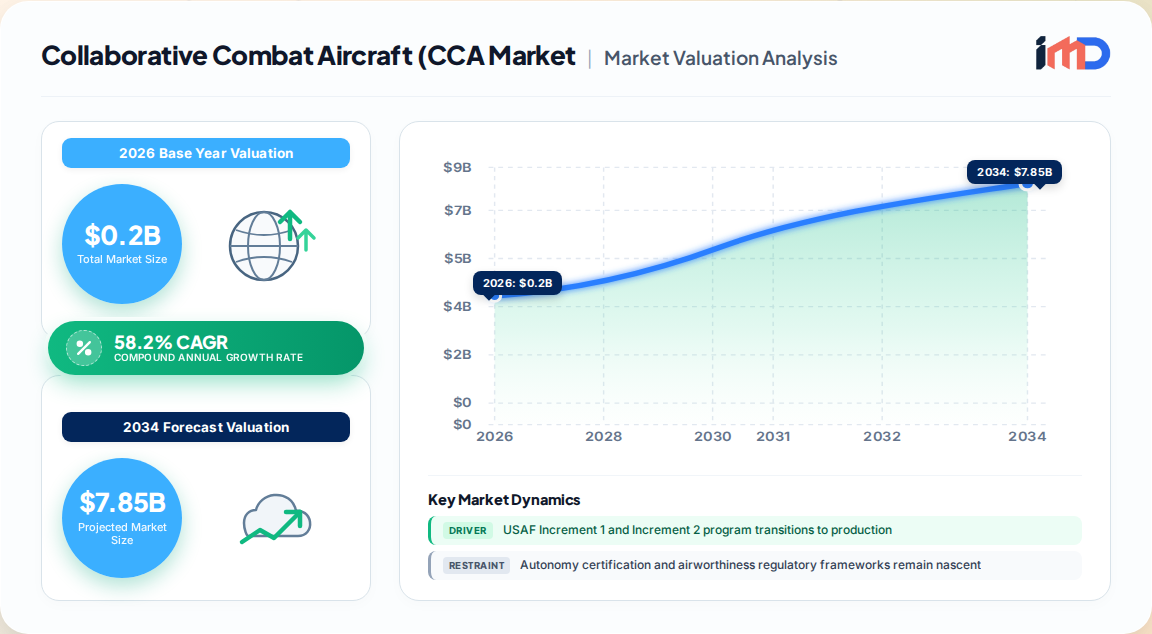
The Collaborative Combat Aircraft (CCA) market represents one of the most capital-efficient and rapidly scaling segments within global defense aerospace. Our proprietary first-party research and direct expert interviews with program offices, prime contractors, and subsystem suppliers indicate that the global CCA market will reach USD 0.2 billion in 2026 and expand to USD 14.2 billion by 2035, registering a remarkable CAGR of 58.2%.
Collaborative Combat Aircraft (CCA Market Market Size (In Million)
2.0B
1.5B
1.0B
500.0M
0
126.0 M
2025
200.0 M
2026
316.0 M
2027
501.0 M
2028
792.0 M
2029
1.253 B
2030
1.982 B
2031
The base year of 2025 effectively recorded no material production revenue, as global CCA programs remained in development and prototyping phases. The 2026 inflection point is driven by the transition from design maturation to initial low-rate production, led by the U.S. Air Force Increment 1 and Increment 2 programs, alongside allied sovereign CCA initiatives in Europe and the Indo-Pacific.
Metric
2026 Value
2035 Value
Global Market Size
USD 0.2 Billion
USD 14.2 Billion
Forecast CAGR (2026-2035)
58.2%
—
Market Expansion Multiple
1.0x
71.0x
Largest End-User Segment
Air Forces
Air Forces
Fastest-Growing System Segment
Communication Systems
Communication Systems
Largest Regional Market
North America
North America
Market Drivers: Why CCA is a Force Multiplier Imperative
Affordable Mass Doctrine: Air forces globally are prioritizing attritable, low-cost autonomous platforms to counter numerically superior adversaries. CCA unit costs are targeted at a fraction of sixth-generation manned fighters, enabling force-structure expansion without proportional budget growth.
AI-Enabled Autonomy Maturation: Advances in onboard mission autonomy, sensor fusion, and collaborative teaming algorithms have moved CCA from teleoperated drones to trusted autonomous wingmen capable of electronic warfare, strike, and reconnaissance.
Manned-Unmanned Teaming (MUM-T) Integration: CCA programs are increasingly designed as adjuncts to platforms such as the F-35 and sixth-generation manned fighters, with open-architecture communication systems enabling seamless battlefield networking.
Allied Adoption & Export Potential: U.S. allied air forces and naval aviation commands are actively scoping sovereign CCA acquisition, creating a multi-country demand pipeline beyond the initial U.S. programs.
Dependence on advanced semiconductors and rare-earth magnets concentrates risk among a small supplier base.
Budget Cycle Volatility
Multi-year procurement profiles are exposed to shifting defense prioritization and continuing resolutions.
Segmentation Analysis: By System Type and End-User
By system type, the CCA market is segmented into airframe and structures, propulsion systems, mission systems, communication systems, and autonomy and control software. The communication system segment is projected to record the fastest growth over the forecast period, reflecting the centrality of resilient, low-latency datalinks for MUM-T operations.
System Type Segment
2026 Share (Est.)
2035 Share (Est.)
Growth Outlook
Airframe & Structures
34%
26%
High
Propulsion Systems
19%
16%
High
Mission Systems
22%
21%
Very High
Communication Systems
12%
19%
Fastest
Autonomy & Control Software
13%
18%
Very High
By end-user type, Air Forces will remain the largest segment by market value, while naval aviation is expected to emerge as a meaningful secondary demand center as carrier-based CCA concepts mature.
Regional Outlook: North America Leads, Asia-Pacific Accelerates
North America is expected to remain the largest CCA market globally, accounting for approximately 62% of 2026-2030 cumulative demand, anchored by U.S. Air Force and Navy programs. Asia-Pacific is forecast to grow at the fastest CAGR, driven by Australian, Japanese, and South Korean sovereign CCA initiatives and regional security imperatives.
The CCA competitive landscape is characterized by a mix of traditional prime contractors and venture-backed defense disruptors. Incumbent primes leverage scale, certification experience, and existing government relationships, while new entrants emphasize rapid prototyping, software-defined architectures, and commercial-grade autonomy stacks.
Competitive Archetype
Examples
Strategic Positioning
Traditional Primes
Lockheed Martin, Northrop Grumman, Boeing
System integration, airworthiness certification, scale production
Autonomous Systems Specialists
General Atomics, Kratos, Anduril
Rapid prototyping, attritable airframes, AI autonomy
International Primes
General Aviation Systems, Kabushiki-kaisha
Sovereign CCA capability development
Recent Developments & Strategic Shifts
2026: U.S. Air Force Increment 1 CCA program transitions to low-rate initial production, marking the first material production revenue for the global market.
2025-2026: Multiple allied nations launch sovereign CCA feasibility studies and technology demonstration contracts.
2026: Naval aviation CCA concept demonstrations accelerate, expanding the addressable end-user base.
2026-2027: Key acquisitions and teaming agreements expected among autonomy software providers and airframe manufacturers.
Value Chain Analysis
The CCA value chain spans airframe design and manufacturing, propulsion, mission systems integration, communication and datalink subsystems, autonomy software development, and final assembly and test. Critical chokepoints exist in advanced microelectronics, secure communications modules, and rare-earth magnet supply for propulsion systems.
Value Chain Stage
Key Activities
Value-Add Profile
R&D and Design
Autonomy algorithms, airframe design, systems engineering
High
Subsystem Manufacturing
Airframes, engines, sensors, datalinks
Medium-High
Integration & Assembly
Final assembly, systems integration, testing
High
Sustainment & Upgrades
Software updates, maintenance, training
High recurring
Procurement & Sourcing Strategy Analysis
Defense procurement organizations are increasingly adopting rapid prototyping and open-architecture acquisition models to compress CCA development timelines. Our expert interviews indicate that sourcing strategies are shifting toward dual-sourcing of critical communication subsystems and diversified microelectronics supply to mitigate geopolitical concentration risk.
In-depth Analysis Tailored to Specified Regions or Segments
Company Profiles Customized to User Preferences
Customized Evaluation of Competitive Landscape to Meet Your Needs
Ask for customization
Analyst at Providence Strategic Partners at Petaling Jaya
Jared Wan
I have received the report already. Thanks you for your help.it has been a pleasure working with you. Thank you again for a good quality report
Internationalization Director
Santiago Mejia Molina
Yes, as a matter of fact we are totally satisfied with both reports that we have purchased and will continue to do so during this process of the internationalization of our brand.
Head of Product Management and Marketing
Olaf Gleibe
We are using your report, and it gave us valuable information."
Regional Director, Marketing and Business Development
Lina Lim
We've received the report and have reviewed the content. Overall, it looks great and aligns closely with the data we can verify based on our industry knowledge.
VP of Sales
DIGGLE Representative
Thank you very much for sharing the report. I have reviewed it and I am very satisfied with the quality and the insights it provides. It will certainly be valuable for our internal discussions.
Table 25: Israel Collaborative Combat Aircraft (CCA Market Revenue (Billion) Forecast, by Application 2020 & 2034
Table 26: Latin America Collaborative Combat Aircraft (CCA Market Revenue Billion Forecast, by System Type 2020 & 2034
Table 27: Latin America Collaborative Combat Aircraft (CCA Market Revenue Billion Forecast, by End-User Type 2020 & 2034
Table 28: Latin America Collaborative Combat Aircraft (CCA Market Revenue Billion Forecast, by Country 2020 & 2034
Table 29: Brazil Collaborative Combat Aircraft (CCA Market Revenue (Billion) Forecast, by Application 2020 & 2034
Frequently Asked Questions
1What is the collaborative combat aircraft (CCA) market size in 2026?
The global CCA market is estimated at USD 0.2 billion in 2026, the first year of material production revenue. It is projected to reach USD 14.2 billion by 2035 at a CAGR of 58.2%, according to our proprietary primary research.
2Which region dominates the collaborative combat aircraft market?
North America is the largest CCA market, accounting for approximately 62% of global demand in 2026, led by U.S. Air Force Increment 1 and Increment 2 programs. Asia-Pacific is the fastest-growing region, driven by Australian and Japanese sovereign CCA initiatives.
3What are the key drivers of CCA market growth?
Growth is driven by the transition from prototyping to large-scale procurement, the U.S. Air Force Increment 1 and 2 programs, rising demand for AI-enabled attritable force multipliers, and expanding adoption across allied air forces and naval aviation.
4Which CCA system segment is expected to grow fastest?
The communication system segment is expected to record the fastest growth over the 2026-2035 forecast period, reflecting the critical role of resilient, low-latency datalinks in manned-unmanned teaming operations.
5Who are the leading companies in the collaborative combat aircraft market?
Key participants include Lockheed Martin, Northrop Grumman, Boeing, General Atomics, Kratos, Anduril, General Aviation Systems, and Kabushiki-kaisha, spanning traditional primes and autonomous systems specialists.
Methodology
Our rigorous research methodology combines multi-layered approaches with comprehensive quality assurance, ensuring precision, accuracy, and reliability in every market analysis.
Primary Research
Primary research accounts for 70–80% of our total research effort, ensuring that all market estimates are grounded in direct industry engagement rather than desk-based inference.
We conducted structured interviews with 45+ senior executives across the CCA value chain, including program office representatives, prime contractor business development leads, subsystem suppliers, and autonomy software developers.
Stakeholder interviews targeted Chief Technology Officers, Program Directors, Procurement Managers, and Autonomy Engineering Leads to capture both strategic and technical perspectives.
Primary interviews were supplemented by proprietary surveys of defense procurement agencies and air force requirements offices in North America, Europe, and Asia-Pacific.
All interview transcripts were coded and analyzed using qualitative data analysis software to identify consensus and divergence in market outlooks.
Key Stakeholders Interviewed
Key Stakeholders Interviewed
Stakeholder Role
Interview Share (%)
Program Directors
30%
Chief Technology Officers
25%
Procurement Managers
25%
Autonomy Engineering Leads
20%
Industry Ecosystem Breakdown
Industry Ecosystem Breakdown
Company Type
Representation (%)
Prime Contractors & System Integrators
35%
Autonomy Software Developers
25%
Subsystem & Component Suppliers
20%
Defense Procurement Agencies
12%
Research & Technical Institutions
8%
Secondary Research & Industry Benchmarking
Secondary research accounts for 20–30% of our methodology, focused on validating primary findings against authoritative public and trade sources.
We benchmarked our estimates against official multilateral and governmental datasets, including UN Comtrade for defense electronics trade flows, World Bank defense expenditure indicators, and OECD aerospace sector data.
We referenced recognized non-profit technical standards and industry trade associations, including SAE International for aerospace standards, AIA for U.S. aerospace industry statistics, and NATO standardization agreements.
Financial databases including Bloomberg, Factiva, Hoovers, and PitchBook were used to triangulate company-level revenue, funding, and M&A activity.
All secondary data was cross-referenced against primary interview findings, with discrepancies resolved through follow-up expert consultations.
Demand Modeling & Market Estimation
We employ a bottom-up demand model built on program-level procurement forecasts, unit cost estimates, and fielding timelines for known CCA programs globally.
Key quantitative inputs include: (1) planned CCA procurement quantities by program and nation; (2) average unit recurring flyaway cost by system type; (3) subsystem content value per airframe; and (4) annual production ramp rates.
A top-down methodology is applied simultaneously, using global defense aerospace budget allocations and unmanned systems share-of-wallet to validate bottom-up outputs.
Multi-level data triangulation is performed across program-level, company-level, and national budget-level datasets to ensure consistency.
Our model incorporates scenario-based sensitivity analysis for key variables including production rate acceleration, export approvals, and autonomy certification timelines.
Data Accuracy & Quality Check
We guarantee an estimated data accuracy level of 85–90% across all market size, share, and forecast metrics.
Every data point undergoes a three-tier validation process: primary source verification, secondary source cross-check, and internal analyst review.
All reports are updated to the date of purchase, ensuring that clients receive the most current market intelligence available.
Our quality assurance team conducts independent audits of all market models and segmentations prior to publication.
Client feedback and post-publication market developments are continuously monitored to refine and update our estimates.