1What is the size of the China sports drink market in 2026?
The China sports drink market is estimated at USD 3.61 billion in 2026, up from USD 3.28 billion in 2025, and is projected to reach USD 5.86 billion by 2031 at a 10.15% CAGR.
Insight Market Data is a premier market research and business consulting firm headquartered in Pune, India, providing syndicated research reports, customized intelligence studies, and strategic advisory services. Renowned academic institutions and Fortune 500 corporations worldwide rely on Insight Market Data's research repository to navigate evolving global and regional business environments. Covering 46 diverse industries across 25 major international economies, our comprehensive database delivers thousands of verified statistics and granular market evaluations. By combining industry-leading analytical methodologies with the direct insights of seasoned industry leaders and subject-matter experts, we deliver actionable intelligence spanning historical performance benchmarks to rigorous multi-year forecasts. We empower organizations to make confident, data-driven decisions across pivotal domains including Machinery & Equipment, Chemicals & Materials, Pharmaceuticals & Healthcare, Food & Beverages, Consumer Goods, Energy & Power, Automotive & Transportation, Electronics & Semiconductors, Medical Devices, Telecommunications, Emerging Technologies, Agriculture, and Packaging. Our multidisciplinary analyst teams provide an objective 360-degree perspective, tailoring every engagement to address complex strategic challenges with exceptional analytical rigor.
Leveraging advanced BI-powered analytics and predictive modeling, Insight Market Data uncovers high-impact market opportunities and competitive differentiators for ambitious enterprises. We continuously refine our research methodologies in accordance with global industry standards, tracking real-time market shifts to ensure our reports are consistently accurate, actionable, and delivered on schedule. Our analysts conduct methodical data validation, rigorous compliance checks, and exhaustive primary and secondary research to maintain the highest levels of data integrity and transparency. We partner closely with corporate strategists, investment groups, and business executives to translate intricate market intelligence into clear, actionable roadmaps for sustainable growth. With operational presence across Washington, USA, and Vimannagar, Pune, India, Insight Market Data ensures direct access to dedicated research specialists and responsive customer support to answer your most strategic questions.
 China Sports Drink Market
 by Soft Drink Type (Electrolyte-Enhanced Water, Hypertonic, Hypotonic, Isotonic, Protein-Based Sport Drinks), by Packaging Type (Aseptic Packages, Glass Bottles, Metal Cans, PET Bottles, Others), by Distribution Channel (Convenience Stores, Online Retail, Specialty Stores, Supermarket/Hypermarket, Others), by East China (Shanghai, Jiangsu, Zhejiang), by South China (Guangdong, Guangxi, Fujian, Hainan), by North China (Beijing, Tianjin, Hebei), by Central China (Hubei, Hunan, Henan), by Southwest China (Sichuan, Chongqing), by Northwest China (Shaanxi, Gansu) Forecast 2026-2034

Research Associate


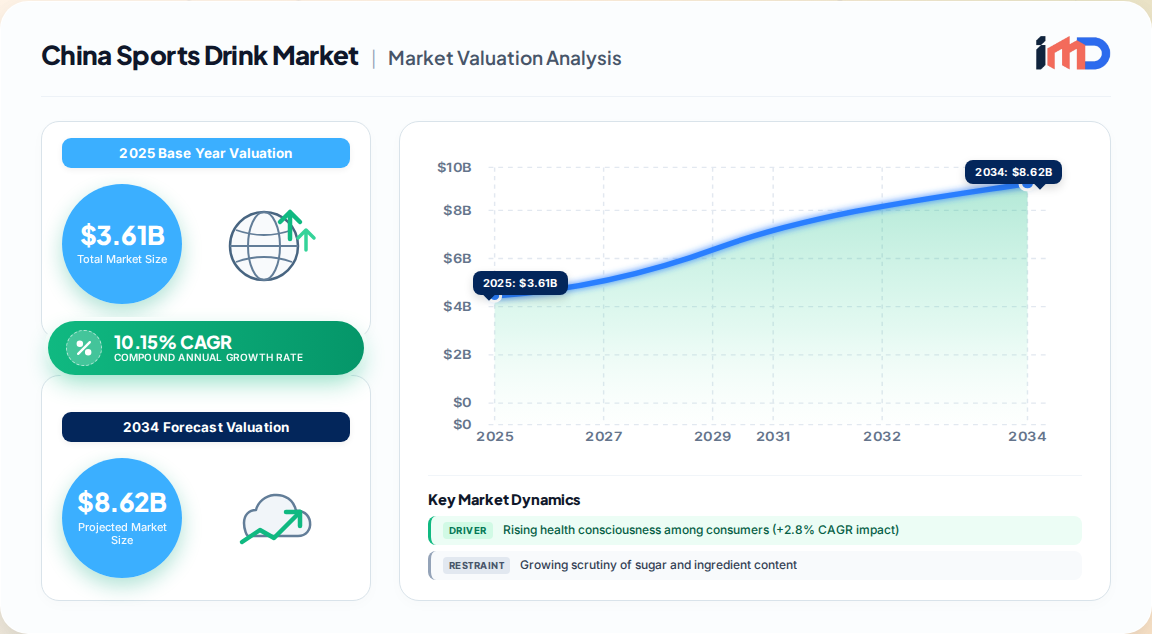
The China sports drink market represents one of the most dynamic functional beverage categories in the Asia-Pacific region. Our proprietary first-party research estimates the market at USD 3.61 billion in 2026, scaling from USD 3.28 billion in 2025 and projected to reach USD 5.86 billion by 2031, implying a robust 10.15% CAGR across the 2026–2031 forecast window. This trajectory sits comfortably above the historical 9.20% CAGR recorded during 2020–2025, signaling accelerating household penetration rather than a maturing category.
Category volume is modeled to rise from approximately 2.73 billion liters in 2025 toward 4.34 billion liters by 2031, while average retail realization climbs from USD 1.20 to USD 1.35 per liter. The structural story is one of dual engines: volume-led penetration in lower-tier cities and value-led premiumization in Tier-1 and Tier-2 metros.
A critical structural gap underpins the upside. Per-capita consumption in China stood at roughly 2.0 liters per person in 2023, compared with approximately 9.6 liters in Japan — a penetration differential of nearly five times. Closing even a fraction of this gap represents a multi-billion-liter opportunity.
| Metric | 2025 (Base) | 2026 (Est.) | 2031 (Forecast) | CAGR 2026–2031 |
|---|---|---|---|---|
| Market Value | USD 3.28 Billion | USD 3.61 Billion | USD 5.86 Billion | 10.15% |
| Sales Volume | 2.73 Billion Liters | 2.94 Billion Liters | 4.34 Billion Liters | High single digit |
| Avg. Retail Price | USD 1.20/Liter | USD 1.23/Liter | USD 1.35/Liter | ~1.5–2.5% mix-led |
| Online Channel Share | 23% | ~25% | ~37% | Structural shift |
Demand formation in this category has decisively moved beyond the professional athlete. Our demand-side modeling attributes the following quantified impacts on forecast CAGR:
Macro anchors are equally supportive. China's urban population reached 953.8 million people (67.9% of total) in 2025, compressing last-mile distribution costs and enabling chilled convenience-store and quick-commerce availability at scale.
Product structure remains concentrated in isotonic hydration, which commanded 46.10% of 2025 category value. Electrolyte-enhanced functional hydration follows at 25.5%, hypotonic at 17.4%, and hypertonic at 11.0%. Protein-based variants, while subscale today, are the fastest-growing pocket at a forecast 10.74% CAGR to 2031, positioned as post-workout muscle-recovery products.
| Segment | 2025 Share | Forecast CAGR | Strategic Read |
|---|---|---|---|
| Isotonic drinks | 46.10% | Core growth | Everyday recovery anchor; defend shelf space |
| Electrolyte-enhanced water | 25.5% | Above-market | Fastest premiumization runway |
| Hypotonic drinks | 17.4% | Market-rate | Light-hydration and summer occasions |
| Hypertonic drinks | 11.0% | Market-rate | Energy-replenishment niche |
| Protein-based sports drinks | Emerging | 10.74% | Highest white-space, gym-linked retail |
Packaging strategy is diverging along price tiers. PET bottles held 54.58% share in 2025, optimized for mass distribution and scalable inland production, while glass bottles are forecast to grow at 11.05% CAGR through 2031, appealing to sustainability-conscious millennials and premium gifting.
Distribution is undergoing structural migration. Supermarkets and hypermarkets held 30.36% share in 2025, leveraging scale and refrigeration, yet specialty stores are set to post a 10.42% CAGR, differentiating on expert guidance around functional claims. Online channels, at 23% of transactions in 2025, are projected to approach 37% by 2031 — the single largest channel-mix shift in the forecast.
East China — anchored by Shanghai, Jiangsu, and Zhejiang — is the leading commercial cluster, benefiting from dense urban retail networks, major beverage headquarters, and mature distribution infrastructure. We estimate this region at roughly 34% of national category value.
Southern China (Guangdong, Guangxi, Fujian, Hainan) over-indexes on per-capita consumption due to heat, outdoor activity, and a deeply embedded regional sports culture. North and Central China represent the volume-expansion frontier, where inland manufacturing investments are cutting freight costs and improving route economics.
The market is assessed as medium concentration, with 35+ active players. The Coca-Cola Company, PepsiCo, Inc., Danone S.A., Otsuka Pharmaceutical Co., Ltd., Nongfu Spring Co., Ltd., Eastroc Beverage (Group) Co., Ltd., Genki Forest, and AJE Group anchor the field.
Competitive strategy clusters into four plays:
The value chain spans ingredient and concentrate supply, contract and owned bottling, warehousing, distributor networks, and omnichannel retail. Two structural shifts are reshaping economics.
First, production localization: manufacturing investments in inland provinces are structurally lowering freight costs and shortening replenishment cycles for interior markets. Second, electrolyte and functional ingredient sourcing — mineral salts, plant-based proteins (pea and soy), and coconut-water-derived electrolytes — is becoming a differentiation lever and a supply-risk concentration point.
Operators with scalable PET production capacity, dense convenience-store coverage, and direct distributor relationships are positioned to capture disproportionate value as daily electrolyte consumption converges with traditional sports-use occasions. Value creation will depend increasingly on mix — functional formulation, pack format, and channel — rather than volume alone.
Three white spaces stand out for strategic allocation:
Adjacent innovation in sparkling formats combining electrolytes with caffeine, choline, and green tea extract suggests a credible premiumization pathway for lifestyle-oriented consumption beyond the workout occasion. Meanwhile, quick-commerce and social-commerce influencer channels are materially lowering customer-acquisition costs for emerging brands.
Our base case holds forecast growth near 10.15% annually, with volume expansion toward the high single digits and price/mix contributing roughly 1.5–2.5% per year. By 2031, omnichannel distribution and differentiated electrolyte formulations should be the decisive competitive advantages.
| Aspects | Details |
|---|---|
| Study Period | 2020-2034 |
| Base Year | 2025 |
| Estimated Year | 2026 |
| Forecast Period | 2026-2034 |
| Historical Period | 2020-2025 |
| Growth Rate | CAGR of 10.15% from 2020-2034 |
| Segmentation |
|

Analyst at Providence Strategic Partners at Petaling Jaya
I have received the report already. Thanks you for your help.it has been a pleasure working with you. Thank you again for a good quality report

Internationalization Director
Yes, as a matter of fact we are totally satisfied with both reports that we have purchased and will continue to do so during this process of the internationalization of our brand.

Head of Product Management and Marketing
We are using your report, and it gave us valuable information."

Regional Director, Marketing and Business Development
We've received the report and have reviewed the content. Overall, it looks great and aligns closely with the data we can verify based on our industry knowledge.

VP of Sales
Thank you very much for sharing the report. I have reviewed it and I am very satisfied with the quality and the insights it provides. It will certainly be valuable for our internal discussions.
By Packaging Type
By Distribution Channel
| By Geography |
|
The China sports drink market is estimated at USD 3.61 billion in 2026, up from USD 3.28 billion in 2025, and is projected to reach USD 5.86 billion by 2031 at a 10.15% CAGR.
Isotonic drinks led with 46.10% of revenue share in 2025, followed by electrolyte-enhanced functional hydration at 25.5%, while protein-based sports drinks are the fastest-growing segment at a 10.74% CAGR to 2031.
Key players include The Coca-Cola Company, PepsiCo, Inc., Danone S.A., Otsuka Pharmaceutical Co., Ltd., Nongfu Spring Co., Ltd., Eastroc Beverage (Group) Co., Ltd., Genki Forest, and AJE Group.
Growth is driven by rising health consciousness (+2.8% CAGR impact), expansion of gym memberships across 117,000 gyms and 69.75 million members, clean-label product innovation, and government fitness initiatives, all supported by an urban population of 953.8 million.
PET bottles held 54.58% share in 2025, but glass bottles are forecast to grow at 11.05% CAGR through 2031. Specialty stores are set to post a 10.42% CAGR, while online channels are projected to rise from 23% to roughly 37% of transactions by 2031.
China consumed about 2.0 liters of sports drinks per person in 2023, compared with approximately 9.6 liters in Japan, indicating substantial structural headroom for volume-led expansion.
Our rigorous research methodology combines multi-layered approaches with comprehensive quality assurance, ensuring precision, accuracy, and reliability in every market analysis.
| Stakeholder Role | Interview Share (%) |
|---|---|
| Category Procurement Director | 30% |
| National Sales Director | 26% |
| Retail Category Manager | 24% |
| Regulatory Affairs Manager | 20% |
| Company Type | Representation (%) |
|---|---|
| Electrolyte & Ingredient Suppliers | 22% |
| Bottling & PET Conversion Operators | 26% |
| Regional Distributors & Quick-Commerce | 28% |
| Hypermarket, Convenience & Specialty Retailers | 24% |
 Related Reports
