1What is the Chile cosmetics products market size in 2026?
The Chile cosmetics products market is valued at USD 412.2 million in 2026 and is projected to reach USD 667.4 million by 2031, growing at a CAGR of 10.12%.
Insight Market Data is a premier market research and business consulting firm headquartered in Pune, India, providing syndicated research reports, customized intelligence studies, and strategic advisory services. Renowned academic institutions and Fortune 500 corporations worldwide rely on Insight Market Data's research repository to navigate evolving global and regional business environments. Covering 46 diverse industries across 25 major international economies, our comprehensive database delivers thousands of verified statistics and granular market evaluations. By combining industry-leading analytical methodologies with the direct insights of seasoned industry leaders and subject-matter experts, we deliver actionable intelligence spanning historical performance benchmarks to rigorous multi-year forecasts. We empower organizations to make confident, data-driven decisions across pivotal domains including Machinery & Equipment, Chemicals & Materials, Pharmaceuticals & Healthcare, Food & Beverages, Consumer Goods, Energy & Power, Automotive & Transportation, Electronics & Semiconductors, Medical Devices, Telecommunications, Emerging Technologies, Agriculture, and Packaging. Our multidisciplinary analyst teams provide an objective 360-degree perspective, tailoring every engagement to address complex strategic challenges with exceptional analytical rigor.
Leveraging advanced BI-powered analytics and predictive modeling, Insight Market Data uncovers high-impact market opportunities and competitive differentiators for ambitious enterprises. We continuously refine our research methodologies in accordance with global industry standards, tracking real-time market shifts to ensure our reports are consistently accurate, actionable, and delivered on schedule. Our analysts conduct methodical data validation, rigorous compliance checks, and exhaustive primary and secondary research to maintain the highest levels of data integrity and transparency. We partner closely with corporate strategists, investment groups, and business executives to translate intricate market intelligence into clear, actionable roadmaps for sustainable growth. With operational presence across Washington, USA, and Vimannagar, Pune, India, Insight Market Data ensures direct access to dedicated research specialists and responsive customer support to answer your most strategic questions.
 Chile Cosmetics Products Market
 by Product Type (Facial Cosmetics, Eye Cosmetics, Lip and Nail Cosmetics), by Category (Mass, Premium), by Nature (Organic, Conventional), by Distribution Channel (Supermarkets/Hypermarkets, Specialty Beauty Stores, Online Retail Channels, Other Channels), by Santiago Metropolitan, by Valparaíso, by Biobío, by Antofagasta, by Maule, by Araucanía, by Los Lagos, by Other Regions Forecast 2026-2034

Research Analyst


 Related Reports

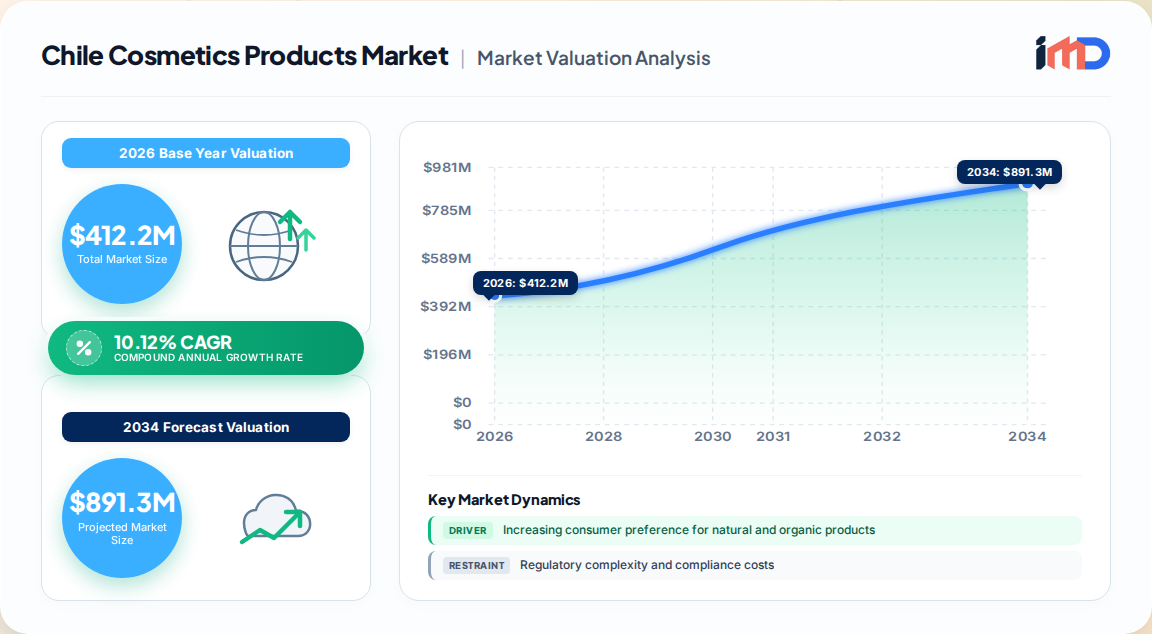
The Chile cosmetics products market is valued at USD 412.2 million in 2026 and is projected to reach USD 667.4 million by 2031, expanding at a CAGR of 10.12% during the forecast period. This growth positions Chile as one of Latin America's most dynamic beauty and personal care arenas, underpinned by rising household incomes, a sophisticated retail infrastructure, and deep integration into global trade networks. Our proprietary research indicates the market is transitioning from a volume-driven recovery to a value-driven expansion, with premiumization and clean-label formulations reshaping competitive dynamics.
Unlike many regional peers, Chile benefits from a high per-capita GDP (projected at USD 710.2 billion in international dollars for 2025 by the IMF) and near-universal internet penetration, which accelerates e-commerce adoption and social commerce influence. The competitive landscape is moderately concentrated, with global majors and regional specialists competing fiercely across mass and premium tiers.
Eye cosmetics dominated with 35.42% share in 2025, driven by affordability and social media tutorials. Facial cosmetics are forecast to grow at an 11.28% CAGR through 2031, fueled by anti-aging and dermatologist-recommended solutions. Lip and nail cosmetics remain steady contributors.
The mass segment accounted for 85.12% of market size in 2025, leveraging supermarket and pharmacy distribution. However, the premium tier is projected to grow at an 11.07% CAGR (2026-2031) as disposable incomes rise and experiential retail expands.
Conventional formulations held 92.10% share in 2025, but organic products are expected to post a 12.21% CAGR to 2031, reflecting sustainability concerns and Chile's natural ingredient sourcing advantages.
Specialty beauty stores captured 35.12% share in 2025, while online retail is set to rise at an 11.02% CAGR through 2031. Supermarkets/hypermarkets and other channels (pharmacies, department stores) complete the landscape.
| Segment | 2025 Share (%) | 2026-2031 CAGR (%) |
|---|---|---|
| Eye Cosmetics | 35.42 | 9.8 |
| Facial Cosmetics | 28.5 | 11.28 |
| Lip & Nail Cosmetics | 36.08 | 9.5 |
| Mass | 85.12 | 9.9 |
| Premium | 14.88 | 11.07 |
| Conventional | 92.10 | 9.9 |
| Organic | 7.90 | 12.21 |
| Specialty Beauty Stores | 35.12 | 10.0 |
| Online Retail | 22.4 | 11.02 |
The Chile cosmetics market features a mix of global heavyweights and agile local players. Key companies include L'Oréal SA, Natura &Co Holding SA, Belcorp Corporation, Chanel Ltd., Beiersdorf AG, The Estée Lauder Companies Inc., Coty Inc., Revlon Inc., Shiseido Co. Ltd., Oriflame Cosmetics SA, LVMH, Huda Beauty LLC, Kosé Corporation, Anastasia Beverly Hills, Petrizzio S.A., Clarins Group, Premier Cosmetics, Lush Cosmetics Limited, Ascoex SpA, and Bellápierre Cosmetics.
Recent strategic moves underscore the market's dynamism:
The Santiago Metropolitan Region dominates consumption, accounting for an estimated 48% of national cosmetics sales, driven by higher incomes, retail density, and early adoption of premium and organic products. Valparaíso (14%) and Biobío (11%) follow, with growing middle-class demand. Northern regions like Antofagasta (7%) show niche potential for sun care and premium skincare due to climatic and mining-sector demographics. Southern regions remain more mass-market oriented but are gradually adopting online channels.
Chile's cosmetics value chain is import-dependent for finished goods and specialty ingredients, with local manufacturing focused on color cosmetics and personal care. Major trade flows originate from the United States, European Union, and China, while Chile exports raw materials such as rosehip oil and grape seed extract to global beauty hubs. The Institute of Public Health (ISP) governs sanitary registrations, and compliance with labeling and composition requirements is mandatory for imports. Recent trade facilitation measures and e-commerce logistics investments are reducing lead times, but regulatory complexity remains a barrier for smaller entrants.
| Aspects | Details |
|---|---|
| Study Period | 2020-2034 |
| Base Year | 2026 |
| Estimated Year | 2026 |
| Forecast Period | 2026-2034 |
| Historical Period | 2020-2025 |
| Growth Rate | CAGR of 10.12% from 2020-2034 |
| Segmentation |
|
By Nature
By Distribution Channel
| By Geography |
|
The Chile cosmetics products market is valued at USD 412.2 million in 2026 and is projected to reach USD 667.4 million by 2031, growing at a CAGR of 10.12%.
Eye cosmetics led with 35.42% share in 2025, driven by affordability and social media influence. Facial cosmetics are the fastest-growing segment at an 11.28% CAGR through 2031.
Online retail accounted for approximately 22.4% of sales in 2025 and is forecast to grow at an 11.02% CAGR through 2031, fueled by convenience and digital payment adoption.
Key companies include L'Oréal SA, Natura &Co, Belcorp, Chanel, Beiersdorf, Estée Lauder, Coty, and Shiseido, among others.
Consumer preference for natural and organic products is driven by sustainability concerns, with organic products expected to post a 12.21% CAGR to 2031 from a 7.90% share in 2025.
New data-protection regulations effective December 2026 impose fines up to 10,000 UTM (approx. USD 725,000), adding compliance costs. The ISP and SERNAC actively monitor product safety and labeling.
Our rigorous research methodology combines multi-layered approaches with comprehensive quality assurance, ensuring precision, accuracy, and reliability in every market analysis.
| Stakeholder Role | Interview Share (%) |
|---|---|
| Procurement Director | 30% |
| Regulatory Affairs Manager | 25% |
| Marketing VP | 25% |
| Supply Chain Head | 20% |
| Company Type | Representation (%) |
|---|---|
| Cosmetic Manufacturers (Local & Global) | 35% |
| Importers & Distributors | 25% |
| Specialty Beauty Retailers | 20% |
| Online Retail Platforms | 12% |
| Regulatory & Trade Bodies | 8% |