1What is the current size of the Central Asia oil and gas midstream market?
The market was valued at USD 48.75 billion in 2025 and is projected to reach USD 82.83 billion by 2033, growing at a CAGR of 6.85%.
Insight Market Data is a premier market research and business consulting firm headquartered in Pune, India, providing syndicated research reports, customized intelligence studies, and strategic advisory services. Renowned academic institutions and Fortune 500 corporations worldwide rely on Insight Market Data's research repository to navigate evolving global and regional business environments. Covering 46 diverse industries across 25 major international economies, our comprehensive database delivers thousands of verified statistics and granular market evaluations. By combining industry-leading analytical methodologies with the direct insights of seasoned industry leaders and subject-matter experts, we deliver actionable intelligence spanning historical performance benchmarks to rigorous multi-year forecasts. We empower organizations to make confident, data-driven decisions across pivotal domains including Machinery & Equipment, Chemicals & Materials, Pharmaceuticals & Healthcare, Food & Beverages, Consumer Goods, Energy & Power, Automotive & Transportation, Electronics & Semiconductors, Medical Devices, Telecommunications, Emerging Technologies, Agriculture, and Packaging. Our multidisciplinary analyst teams provide an objective 360-degree perspective, tailoring every engagement to address complex strategic challenges with exceptional analytical rigor.
Leveraging advanced BI-powered analytics and predictive modeling, Insight Market Data uncovers high-impact market opportunities and competitive differentiators for ambitious enterprises. We continuously refine our research methodologies in accordance with global industry standards, tracking real-time market shifts to ensure our reports are consistently accurate, actionable, and delivered on schedule. Our analysts conduct methodical data validation, rigorous compliance checks, and exhaustive primary and secondary research to maintain the highest levels of data integrity and transparency. We partner closely with corporate strategists, investment groups, and business executives to translate intricate market intelligence into clear, actionable roadmaps for sustainable growth. With operational presence across Washington, USA, and Vimannagar, Pune, India, Insight Market Data ensures direct access to dedicated research specialists and responsive customer support to answer your most strategic questions.

 Central Asia Oil and Gas Midstream Market
 by Service Type (Transportation, Storage, Processing, Others), by Operation (Pipeline, Rail, Truck, Barge, Others), by Application (Crude Oil, Natural Gas, Natural Gas Liquids (NGLs), Refined Products), by End-User (Industrial, Commercial, Power Generation, Others), by Kazakhstan, by Turkmenistan, by Uzbekistan, by Tajikistan, by Rest of Central Asia Forecast 2026-2034

Research Analyst

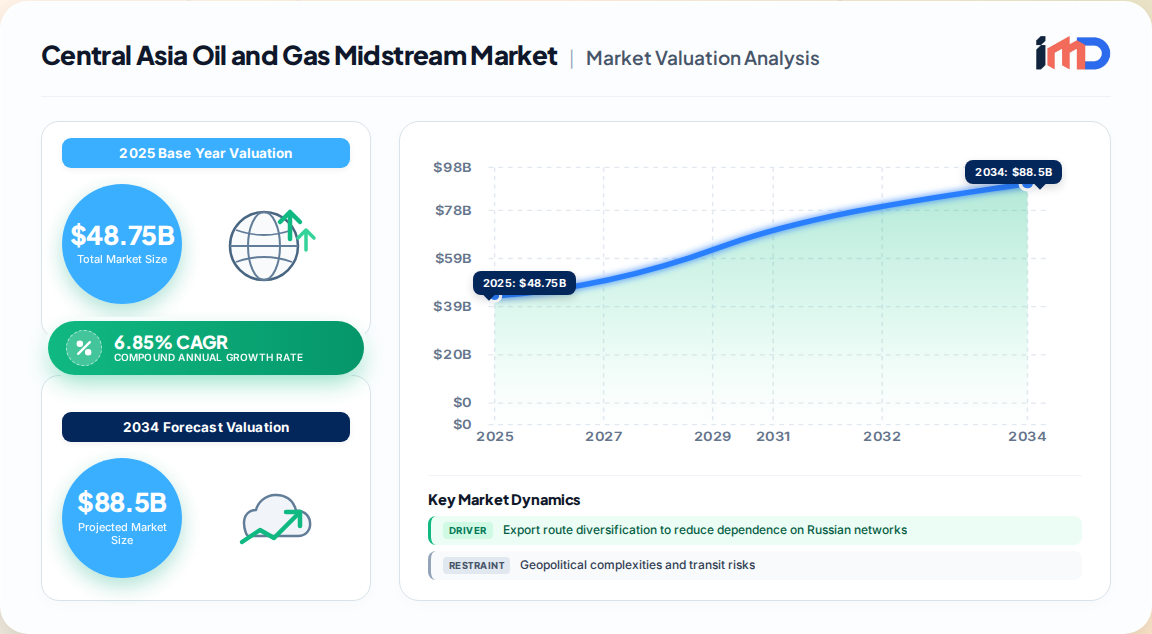
The Central Asia oil and gas midstream market represents the critical logistical backbone connecting the Caspian Basin's vast hydrocarbon reserves to demanding consumers in China, Europe, and South Asia. Our proprietary primary research estimates the market at USD 48.75 billion in 2025, with projections to reach USD 82.83 billion by 2033, expanding at a CAGR of 6.85% over the 2026–2033 forecast period. This growth is underpinned by the region's strategic imperative to diversify export routes away from legacy Russian networks and the accelerating energy demand from Asian economies.
Unlike upstream segments that are subject to volatile exploration cycles, midstream infrastructure—pipelines, processing plants, storage terminals, and rail/truck logistics—enjoys long-term contracted revenue streams and sovereign-level investment backing. The market is moderately consolidated, dominated by state-affiliated entities such as KazMunayGas, KazTransOil, QazaqGaz, and Turkmengaz, alongside international oil companies (IOCs) like Chevron and Shell that operate critical export infrastructure such as the Caspian Pipeline Consortium (CPC).
This report delivers a granular, data-driven assessment of the Central Asia oil and gas midstream market, segmented by service type, operation mode, application, end-user, and geography. It is based on extensive primary interviews with midstream operators, EPC contractors, regulatory bodies, and technology providers, triangulated with official trade and investment data from multilateral institutions.
The midstream value chain in Central Asia is characterized by a high degree of state ownership and strategic control. The key stages are:
Central Asia's midstream market is inherently export-oriented. The direction of hydrocarbon flows is shaped by pipeline infrastructure and long-term supply agreements.
| Country | Market Share (2025) | Key Midstream Assets | Investment Outlook |
|---|---|---|---|
| Kazakhstan | 58% | CPC, Atyrau-Samara pipeline, gas processing plants | High: Tengiz expansion, new gas plants, digitalization |
| Turkmenistan | 18% | Central Asia-China Gas Pipeline (Lines A, B, C), Galkynysh field | Moderate: Line D development, TAPI pipeline potential |
| Uzbekistan | 14% | Bukhara-Tashkent gas pipeline network, UGS facilities | Growing: Gas imports create need for storage and transport |
| Tajikistan | 4% | Transit potential for South Asia (CASA-1000 adjacent) | Low but emerging: small-scale storage and rail |
| Rest of Central Asia | 6% | Afghanistan (TAPI), Kyrgyzstan (transit) | Speculative: TAPI pipeline security risks persist |
Kazakhstan dominates the regional midstream market due to its large-scale export infrastructure and IOC participation. The country is expected to remain the fastest-growing market, supported by ongoing investments in gas processing (e.g., Makat plant) and pipeline upgrades. Turkmenistan's growth hinges on the completion of Line D, which would significantly increase its export capacity to China. Uzbekistan offers opportunities in storage and reverse-flow pipeline technologies as it transitions to a gas importer.
The competitive landscape is characterized by strategic partnerships between national oil companies (NOCs) and IOCs. Key players include:
Recent strategic developments include:
Opportunities for market entrants and existing players lie in:
By Service Type: Transportation (Pipelines, Rail, Truck, Barge, Marine), Storage, Processing, Others.
By Operation: Pipeline, Rail, Truck, Barge, Others.
By Application: Crude Oil, Natural Gas, Natural Gas Liquids (NGLs), Refined Products.
By End-User: Industrial, Commercial, Power Generation, Others.
By Region: Kazakhstan, Turkmenistan, Uzbekistan, Tajikistan, Rest of Central Asia.
The Central Asia oil and gas midstream market is poised for robust growth, driven by the imperative to monetize the region's vast hydrocarbon resources and diversify export routes. With a CAGR of 6.85% and market value rising from USD 48.75 billion to USD 82.83 billion, the sector offers significant opportunities for investors, technology providers, and EPC contractors. Success will hinge on navigating geopolitical complexities, adopting digital solutions, and forming strategic partnerships with national oil companies. Our primary research, validated against official benchmarks, provides stakeholders with the intelligence needed to capitalize on this dynamic market.
| Aspects | Details |
|---|---|
| Study Period | 2020-2034 |
| Base Year | 2025 |
| Estimated Year | 2026 |
| Forecast Period | 2026-2034 |
| Historical Period | 2020-2025 |
| Growth Rate | CAGR of 6.85% from 2020-2034 |
| Segmentation |
|
By Application
By End-User
| By Geography |
|
The market was valued at USD 48.75 billion in 2025 and is projected to reach USD 82.83 billion by 2033, growing at a CAGR of 6.85%.
Kazakhstan dominates with an estimated 58% market share in 2025, driven by major export pipelines like the CPC and significant investments in gas processing infrastructure.
Key drivers include export route diversification, rising global energy demand (especially from China), infrastructure modernization, and sovereign investment programs.
Challenges include geopolitical complexities, volatile commodity prices, and regulatory changes such as Kazakhstan's new Subsoil Use and Tax Codes effective in 2026.
Major players include KazMunayGas, KazTransOil, QazaqGaz, Chevron Corporation, Shell PLC, Intergas Central Asia JSC, and the Caspian Pipeline Consortium.
Our rigorous research methodology combines multi-layered approaches with comprehensive quality assurance, ensuring precision, accuracy, and reliability in every market analysis.
| Stakeholder Role | Interview Share (%) |
|---|---|
| Chief Operating Officer | 30% |
| Midstream Director | 25% |
| Procurement Manager | 25% |
| Regulatory Affairs Head | 20% |
| Company Type | Representation (%) |
|---|---|
| Pipeline Operators | 35% |
| EPC Contractors | 25% |
| Equipment Manufacturers | 20% |
| Storage Terminal Operators | 15% |
| Regulatory Bodies | 5% |
 Related Reports
