1What is the current market size of the carbon dioxide pipeline market?
The global carbon dioxide pipeline market was valued at USD 903 million in 2025 and is projected to reach USD 1,683 million by 2034, growing at a CAGR of 7.2%.
Insight Market Data is a premier market research and business consulting firm headquartered in Pune, India, providing syndicated research reports, customized intelligence studies, and strategic advisory services. Renowned academic institutions and Fortune 500 corporations worldwide rely on Insight Market Data's research repository to navigate evolving global and regional business environments. Covering 46 diverse industries across 25 major international economies, our comprehensive database delivers thousands of verified statistics and granular market evaluations. By combining industry-leading analytical methodologies with the direct insights of seasoned industry leaders and subject-matter experts, we deliver actionable intelligence spanning historical performance benchmarks to rigorous multi-year forecasts. We empower organizations to make confident, data-driven decisions across pivotal domains including Machinery & Equipment, Chemicals & Materials, Pharmaceuticals & Healthcare, Food & Beverages, Consumer Goods, Energy & Power, Automotive & Transportation, Electronics & Semiconductors, Medical Devices, Telecommunications, Emerging Technologies, Agriculture, and Packaging. Our multidisciplinary analyst teams provide an objective 360-degree perspective, tailoring every engagement to address complex strategic challenges with exceptional analytical rigor.
Leveraging advanced BI-powered analytics and predictive modeling, Insight Market Data uncovers high-impact market opportunities and competitive differentiators for ambitious enterprises. We continuously refine our research methodologies in accordance with global industry standards, tracking real-time market shifts to ensure our reports are consistently accurate, actionable, and delivered on schedule. Our analysts conduct methodical data validation, rigorous compliance checks, and exhaustive primary and secondary research to maintain the highest levels of data integrity and transparency. We partner closely with corporate strategists, investment groups, and business executives to translate intricate market intelligence into clear, actionable roadmaps for sustainable growth. With operational presence across Washington, USA, and Vimannagar, Pune, India, Insight Market Data ensures direct access to dedicated research specialists and responsive customer support to answer your most strategic questions.
 Carbon Dioxide Pipeline Market
 by Type (Supercritical, Gaseous), by Application (Enhanced Oil Recovery, Dedicated Storage, Utilization), by Component (Line Pipe, Compressors, Valves, Controls), by End-User ( Oil & Gas, Power Generation, Chemical, Cement, Iron & Steel), by North America (USA, Canada, Mexico), by Europe (Germany, UK, Norway, Netherlands), by Asia Pacific (China, India, Indonesia, Malaysia), by South America (Brazil, Argentina), by Middle East & Africa (UAE, Saudi Arabia, South Africa) Forecast 2026-2034

Research Analyst


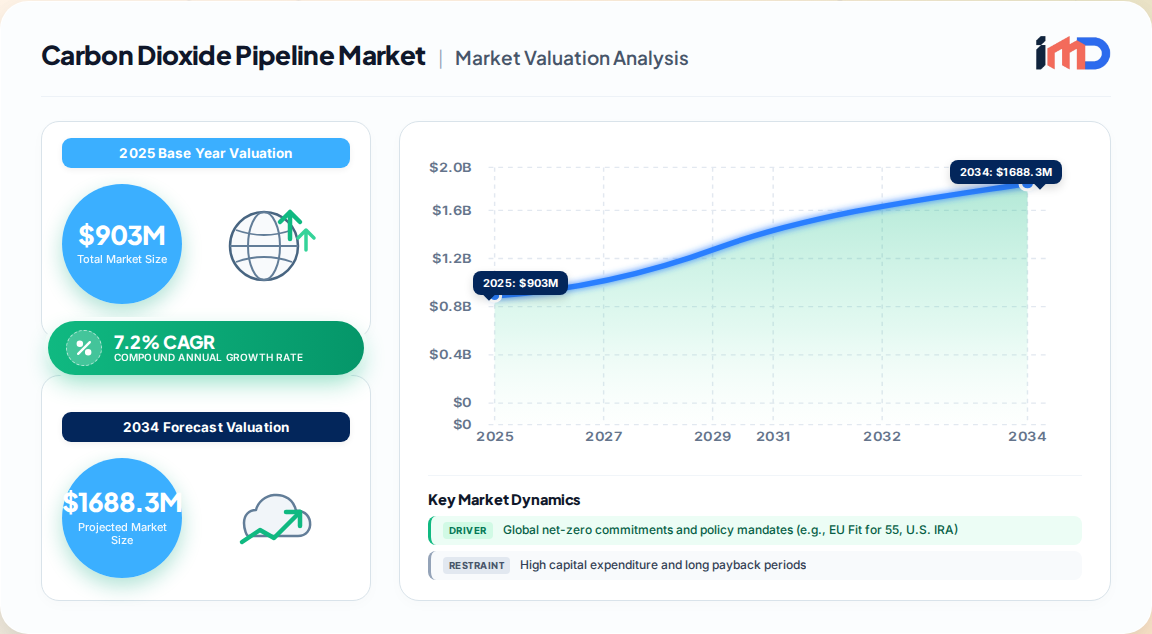
The global carbon dioxide pipeline market was valued at USD 903 million in 2025 and is projected to reach USD 1,683 million by 2034, exhibiting a CAGR of 7.2% over the forecast period. Carbon dioxide pipelines are specialized midstream assets engineered to transport captured CO2—typically in supercritical form at pressures of 10–15 MPa—from industrial emitters such as power plants, refineries, and chemical facilities to geological storage repositories or utilization sites. These pipelines are the connective tissue of carbon capture, utilization, and storage (CCUS) value chains, enabling the scale-up of emission reduction strategies and enhanced oil recovery (EOR) operations.
The global CO2 pipeline network reached approximately 15,953 kilometers in 2025, a 12% increase over the prior year. This expansion reflects accelerating policy mandates—particularly in North America and Europe—where infrastructure readiness is increasingly a prerequisite for CCUS project approvals. Average pipeline construction costs are estimated at USD 32 per meter, with operating gross margins near 49%, making pipeline development portfolios attractive to infrastructure investors seeking high-yield, low-volatility assets.
North America dominates the market, accounting for an estimated 38% of global revenue in 2025, underpinned by a mature EOR industry and favorable fiscal incentives. Asia-Pacific is the fastest-growing region, driven by rapid industrialization, rising CO2 capture volumes, and supportive government policies for CCUS deployment. Europe follows closely, supported by the EU's Fit for 55 package and an ambitious continental pipeline grid roadmap.
The CO2 pipeline value chain comprises four distinct stages, each with specialized participants and value drivers.
| Value Chain Stage | Key Activities | Typical Participants | Value Drivers |
|---|---|---|---|
| Capture & Compression | CO2 separation from industrial flue gases; compression to pipeline-ready pressure | Industrial emitters, capture technology licensors, EPC contractors | Capture efficiency, compression energy costs |
| Pipeline Design & Engineering | Route planning, materials selection, pressure management systems | Engineering, procurement, and construction (EPC) firms; pipeline design consultancies | Supercritical CO2 expertise, regulatory compliance |
| Construction & Installation | Welding, coating, trenching, commissioning | Pipeline contractors, steel pipe manufacturers, coating applicators | Construction cost per meter, project timelines |
| Operations & Maintenance | Monitoring, inspection, leak detection, pressure control | Pipeline operators, midstream companies, inspection service providers | Utilization rates, safety record, digital twin adoption |
The midstream segment—pipeline ownership and operation—captures the highest margins, with operating gross margins near 49%. This has attracted private equity and infrastructure funds seeking stable, long-term returns. However, the capital-intensive nature of pipeline construction and the regulatory complexity of route permitting create significant barriers to entry.
North America remains the largest and most attractive market for CO2 pipelines, supported by:
Europe is the second-largest market, with an ambitious CCUS roadmap targeting 12 gigatons of CO2 sequestered by 2040. The EU is legislating a continental pipeline grid with baseline connectivity projected to exceed 2,000 km by 2030. The North European corridor—spanning Norway, the Netherlands, and the UK—is a hotspot for cross-border CO2 transport projects, although permitting delays and land-use conflicts pose challenges.
Asia-Pacific is the fastest-growing region, driven by:
South America and the Middle East & Africa are emerging markets, with pilot projects and feasibility studies underway. Brazil and the UAE are notable for their early-stage CCUS hubs, though pipeline infrastructure remains limited.
The carbon dioxide pipeline market is moderately concentrated, with a mix of integrated energy majors, midstream infrastructure operators, and specialized engineering firms. Key players include ExxonMobil, Tenaris, Vallourec, and several regional pipeline operators. Competitive strategies focus on:
CO2 pipeline components—particularly high-grade steel line pipes, valves, and compression equipment—are traded globally, with suppliers concentrated in Europe, North America, and East Asia. The U.S., Germany, Japan, and China are major exporters of pipeline steel and equipment. Trade flows are influenced by:
Supply chain risks include geopolitical tensions affecting steel trade, logistical constraints for large-diameter pipe transport, and limited availability of specialized valves and fittings rated for high-pressure CO2 service.
Several untapped opportunities exist in the CO2 pipeline market:
Procurement strategies for CO2 pipeline projects must balance cost, quality, and lead times:
Given the long asset lives and safety-critical nature of CO2 pipelines, procurement decisions should prioritize total cost of ownership over lowest initial bid. Supplier qualification programs and rigorous inspection regimes are essential.
| Aspects | Details |
|---|---|
| Study Period | 2020-2034 |
| Base Year | 2025 |
| Estimated Year | 2026 |
| Forecast Period | 2026-2034 |
| Historical Period | 2020-2025 |
| Growth Rate | CAGR of 7.2% from 2020-2034 |
| Segmentation |
|
By Component
By End-User
| By Geography |
|
The global carbon dioxide pipeline market was valued at USD 903 million in 2025 and is projected to reach USD 1,683 million by 2034, growing at a CAGR of 7.2%.
North America holds the largest share, accounting for approximately 38% of global revenue in 2025, driven by its mature enhanced oil recovery industry and supportive policies like the U.S. Inflation Reduction Act.
Key drivers include global net-zero commitments, expansion of enhanced oil recovery (EOR) using CO2, and the build-out of CCUS infrastructure, with captured CO2 volumes exceeding 2.5 gigatons in 2025.
High capital expenditure (around USD 32 per meter), long permitting timelines (averaging 18 months), and a shortage of specialized pipeline engineers are major challenges restraining market growth.
Key players include ExxonMobil, Tenaris, Vallourec, and other midstream operators and engineering firms specializing in supercritical CO2 pipeline design and construction.
Our rigorous research methodology combines multi-layered approaches with comprehensive quality assurance, ensuring precision, accuracy, and reliability in every market analysis.
| Stakeholder Role | Interview Share (%) |
|---|---|
| Procurement Director | 30% |
| Pipeline Engineering Manager | 25% |
| Project Director | 25% |
| Regulatory Affairs Head | 20% |
| Company Type | Representation (%) |
|---|---|
| Pipeline EPC Contractors | 35% |
| Steel Pipe Manufacturers | 25% |
| Compression Equipment OEMs | 20% |
| Midstream Pipeline Operators | 20% |
 Related Reports
