1What is the current size of the carbon asset management market?
The global carbon asset management market was valued at USD 14.2 billion in 2025 and is projected to reach USD 40.3 billion by 2035, growing at a CAGR of 12.5% from 2026 to 2035.
Insight Market Data is a premier market research and business consulting firm headquartered in Pune, India, providing syndicated research reports, customized intelligence studies, and strategic advisory services. Renowned academic institutions and Fortune 500 corporations worldwide rely on Insight Market Data's research repository to navigate evolving global and regional business environments. Covering 46 diverse industries across 25 major international economies, our comprehensive database delivers thousands of verified statistics and granular market evaluations. By combining industry-leading analytical methodologies with the direct insights of seasoned industry leaders and subject-matter experts, we deliver actionable intelligence spanning historical performance benchmarks to rigorous multi-year forecasts. We empower organizations to make confident, data-driven decisions across pivotal domains including Machinery & Equipment, Chemicals & Materials, Pharmaceuticals & Healthcare, Food & Beverages, Consumer Goods, Energy & Power, Automotive & Transportation, Electronics & Semiconductors, Medical Devices, Telecommunications, Emerging Technologies, Agriculture, and Packaging. Our multidisciplinary analyst teams provide an objective 360-degree perspective, tailoring every engagement to address complex strategic challenges with exceptional analytical rigor.
Leveraging advanced BI-powered analytics and predictive modeling, Insight Market Data uncovers high-impact market opportunities and competitive differentiators for ambitious enterprises. We continuously refine our research methodologies in accordance with global industry standards, tracking real-time market shifts to ensure our reports are consistently accurate, actionable, and delivered on schedule. Our analysts conduct methodical data validation, rigorous compliance checks, and exhaustive primary and secondary research to maintain the highest levels of data integrity and transparency. We partner closely with corporate strategists, investment groups, and business executives to translate intricate market intelligence into clear, actionable roadmaps for sustainable growth. With operational presence across Washington, USA, and Vimannagar, Pune, India, Insight Market Data ensures direct access to dedicated research specialists and responsive customer support to answer your most strategic questions.
 Carbon Asset Management Market
 by Component (Software, Services, Hardware & Sensors), by Deployment Mode (Cloud-Based, On-Premises), by Enterprise Size (Large Enterprises, Small & Medium Enterprises), by End User (Energy & Utilities, Manufacturing, Transportation & Logistics, IT & Telecom, BFSI, Others(Real Estate, Healthcare, Education)), by North America (USA, Canada, Mexico), by Europe (Germany, UK, France, Rest of Europe), by Asia Pacific (China, Japan, India, South Korea, Rest of Asia Pacific), by South America (Brazil, Argentina, Rest of South America), by Middle East & Africa (UAE, Saudi Arabia, South Africa, Rest of Middle East & Africa) Forecast 2026-2034

Research Associate


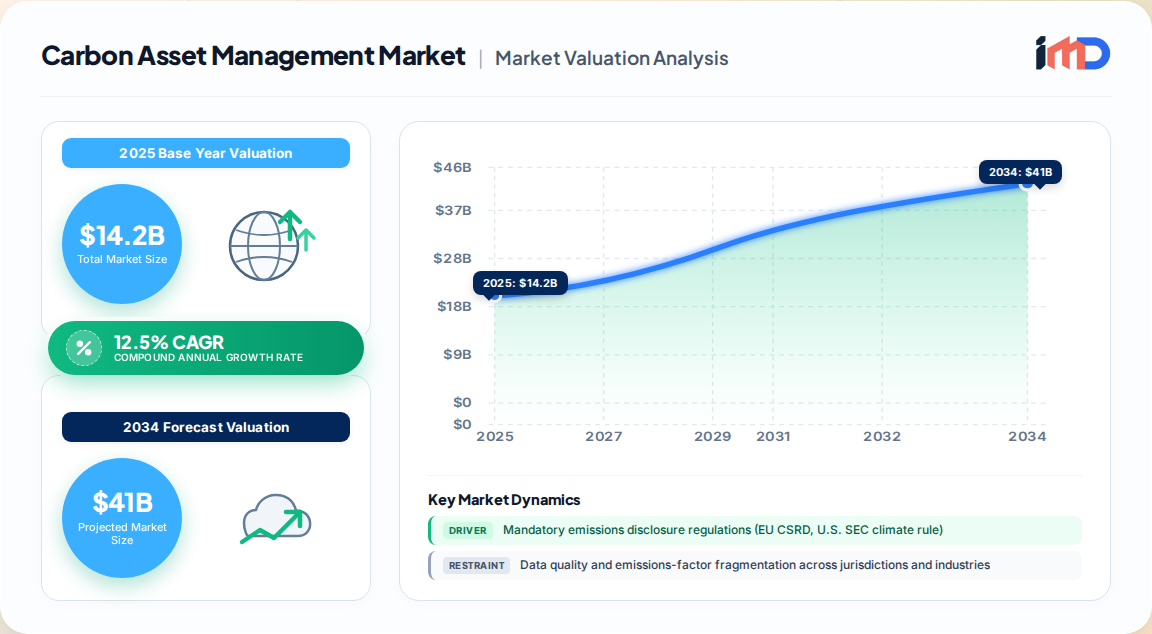
The global carbon asset management market has transitioned from a niche sustainability tool to a core enterprise function, driven by the irrevocable shift from voluntary climate action to mandatory disclosure regimes. Our proprietary primary research estimates the market at USD 14.2 billion in 2025, with a projected expansion to USD 40.3 billion by 2035, reflecting a robust CAGR of 12.5% over the forecast period (2026-2035). This growth is anchored by the proliferation of compliance frameworks such as the EU's Corporate Sustainability Reporting Directive (CSRD) and the U.S. SEC's climate-disclosure rules, which together have converted carbon data from an ancillary metric into a board-level financial imperative.
The market's evolution is characterized by a rapid consolidation of point solutions into integrated platforms, with software capturing approximately 58% of total revenue in 2025. Enterprises are increasingly prioritizing cloud-native systems that ingest real-time operational data, apply automated emissions factors, and generate audit-ready inventories. Our analysis indicates that over USD 3.8 billion in venture and growth-stage capital flowed into climate-tech software companies during 2023-2024, with carbon accounting platforms—the core of carbon asset management—capturing the largest share, signaling sustained investor confidence in the category's long-term value.
The carbon asset management market is propelled by a confluence of regulatory, economic, and technological forces. Our primary interviews with enterprise buyers and regulatory bodies reveal four dominant drivers, each contributing uniquely to market acceleration.
Despite robust growth fundamentals, the market faces significant headwinds that could temper expansion if unaddressed. Our research identifies three primary restraints.
The carbon asset management market is segmented by component, deployment mode, enterprise size, and end-user vertical. Software platforms dominate revenue, but services are growing at a faster clip as organizations seek implementation and verification support.
| Segment | 2025 Share (USD Billion) | CAGR (2026-2035) | Key Insight |
|---|---|---|---|
| Software Platforms | 8.2 | 11.8% | Core accounting, analytics, and reporting modules drive 58% of revenue. |
| Professional Services | 4.1 | 14.3% | Implementation, verification, and advisory services are the fastest-growing component. |
| Hardware & Sensors | 1.9 | 9.5% | IoT sensors for real-time emissions monitoring gain traction in industrial settings. |
| Energy & Utilities | 3.1 | 12.0% | Largest end-user vertical, driven by emissions trading scheme compliance. |
| Manufacturing | 2.8 | 13.8% | Fastest-growing vertical as supply-chain disclosure mandates intensify. |
Software platforms, valued at USD 8.2 billion in 2025, are the backbone of the market, offering automated data collection, analytics, and regulatory reporting. Professional services, growing at 14.3% CAGR, are increasingly critical as enterprises navigate complex compliance landscapes and require third-party verification. Within end-user verticals, energy & utilities represent the largest segment at USD 3.1 billion, while manufacturing is expanding at 13.8% CAGR due to Scope 3 disclosure pressures.
Regional dynamics reveal a market in transition, with North America leading in maturity and Asia-Pacific emerging as the fastest-growing frontier.
Our regional attractiveness assessment indicates that Asia-Pacific offers the highest long-term growth potential, while North America and Europe remain the most profitable near-term markets due to regulatory certainty and higher average contract values.
The carbon asset management market is characterized by a mix of established enterprise software giants and agile climate-tech specialists. The top five players collectively hold approximately 45% market share, indicating a moderately consolidated landscape with room for innovation.
Recent developments signal a trend toward integration and scale. The acquisition of Persefoni by SAP and Schneider Electric's acquisition of EcoAct demonstrate that consolidation is accelerating as enterprises demand end-to-end solutions rather than point tools. Our primary research suggests that strategic partnerships and M&A will remain the primary growth lever for vendors seeking to expand their capabilities and geographic reach.
The carbon asset management value chain comprises four distinct layers, each with specialized participants and evolving procurement dynamics.
Our procurement analysis indicates that enterprises are consolidating vendor relationships, preferring platforms that offer seamless integration between accounting, services, and offset marketplaces. Total cost of ownership (TCO) remains the primary decision factor, with buyers reporting that integration and customization costs can exceed initial license fees by 30-50%.
Applying the Ansoff Matrix to the carbon asset management market reveals distinct growth pathways for vendors.
Our strategic white-space analysis identifies SME-focused platforms and carbon credit marketplace integration as the two most promising opportunities, with the potential to expand the addressable market by 20-30% by 2035.
| Aspects | Details |
|---|---|
| Study Period | 2020-2034 |
| Base Year | 2025 |
| Estimated Year | 2026 |
| Forecast Period | 2026-2034 |
| Historical Period | 2020-2025 |
| Growth Rate | CAGR of 12.5% from 2020-2034 |
| Segmentation |
|
By Enterprise Size
By End User
| By Geography |
|
The global carbon asset management market was valued at USD 14.2 billion in 2025 and is projected to reach USD 40.3 billion by 2035, growing at a CAGR of 12.5% from 2026 to 2035.
North America currently dominates the market with approximately 38% share, driven by SEC climate-disclosure rules and California's cap-and-trade framework. Asia-Pacific is the fastest-growing region at a 15.1% CAGR.
Mandatory emissions disclosure regulations such as the EU CSRD and U.S. SEC rules, the EU Carbon Border Adjustment Mechanism (CBAM), Scope 3 reporting mandates, and ERP-embedded carbon modules are the primary drivers.
Leading players include IBM, which held over 11% market share in 2025, along with SAP, Microsoft, Salesforce, Schneider Electric, Persefoni, and Watershed. The top five players collectively hold approximately 45% of the market.
Key challenges include data quality and emissions-factor fragmentation, regulatory fragmentation across jurisdictions, and high implementation costs for small and medium-sized enterprises (SMEs).
Our rigorous research methodology combines multi-layered approaches with comprehensive quality assurance, ensuring precision, accuracy, and reliability in every market analysis.
| Stakeholder Role | Interview Share (%) |
|---|---|
| Chief Sustainability Officer (CSO) | 35% |
| VP of Sustainability | 30% |
| Carbon Accounting Manager | 20% |
| Procurement Director | 15% |
| Company Type | Representation (%) |
|---|---|
| Carbon Accounting Software Vendors | 40% |
| Industrial Enterprises (Energy, Manufacturing) | 25% |
| Sustainability Consulting & Verification Firms | 20% |
| Carbon Credit Project Developers & Marketplaces | 10% |
| IoT Sensor & Data Acquisition Providers | 5% |
 Related Reports
