1What is the Brazil jewelry market size in 2023?
The Brazil jewelry market was valued at USD 3.07 Billion in 2023, according to our proprietary primary research.
Insight Market Data is a premier market research and business consulting firm headquartered in Pune, India, providing syndicated research reports, customized intelligence studies, and strategic advisory services. Renowned academic institutions and Fortune 500 corporations worldwide rely on Insight Market Data's research repository to navigate evolving global and regional business environments. Covering 46 diverse industries across 25 major international economies, our comprehensive database delivers thousands of verified statistics and granular market evaluations. By combining industry-leading analytical methodologies with the direct insights of seasoned industry leaders and subject-matter experts, we deliver actionable intelligence spanning historical performance benchmarks to rigorous multi-year forecasts. We empower organizations to make confident, data-driven decisions across pivotal domains including Machinery & Equipment, Chemicals & Materials, Pharmaceuticals & Healthcare, Food & Beverages, Consumer Goods, Energy & Power, Automotive & Transportation, Electronics & Semiconductors, Medical Devices, Telecommunications, Emerging Technologies, Agriculture, and Packaging. Our multidisciplinary analyst teams provide an objective 360-degree perspective, tailoring every engagement to address complex strategic challenges with exceptional analytical rigor.
Leveraging advanced BI-powered analytics and predictive modeling, Insight Market Data uncovers high-impact market opportunities and competitive differentiators for ambitious enterprises. We continuously refine our research methodologies in accordance with global industry standards, tracking real-time market shifts to ensure our reports are consistently accurate, actionable, and delivered on schedule. Our analysts conduct methodical data validation, rigorous compliance checks, and exhaustive primary and secondary research to maintain the highest levels of data integrity and transparency. We partner closely with corporate strategists, investment groups, and business executives to translate intricate market intelligence into clear, actionable roadmaps for sustainable growth. With operational presence across Washington, USA, and Vimannagar, Pune, India, Insight Market Data ensures direct access to dedicated research specialists and responsive customer support to answer your most strategic questions.
 Brazil Jewelry Market
 by Type (Rings, Charms & Bracelets, Earrings, Necklaces, Others), by Material (Precious Metals(Gold, Silver, Platinum-Group Metals), Base Metals, Mixed Materials), by Category (Fine Jewelry, Costume Jewelry), by End User (Women, Men, Children), by Distribution Channel (Online Retail Stores, Offline Retail Stores), by Price Tier (Mass and Fashion, Affordable Fine, Premium, Luxury), by Southeast (São Paulo, Rio de Janeiro), by South (Porto Alegre, Curitiba), by Northeast (Salvador, Recife), by Central-West (Brasília, Goiânia), by North (Manaus, Belém) Forecast 2026-2034

Research Analyst


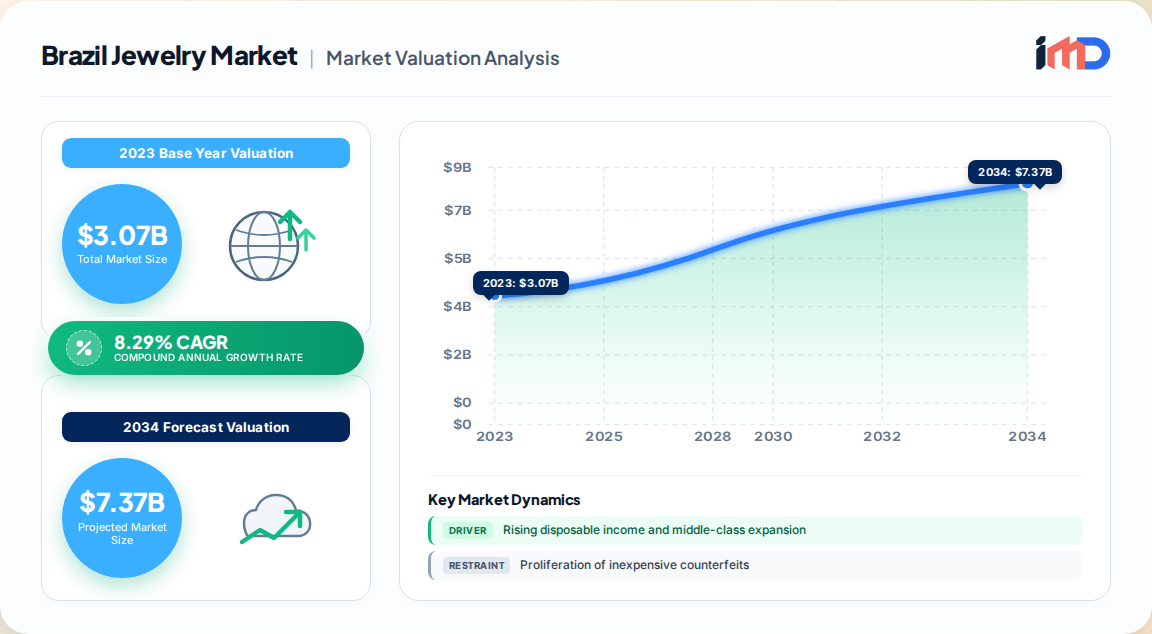
The Brazil jewelry market represents one of Latin America's most resilient and culturally embedded consumer categories, combining deep artisanal heritage with a rapidly modernizing retail infrastructure. Our proprietary primary research estimates the market at USD 3.07 Billion in 2023, with a projected expansion to USD 6.81 Billion by 2033, registering a robust CAGR of 8.29%. Brazil's population of approximately 213.4 million sustains a large recurring demand pool across self-purchase, gifting, weddings, and milestone occasions.
The Brazil jewelry market is segmented by type, material, category, and distribution channel, revealing distinct consumer preferences and growth dynamics.
| Segment Dimension | Dominant Segment | Share / CAGR | Key Insights |
|---|---|---|---|
| Type | Rings | 34.10% share (2025) | Strong bridal and engagement traditions; customization drives premium pricing. Necklaces hold significant share due to versatility. Bracelets fastest-growing at 6.78% CAGR through 2031. |
| Material | Precious Metals | 61.92% share (2025) | Brazil's world-class gold mining (Minas Gerais, Bahia) supports dominance. Mixed materials fastest-growing at 7.05% CAGR, reflecting affordable luxury demand. |
| Category | Fine Jewelry | ~58% of value | Costume jewelry expands faster due to fashion consciousness and price sensitivity. |
| Distribution Channel | Offline Retail Stores | ~88% of sales (2025) | Physical stores provide authenticity and try-on experience. Online channel growing at a faster pace, reaching 18% share by 2031. |
| End User | Women | ~72% of purchases | Men's and children's segments offer untapped potential, driven by gifting and fashion trends. |
Brazil's jewelry demand is heavily concentrated in urban centers, but secondary cities are gaining traction as disposable incomes rise.
The Brazil jewelry market is characterized by a mix of domestic vertically integrated leaders and global luxury houses, alongside thousands of independent players.
| Company | Positioning and Strategy |
|---|---|
| Jóias Vivara | Largest domestic branded jeweler; vertically integrated with a factory producing ~3.5 million pieces (80% of products sold). Focus on omnichannel and personalized collections. |
| H Stern Jewelers Inc. | Premium brand with international presence; leverages Brazilian gemstones and craftsmanship. |
| Pandora A/S | Mass-market charm bracelets and lab-grown diamond collections (Pandora Nova, Era, Talisman launched in Brazil, August 2023). |
| LVMH Moet Hennessy Louis Vuitton | Luxury segment leader with selective boutiques in São Paulo and Rio de Janeiro. |
| Compagnie Financiere Richemont SA | Owns Cartier, with two São Paulo boutiques; targets affluent consumers. |
| Manoel Bernardes SA | Traditional jeweler with strong brand equity in fine jewelry. |
| Monte Carlo Joias | Operates 50 stores nationally; focuses on accessible fine jewelry. |
| Rommanel | Semi-jewelry and costume jewelry leader, with extensive franchise network. |
Recent Developments:
Brazil is a net importer of finished jewelry and a significant exporter of colored gemstones and gold. Trade flows are shaped by import tariffs, exchange rates, and sourcing preferences.
The Brazil jewelry value chain spans from mining and refining to retail and after-sales service, with significant value addition at each stage.
Several underpenetrated segments offer attractive growth opportunities for investors and operators.
| Aspects | Details |
|---|---|
| Study Period | 2020-2034 |
| Base Year | 2023 |
| Estimated Year | 2026 |
| Forecast Period | 2026-2034 |
| Historical Period | 2020-2025 |
| Growth Rate | CAGR of 8.29% from 2020-2034 |
| Segmentation |
|
By Category
By End User
By Distribution Channel
By Price Tier
| By Geography |
|
The Brazil jewelry market was valued at USD 3.07 Billion in 2023, according to our proprietary primary research.
The market is projected to grow at a CAGR of 8.29% from 2023 to 2033, reaching USD 6.81 Billion by 2033.
Necklaces held the largest share in 2023, driven by their versatility and broad appeal, while rings are also a major segment due to bridal traditions.
Key players include Jóias Vivara, H Stern Jewelers Inc., Pandora A/S, LVMH, and Compagnie Financiere Richemont SA, among others.
Lab-grown diamonds are gaining traction, especially among Gen Z and Millennials, with retailers allocating 40–60% of showcase space to these sustainable and cost-effective alternatives.
Online sales accounted for approximately 11.2% of the market in 2025 and are expected to reach 18.0% by 2031, driven by internet penetration and convenience.
Our rigorous research methodology combines multi-layered approaches with comprehensive quality assurance, ensuring precision, accuracy, and reliability in every market analysis.
| Stakeholder Role | Interview Share (%) |
|---|---|
| CEO / Managing Director | 30% |
| Procurement Director | 25% |
| Merchandising Manager | 25% |
| Marketing Director | 20% |
| Company Type | Representation (%) |
|---|---|
| Branded Jewelry Manufacturers | 35% |
| Independent Ateliers & Artisans | 20% |
| Precious Metal & Gemstone Suppliers | 18% |
| Retailers & Distributors | 15% |
| Technology & E-commerce Platforms | 12% |
 Related Reports
