1What is the size of the Brazil building market in 2026?
The Brazil building market is estimated at USD 161.91 Billion in 2026, growing from USD 155.98 Billion in 2025. It is projected to reach USD 218.19 Billion by 2034 at a CAGR of 3.80%.
Insight Market Data is a premier market research and business consulting firm headquartered in Pune, India, providing syndicated research reports, customized intelligence studies, and strategic advisory services. Renowned academic institutions and Fortune 500 corporations worldwide rely on Insight Market Data's research repository to navigate evolving global and regional business environments. Covering 46 diverse industries across 25 major international economies, our comprehensive database delivers thousands of verified statistics and granular market evaluations. By combining industry-leading analytical methodologies with the direct insights of seasoned industry leaders and subject-matter experts, we deliver actionable intelligence spanning historical performance benchmarks to rigorous multi-year forecasts. We empower organizations to make confident, data-driven decisions across pivotal domains including Machinery & Equipment, Chemicals & Materials, Pharmaceuticals & Healthcare, Food & Beverages, Consumer Goods, Energy & Power, Automotive & Transportation, Electronics & Semiconductors, Medical Devices, Telecommunications, Emerging Technologies, Agriculture, and Packaging. Our multidisciplinary analyst teams provide an objective 360-degree perspective, tailoring every engagement to address complex strategic challenges with exceptional analytical rigor.
Leveraging advanced BI-powered analytics and predictive modeling, Insight Market Data uncovers high-impact market opportunities and competitive differentiators for ambitious enterprises. We continuously refine our research methodologies in accordance with global industry standards, tracking real-time market shifts to ensure our reports are consistently accurate, actionable, and delivered on schedule. Our analysts conduct methodical data validation, rigorous compliance checks, and exhaustive primary and secondary research to maintain the highest levels of data integrity and transparency. We partner closely with corporate strategists, investment groups, and business executives to translate intricate market intelligence into clear, actionable roadmaps for sustainable growth. With operational presence across Washington, USA, and Vimannagar, Pune, India, Insight Market Data ensures direct access to dedicated research specialists and responsive customer support to answer your most strategic questions.
 Brazil Building Market
 by Residential (New Construction, Renovation), by Commercial (New Construction, Renovation), by Infrastructure (Transportation, Sanitation, Energy, Ports and Airports), by Industrial (Factories, Warehouses, Logistics Hubs), by Institutional, by Construction Method (Conventional On-Site, Prefabricated and Modular), by Investment Source (Public, Private), by Southeast, by South, by Northeast, by Central-West, by North Forecast 2026-2034

Research Analyst


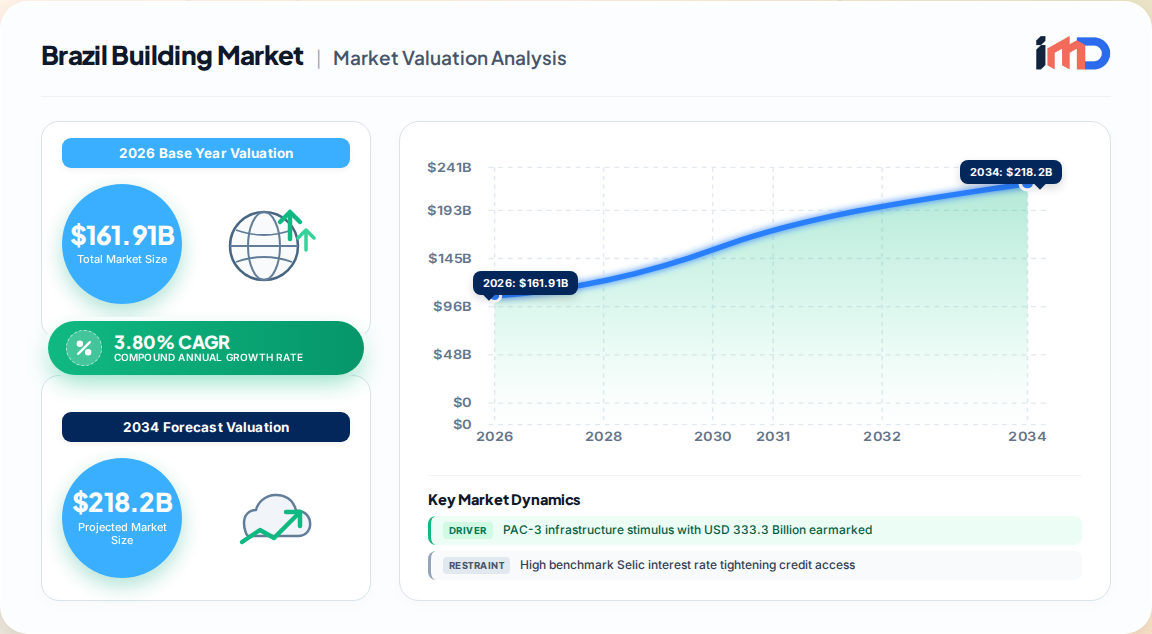
The Brazil building market represents the largest built-environment ecosystem in Latin America, spanning residential housing, commercial real estate, industrial facilities, transportation infrastructure, and energy construction. Our proprietary bottom-up modeling, validated through primary interviews with contractors, developers, and materials suppliers, estimates the market at USD 161.91 Billion in 2026, expanding from USD 155.98 Billion in 2025 and forecast to reach USD 218.19 Billion by 2034 at a CAGR of 3.80%.
This trajectory is anchored by a projected BRL 2.7 trillion in project activity by 2030, reflecting a multi-year pipeline across public concessions and private development. The sector has outperformed the broader Brazilian economy for three consecutive years through 2025, driven by infrastructure acceleration programs and sustained housing demand.
| Metric | Value |
|---|---|
| Market Size (2025) | USD 155.98 Billion |
| Market Size (2026) | USD 161.91 Billion |
| Forecast Size (2034) | USD 218.19 Billion |
| CAGR (2026–2034) | 3.80% |
| Dominant Sector | Residential (34.6%) |
| Leading Region | Southeast (41.3%) |
Residential construction commands 34.6% of total market value, while the Southeast region concentrates 41.3% of national activity. The market's structural foundation rests on a persistent housing deficit, demographic urbanization, and a reinvigorated federal infrastructure agenda.
Foreign direct investment in Brazil increased by USD 6.04 Billion in March 2026, and the country captured the largest share of Latin American FDI. This capital inflow is directly translating into demand for factories, warehouses, logistics hubs, and utility infrastructure. Investments in electric vehicle manufacturing, renewable energy equipment, battery production, and advanced manufacturing are reinforcing industrial construction activity.
The Growth Acceleration Program (PAC-3) earmarks USD 333.3 Billion, including USD 120.0 Billion reserved for private-sector participation across 92 concessions. The Brazilian Development Bank approved USD 5.1 Billion in infrastructure credit during H1 2024. Railway priorities, including the 537 km FIOL1 corridor, are expected to move 60 million tonnes of freight annually by end-2026, driving heavy civil works demand.
The MCMV 3.0 scheme closed 2024 with 1.26 million units contracted toward a 2 million-unit 2026 target, backed by a USD 27.5 Billion 2025 budget. Higher income ceilings now allow households earning up to USD 1,568 per month to access subsidized mortgages, broadening demand. Since inception, the program has delivered 8.4 million homes and directly addresses the 5.9 million-unit housing gap.
More than 87% of Brazil's 203 million residents lived in urban areas in 2022, with the urban population projected to reach 90% by 2050, well above the global average of 70%. This urban concentration sustains demand for housing, commercial spaces, transport links, and sanitation networks.
The elevated Selic rate increases borrowing costs for developers, contractors, and homebuyers. With high real interest rates, developers postpone new launches while buyers delay purchases, particularly in market-rate projects dependent on credit. Even with gradual monetary easing, elevated real rates continue to limit stronger expansion.
Construction cost indices reflect higher materials and labor costs. Limited availability of skilled workers raises wages and constrains project execution, compressing contractor margins and increasing delay risk. Supply-chain kinks in cement and rebar impose scheduling risk, prompting mid-sized players to form joint procurement platforms and pursue regional consolidation.
Public infrastructure spending remains exposed to fiscal adjustments and political cycles, creating lumpiness in tender pipelines and payment cycles for contractors.
| Segment | Share / Growth | Key Insight |
|---|---|---|
| Residential | 34.6% share (2025) | Fastest-growing at ~4.1% CAGR through 2034 |
| Infrastructure | ~3.9% CAGR | PAC-3, highway concessions, sanitation, airports |
| Commercial | Moderate growth | Urban redevelopment, mixed-use, logistics |
| Industrial | Expanding | Nearshoring, EV supply chain, green hydrogen |
| New Construction | 73.45% of 2024 value | Dominant construction type |
| Renovation | 4.32% CAGR | Accelerating through 2030 |
| Conventional On-Site | 82.43% share (2024) | Still dominant but losing share |
| Prefabricated & Modular | 10.40% CAGR (2025–2030) | Fastest-growing method |
| Public Investment | 62.34% share (2024) | Dominant funding source |
| Private Investment | 5.65% CAGR | Growing share through 2030 |
Residential growth combines the housing deficit with a growing middle class creating demand above the subsidy threshold. Infrastructure benefits from federal commitment, state concession programs for highways and sanitation, and airport privatization. Industrialized construction is gaining traction as developers push for faster cycle times and lower waste.
| Region | Share / Growth | Characteristics |
|---|---|---|
| Southeast | 41.3% share | Economic corridor, highest construction volume, Rio-São Paulo axis |
| South | ~22% (est.) | Industrial base, agribusiness logistics, modular housing adoption |
| Northeast | 4.90% CAGR (fastest) | Renewable energy build-out, tourism infrastructure, MCMV demand |
| Central-West | ~12% (est.) | Agribusiness-driven logistics, Brasília public works, new industrial parks |
| North | ~5.7% (est.) | Logistics hubs, sanitation gaps, Amazon infrastructure |
The Southeast commands 41.3% of national market share through its concentration of major urban and economic hubs. The Northeast registers the fastest growth at 4.90% CAGR through 2030, underpinned by utility-scale renewables and housing programs. Bahia is identified as the fastest-growing state-level market, reflecting wind and solar investment.
The Brazilian building market features medium concentration with a mix of large homebuilders, heavy construction contractors, and regional developers. Leading residential players include MRV Engenharia, Cyrela Brazil Realty, Direcional Engenharia, Tenda, and Gafisa.
Recent strategic developments demonstrate market momentum:
Mid-sized developers are forming regional joint ventures to share risk and local expertise, while larger contractors pursue consortium models for mega-projects.
Building Information Modeling mandates in federal procurement are accelerating digital workflows. Contractors now submit ISO 19650-aligned execution plans, citing faster permitting and fewer rework claims. Early adopters report improved margin resilience amid tight credit.
The opening of a fully automated plant in Cascavel, Paraná, capable of producing 2,400 housing units in six months, illustrates the shift toward factory-built solutions. Prefabricated assemblies reduce on-site labor needs by 30% and cut waste disposal volumes. Equipment amortization remains a barrier for smaller firms, prompting consortium models where plants lease production slots to multiple developers.
The Brazil smart building market generated USD 3,205.0 Million in 2025 and is projected to reach USD 12,998.8 Million by 2033 at a 19.5% CAGR. Solution components accounted for 89.71% of 2025 revenue, while services represent the fastest-growing component. This digital overlay is increasingly embedded in new commercial and residential developments.
Utility-scale wind and solar farms are reshaping regional order books. The 553 MW Babilônia Centro complex secured USD 620 Million in BNDES financing covering 80% of capex. Vestas landed a 1.3 GW turbine supply with Casa dos Ventos, the largest onshore order in Latin America. Green hydrogen hubs near industrial and export ports support construction activity across energy, logistics, and industrial segments.
The building value chain integrates heavy construction companies, residential developers, commercial developers, industrial constructors, financial institutions, materials suppliers, equipment suppliers, and regulatory bodies. Public sector demand flows through federal, state, and municipal tenders, while private demand is intermediated by developers and homebuilders.
Materials procurement is increasingly strategic. Cement and rebar supply-chain volatility has prompted mid-sized players to form joint procurement platforms. Tax-incentivized infrastructure debentures are widening the investor base and partially insulating projects from bank-lending volatility. Equipment amortization models and plant slot leasing are emerging as financing innovations for modular construction.
Macroeconomic factors, including rising employment and wages, sustained public and private investment, and gradual monetary easing, will determine the pace of project conversion from pipeline to execution.
| Aspects | Details |
|---|---|
| Study Period | 2020-2034 |
| Base Year | 2026 |
| Estimated Year | 2026 |
| Forecast Period | 2026-2034 |
| Historical Period | 2020-2025 |
| Growth Rate | CAGR of 3.80% from 2020-2034 |
| Segmentation |
|
By Infrastructure
By Industrial
By Institutional
By Construction Method
By Investment Source
| By Geography |
|
The Brazil building market is estimated at USD 161.91 Billion in 2026, growing from USD 155.98 Billion in 2025. It is projected to reach USD 218.19 Billion by 2034 at a CAGR of 3.80%.
Residential construction leads with a 34.6% market share in 2025, driven by a persistent housing deficit and programs like Minha Casa Minha Vida 3.0, which contracted 1.26 million units toward a 2 million-unit target.
The Southeast region commands 41.3% of the national market, reflecting its concentration of major urban and economic hubs. The Northeast is the fastest-growing region at a 4.90% CAGR through 2030.
Key drivers include the PAC-3 infrastructure program with USD 333.3 Billion earmarked, industrial nearshoring and FDI expansion, rapid urbanization with 87% of the population in urban areas, and renewable energy infrastructure build-out.
High benchmark Selic interest rates increase borrowing costs for developers and homebuyers. Input cost volatility and construction labor scarcity further compress contractor margins and increase delay risk.
Prefabricated and modular solutions are expanding at a 10.40% CAGR between 2025 and 2030, supported by automated plants like the Cascavel facility capable of producing 2,400 housing units in six months.
Our rigorous research methodology combines multi-layered approaches with comprehensive quality assurance, ensuring precision, accuracy, and reliability in every market analysis.
| Stakeholder Role | Interview Share (%) |
|---|---|
| Chief Operating Officer | 30% |
| Head of Project Development | 25% |
| Procurement Director | 25% |
| Chief Financial Officer | 20% |
| Company Type | Representation (%) |
|---|---|
| General Contractors & EPC Firms | 30% |
| Residential Developers & Homebuilders | 25% |
| Materials Suppliers (Cement, Steel, Rebar) | 20% |
| Industrial & Logistics Constructors | 15% |
| Construction Equipment & Modular OEMs | 10% |
 Related Reports
