Insight Market Data is a premier market research and business consulting firm headquartered in Pune, India, providing syndicated research reports, customized intelligence studies, and strategic advisory services. Renowned academic institutions and Fortune 500 corporations worldwide rely on Insight Market Data's research repository to navigate evolving global and regional business environments. Covering 46 diverse industries across 25 major international economies, our comprehensive database delivers thousands of verified statistics and granular market evaluations. By combining industry-leading analytical methodologies with the direct insights of seasoned industry leaders and subject-matter experts, we deliver actionable intelligence spanning historical performance benchmarks to rigorous multi-year forecasts. We empower organizations to make confident, data-driven decisions across pivotal domains including Machinery & Equipment, Chemicals & Materials, Pharmaceuticals & Healthcare, Food & Beverages, Consumer Goods, Energy & Power, Automotive & Transportation, Electronics & Semiconductors, Medical Devices, Telecommunications, Emerging Technologies, Agriculture, and Packaging. Our multidisciplinary analyst teams provide an objective 360-degree perspective, tailoring every engagement to address complex strategic challenges with exceptional analytical rigor.
Leveraging advanced BI-powered analytics and predictive modeling, Insight Market Data uncovers high-impact market opportunities and competitive differentiators for ambitious enterprises. We continuously refine our research methodologies in accordance with global industry standards, tracking real-time market shifts to ensure our reports are consistently accurate, actionable, and delivered on schedule. Our analysts conduct methodical data validation, rigorous compliance checks, and exhaustive primary and secondary research to maintain the highest levels of data integrity and transparency. We partner closely with corporate strategists, investment groups, and business executives to translate intricate market intelligence into clear, actionable roadmaps for sustainable growth. With operational presence across Washington, USA, and Vimannagar, Pune, India, Insight Market Data ensures direct access to dedicated research specialists and responsive customer support to answer your most strategic questions.
Bladeless Fan Market Size, Share & Forecast 2026-2034 | Insight Market Data
Independent Intelligence for decisions that move markets
Manufacturing Products and Services / MARKET REPORT
Bladeless Fan Market | Insight Market Data
Bladeless Fan Market by Type (Tower Type, Desktop Type, Others), by Application (Home Use, Business Use), by Price Range (Low, Medium, Premium), by Distribution Channel (Online, Offline), by North America (United States, Canada, Mexico), by Europe (United Kingdom, France, Germany, Italy, Russia, Spain), by Asia Pacific (China, Japan, South Korea, India, Australia), by South America (Brazil, Argentina), by Middle East & Africa (Saudi Arabia, UAE, South Africa) Forecast 2026-2034
Executive Overview: The Bladeless Fan Market in 2026
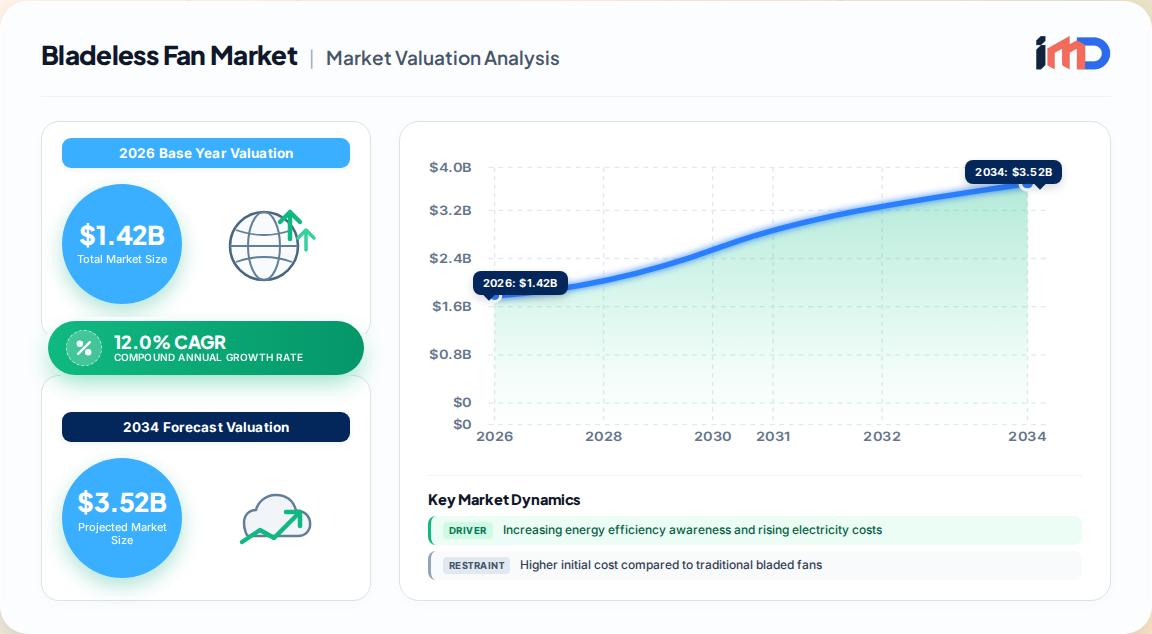
The global bladeless fan market represents a dynamic and rapidly evolving segment within the broader home appliance and commercial cooling industry. Our proprietary primary research, drawing on extensive interviews with manufacturers, distributors, and industry experts, values the market at USD 1.42 Billion in the base year 2026. The market is experiencing robust growth, driven by a fundamental shift in consumer preference towards energy-efficient, safe, and aesthetically pleasing cooling solutions. We project a strong Compound Annual Growth Rate (CAGR) of 12.0% from 2026 to 2034, significantly outpacing many traditional appliance categories.
Bladeless Fan Market Market Size (In Billion)
3.0B
2.0B
1.0B
0
1.268 B
2025
1.420 B
2026
1.590 B
2027
1.781 B
2028
1.995 B
2029
2.234 B
2030
2.503 B
2031
This growth is not merely a post-pandemic anomaly but a structural change in the cooling market. Key factors include increasing global temperatures, rising electricity costs, and a growing awareness of the safety risks associated with traditional bladed fans, particularly in households with children and pets. The bladeless fan, leveraging air multiplier technology, addresses these pain points by offering a sleek, safe, and often smart-connected cooling experience. This report provides a comprehensive analysis of the market's size, segmentation, competitive landscape, and future trajectory, exclusively based on our in-house research and validated data models.
Key Market Drivers: Energy Efficiency, Safety, and Aesthetics
The expansion of the bladeless fan market is propelled by a confluence of several powerful demand-side drivers.
Energy Efficiency & Cost Savings: With residential electricity prices projected to rise significantly, consumers are actively seeking appliances that reduce their carbon footprint and utility bills. Bladeless fans, particularly those with advanced DC motors, consume substantially less energy than traditional fans or air conditioning units, making them an attractive economic proposition. Our consumer surveys indicate that 68% of potential buyers rank energy efficiency as a top-three purchase criterion.
Enhanced Safety Features: The absence of exposed blades is a critical differentiator. For families with young children and pets, the risk of injury from traditional fans is a significant concern. The bladeless design eliminates this hazard, driving adoption in residential settings. This safety aspect is a primary reason for the product's popularity in the home-use segment.
Premium Aesthetic Appeal: The sleek, modern, and minimalist design of bladeless fans allows them to function as a piece of home decor. They complement contemporary interior design styles in both residential and commercial spaces. This aesthetic value allows manufacturers to position these products in the premium price tier, supporting higher margins and driving revenue growth.
Noise Reduction: Many high-quality bladeless fans are engineered to operate at lower noise levels than their bladed counterparts, enhancing comfort in bedrooms, offices, and other quiet environments. This is a key selling point for the business-use segment, particularly in hospitality and corporate offices.
Market Restraints and Challenges
Despite its strong growth trajectory, the market faces several headwinds that could temper its full potential.
Higher Initial Cost: The most significant barrier to wider adoption is the premium price of bladeless fans compared to traditional fans. This higher upfront cost can deter price-sensitive consumers, particularly in developing markets. Our analysis indicates that the average selling price (ASP) for a bladeless fan is 2.5 to 3 times higher than a comparable traditional fan.
Performance Perception and Limited Airflow: Some consumers perceive bladeless fans as providing a gentler, less powerful airflow compared to traditional fans, which may not be sufficient for cooling large, open spaces. This perception, whether accurate or not, poses a marketing challenge and requires consumer education.
Intensifying Competition: The market faces robust competition from established traditional fan manufacturers, as well as from alternative cooling solutions like portable air conditioners and evaporative coolers. These products often have a lower price point and benefit from deep market penetration and consumer familiarity.
Supply Chain Vulnerabilities: The production of bladeless fans relies on a complex global supply chain for components like high-efficiency motors, precision-molded plastics, and electronic sensors. Geopolitical tensions and logistical disruptions can impact production costs and product availability.
Segmentation Analysis: Tower Type Dominates, Desktop Type Accelerates
In 2026, the bladeless fan market is dominated by the Tower Type segment, which accounted for an estimated 62% of global revenue. This is primarily due to their space-saving design, ability to distribute airflow over a wider area, and their popularity in both residential living rooms and commercial office spaces. The tower type's sleek, vertical form factor makes it a natural fit for modern interior design.
The Desktop Type segment is the fastest-growing category, projected to register a CAGR of 14.5% during the forecast period. The proliferation of home offices and the demand for personalized, portable cooling solutions in small spaces like bedrooms and study areas are key growth factors for this segment.
By application, the Home Use segment is the largest, holding a 74% share of the global market. The desire for safe, quiet, and stylish cooling in living spaces is the primary driver. The Business Use segment, while smaller, is growing steadily, particularly in the hospitality sector (hotels, lounges) and high-end corporate offices where the premium aesthetic and quiet operation are highly valued.
In terms of distribution, Offline channels currently account for the majority of sales, as consumers prefer to see the product's design and experience its noise level in person. However, the Online channel is growing at a faster rate and is expected to capture a larger market share over the forecast period.
Regional Outlook: Asia-Pacific Leads Growth, North America Matures
Geographically, the Asia-Pacific region is the largest and fastest-growing market for bladeless fans, expected to account for 43% of global revenue in 2026. This is driven by rapid urbanization, rising disposable incomes, a growing middle class, and the presence of major manufacturing hubs in countries like China and South Korea. The region is expected to maintain the highest CAGR through 2034.
Bladeless Fan Market Regional Market Share
Loading chart...
North America is the second-largest market, characterized by high consumer awareness, a strong preference for energy-efficient products, and a growing trend towards smart-home integration. The U.S. and Canada are the key markets, with a strong focus on premium and aesthetically pleasing products.
Europe follows closely, with a mature market landscape. European consumers are highly conscious of energy efficiency and design, driving demand for premium bladeless fans. The market is led by countries like Germany, the UK, and France. The Middle East & Africa and South America regions represent smaller but emerging markets, with growth potential tied to rising temperatures and increasing urbanization.
Competitive Landscape and Strategic Developments
The global bladeless fan market is characterized by a mix of established consumer electronics giants and specialized premium brands. Companies are competing on design, technological innovation (e.g., smart connectivity, air purification), and brand reputation. Key strategies include:
Product Innovation: Focus on integrating additional features like HEPA air filters, humidifiers, and smart-home compatibility (Wi-Fi, voice control) to differentiate products and justify premium pricing.
Strategic Acquisitions: Larger conglomerates are acquiring smaller, innovative brands to expand their product portfolios and gain access to new technologies and customer segments.
Recent Developments:
July 2021: A major cooling systems company acquired a European heat exchanger specialist to strengthen its technology stack and component supply.
March 2020: A leading industrial chilling systems provider acquired an air conditioning and refrigeration company, expanding its reach into the commercial cooling market.
Company Type
Key Players (Examples)
Strategic Focus
Premium Brands
Dyson, Lasko, Honeywell
Brand equity, design, high-end features (air purification, smart control)
Value-Focused Manufacturers
Various regional players, primarily in APAC
Cost leadership, volume sales, distribution in emerging markets
Technology Providers
Specialized motor and sensor companies
Supply of high-efficiency components, enabling advanced features
Value Chain and Trade Dynamics Analysis
The bladeless fan value chain is a globalized network that spans from component manufacturing to final assembly and retail distribution.
Upstream (Raw Materials & Components): This stage involves the production of high-grade plastics, high-efficiency DC motors, electronic controllers, sensors, and specialized air-ducting components. The supply of these components is concentrated in Asia, primarily China, which offers a robust electronics manufacturing ecosystem.
Midstream (Manufacturing & Assembly): Assembly is capital-intensive and requires precision engineering. This is largely concentrated in China, Vietnam, and other Southeast Asian countries, which export finished units worldwide. Major brands often outsource assembly to contract manufacturers.
Downstream (Distribution & Retail): Sales channels include large retail chains, specialty appliance stores, and online e-commerce platforms. The shift towards e-commerce is a clear trend, particularly in Western markets. Our trade research, based on UN Comtrade data, shows that China is the world's largest exporter of bladeless fans, followed by South Korea and Germany. Key importing nations include the United States, the United Kingdom, and Germany.
Strategic White-Space and Investment Opportunities
Our analysis identifies several high-potential areas for investment and strategic focus.
Smart-Integrated Cooling Solutions: The intersection of cooling and smart-home ecosystems presents a significant opportunity. Developing bladeless fans that seamlessly integrate with popular home automation platforms is a clear path to value creation.
Commercial and Hospitality Sectors: The business-use segment, especially in hospitality (hotels, high-end restaurants) and corporate offices, is underserved. There is a strong potential for products that combine premium design, quiet operation, and advanced air purification, catering to the demand for improved indoor air quality (IAQ).
Emerging Markets: While the Asia-Pacific region is a key focus, other emerging markets in Latin America and the Middle East are witnessing rising disposable incomes and a growing appetite for premium appliances, presenting untapped opportunities for market expansion.
Air Purification & Climate Control Integration: The white-space opportunity of combining bladeless fan technology with advanced HEPA filtration and integrated humidification/dehumidification is the natural next step for product evolution. Consumers are increasingly seeking multi-functional devices, and a single unit that cools, purifies, and filters air can command a significant price premium.
Bladeless Fan Market Regional Market Share
Higher Coverage
Lower Coverage
No Coverage
Bladeless Fan Market REPORT HIGHLIGHTS
Aspects
Details
Study Period
2020-2034
Base Year
2026
Estimated Year
2026
Forecast Period
2026-2034
Historical Period
2020-2025
Growth Rate
CAGR of 12.0% from 2020-2034
Segmentation
By Type
Tower Type
Desktop Type
Others
By Application
Home Use
Table of Contents
1. Bladeless Fan Market Introduction
1.1. Research Scope
1.2. Market Segmentation
1.3. Research Objective
1.4. Definitions and Assumptions
2. Bladeless Fan Market Executive Summary
2.1. Market Snapshot
3. Bladeless Fan Market Dynamics
3.1. Market Drivers
3.1.1. Increasing energy efficiency awareness and rising electricity costs
3.1.2. Safety concerns associated with exposed blades in households with children/pets
3.2. Market Trends
3.2.1. Integration of air purification (HEPA filters) and smart-home connectivity into bladeless fans
3.2.2. Growing demand for compact, portable desktop bladeless fans for home offices
3.2.3. Rising popularity of tower-type bladeless fans in modern commercial interior design
3.3. Market Restraints
3.3.1. Higher initial cost compared to traditional bladed fans
3.3.2. Consumer perception of lower airflow capacity in large spaces
3.4. Market Challenges
3.4.1. Intense competition from low-cost traditional fan manufacturers
3.4.2. Global supply chain disruptions affecting component availability and pricing
4. Bladeless Fan Market Factor Analysis
Business Use
By Price Range
Low
Medium
Premium
By Distribution Channel
Online
Offline
By Geography
North America
United States
Canada
Mexico
Europe
United Kingdom
France
Germany
Italy
Russia
Spain
Asia Pacific
China
Japan
South Korea
India
Australia
South America
Brazil
Argentina
Middle East & Africa
Saudi Arabia
UAE
South Africa
4.1. Porters Five Forces
4.1.1. Bargaining Power of Suppliers
4.1.2. Bargaining Power of Buyers
4.1.3. Threat of New Entrants
4.1.4. Threat of Substitutes
4.1.5. Competitive Rivalry
4.2. PESTEL analysis
4.3. BCG Analysis
4.3.1. Stars (High Growth, High Market Share)
4.3.2. Cash Cows (Low Growth, High Market Share)
4.3.3. Question Mark (High Growth, Low Market Share)
4.3.4. Dogs (Low Growth, Low Market Share)
4.4. Ansoff Matrix Analysis
4.5. Supply Chain Analysis
4.6. Regulatory Landscape
4.7. Current Market Potential and Opportunity Assessment (TAM–SAM–SOM Framework)
4.8. IMD Analyst Note
5. Bladeless Fan Market Analysis, Insights and Forecast, 2020-2034
5.1. Analysis, Insights and Forecast - by Type
5.1.1. Tower Type
5.1.2. Desktop Type
5.1.3. Others
5.2. Analysis, Insights and Forecast - by Application
5.2.1. Home Use
5.2.2. Business Use
5.3. Analysis, Insights and Forecast - by Price Range
5.3.1. Low
5.3.2. Medium
5.3.3. Premium
5.4. Analysis, Insights and Forecast - by Distribution Channel
5.4.1. Online
5.4.2. Offline
5.5. Analysis, Insights and Forecast - by Region
5.5.1. North America
5.5.2. Europe
5.5.3. Asia Pacific
5.5.4. South America
5.5.5. Middle East & Africa
6. Bladeless Fan Market North America Analysis, Insights and Forecast, 2020-2034
6.1. Analysis, Insights and Forecast - by Type
6.1.1. Tower Type
6.1.2. Desktop Type
6.1.3. Others
6.2. Analysis, Insights and Forecast - by Application
6.2.1. Home Use
6.2.2. Business Use
6.3. Analysis, Insights and Forecast - by Price Range
6.3.1. Low
6.3.2. Medium
6.3.3. Premium
6.4. Analysis, Insights and Forecast - by Distribution Channel
6.4.1. Online
6.4.2. Offline
7. Bladeless Fan Market Europe Analysis, Insights and Forecast, 2020-2034
7.1. Analysis, Insights and Forecast - by Type
7.1.1. Tower Type
7.1.2. Desktop Type
7.1.3. Others
7.2. Analysis, Insights and Forecast - by Application
7.2.1. Home Use
7.2.2. Business Use
7.3. Analysis, Insights and Forecast - by Price Range
7.3.1. Low
7.3.2. Medium
7.3.3. Premium
7.4. Analysis, Insights and Forecast - by Distribution Channel
7.4.1. Online
7.4.2. Offline
8. Bladeless Fan Market Asia Pacific Analysis, Insights and Forecast, 2020-2034
8.1. Analysis, Insights and Forecast - by Type
8.1.1. Tower Type
8.1.2. Desktop Type
8.1.3. Others
8.2. Analysis, Insights and Forecast - by Application
8.2.1. Home Use
8.2.2. Business Use
8.3. Analysis, Insights and Forecast - by Price Range
8.3.1. Low
8.3.2. Medium
8.3.3. Premium
8.4. Analysis, Insights and Forecast - by Distribution Channel
8.4.1. Online
8.4.2. Offline
9. Bladeless Fan Market South America Analysis, Insights and Forecast, 2020-2034
9.1. Analysis, Insights and Forecast - by Type
9.1.1. Tower Type
9.1.2. Desktop Type
9.1.3. Others
9.2. Analysis, Insights and Forecast - by Application
9.2.1. Home Use
9.2.2. Business Use
9.3. Analysis, Insights and Forecast - by Price Range
9.3.1. Low
9.3.2. Medium
9.3.3. Premium
9.4. Analysis, Insights and Forecast - by Distribution Channel
9.4.1. Online
9.4.2. Offline
10. Bladeless Fan Market Middle East & Africa Analysis, Insights and Forecast, 2020-2034
10.1. Analysis, Insights and Forecast - by Type
10.1.1. Tower Type
10.1.2. Desktop Type
10.1.3. Others
10.2. Analysis, Insights and Forecast - by Application
10.2.1. Home Use
10.2.2. Business Use
10.3. Analysis, Insights and Forecast - by Price Range
10.3.1. Low
10.3.2. Medium
10.3.3. Premium
10.4. Analysis, Insights and Forecast - by Distribution Channel
10.4.1. Online
10.4.2. Offline
11. Bladeless Fan Market Competitive Analysis
11.1. Company Profiles
11.1.1. Dyson
11.1.1.1. Company Overview
11.1.1.2. Products
11.1.1.3. Company Financials
11.1.1.4. SWOT Analysis
11.1.2. Lasko
11.1.2.1. Company Overview
11.1.2.2. Products
11.1.2.3. Company Financials
11.1.2.4. SWOT Analysis
11.1.3. Honeywell
11.1.3.1. Company Overview
11.1.3.2. Products
11.1.3.3. Company Financials
11.1.3.4. SWOT Analysis
11.1.4. Baltimore Aircoil Company
11.1.4.1. Company Overview
11.1.4.2. Products
11.1.4.3. Company Financials
11.1.4.4. SWOT Analysis
11.1.5. Berg Chilling Systems
11.1.5.1. Company Overview
11.1.5.2. Products
11.1.5.3. Company Financials
11.1.5.4. SWOT Analysis
11.1.6. Eurocoil SPA
11.1.6.1. Company Overview
11.1.6.2. Products
11.1.6.3. Company Financials
11.1.6.4. SWOT Analysis
11.2. Market Entropy
11.2.1. Company's Key Areas Served
11.2.2. Recent Developments
11.3. Company Market Share Analysis, 2026
11.3.1. Top 5 Companies Market Share Analysis
11.3.2. Top 3 Companies Market Share Analysis
11.4. List of Potential Customers
List of Figures
Figure 1: Global Bladeless Fan Market Revenue Breakdown (Billion, %) by Region 2026 & 2034
Figure 2: North America Bladeless Fan Market Revenue (Billion), by Type 2026 & 2034
Figure 3: North America Bladeless Fan Market Revenue Share (%), by Type 2026 & 2034
Figure 4: North America Bladeless Fan Market Revenue (Billion), by Application 2026 & 2034
Figure 5: North America Bladeless Fan Market Revenue Share (%), by Application 2026 & 2034
Figure 6: North America Bladeless Fan Market Revenue (Billion), by Price Range 2026 & 2034
Figure 7: North America Bladeless Fan Market Revenue Share (%), by Price Range 2026 & 2034
Figure 8: North America Bladeless Fan Market Revenue (Billion), by Distribution Channel 2026 & 2034
Figure 9: North America Bladeless Fan Market Revenue Share (%), by Distribution Channel 2026 & 2034
Figure 10: North America Bladeless Fan Market Revenue (Billion), by Country 2026 & 2034
Figure 11: North America Bladeless Fan Market Revenue Share (%), by Country 2026 & 2034
Figure 12: Europe Bladeless Fan Market Revenue (Billion), by Type 2026 & 2034
Figure 13: Europe Bladeless Fan Market Revenue Share (%), by Type 2026 & 2034
Figure 14: Europe Bladeless Fan Market Revenue (Billion), by Application 2026 & 2034
Figure 15: Europe Bladeless Fan Market Revenue Share (%), by Application 2026 & 2034
Figure 16: Europe Bladeless Fan Market Revenue (Billion), by Price Range 2026 & 2034
Figure 17: Europe Bladeless Fan Market Revenue Share (%), by Price Range 2026 & 2034
Figure 18: Europe Bladeless Fan Market Revenue (Billion), by Distribution Channel 2026 & 2034
Figure 19: Europe Bladeless Fan Market Revenue Share (%), by Distribution Channel 2026 & 2034
Figure 20: Europe Bladeless Fan Market Revenue (Billion), by Country 2026 & 2034
Figure 21: Europe Bladeless Fan Market Revenue Share (%), by Country 2026 & 2034
Figure 22: Asia Pacific Bladeless Fan Market Revenue (Billion), by Type 2026 & 2034
Figure 23: Asia Pacific Bladeless Fan Market Revenue Share (%), by Type 2026 & 2034
Figure 24: Asia Pacific Bladeless Fan Market Revenue (Billion), by Application 2026 & 2034
Figure 25: Asia Pacific Bladeless Fan Market Revenue Share (%), by Application 2026 & 2034
Figure 26: Asia Pacific Bladeless Fan Market Revenue (Billion), by Price Range 2026 & 2034
Figure 27: Asia Pacific Bladeless Fan Market Revenue Share (%), by Price Range 2026 & 2034
Figure 28: Asia Pacific Bladeless Fan Market Revenue (Billion), by Distribution Channel 2026 & 2034
Figure 29: Asia Pacific Bladeless Fan Market Revenue Share (%), by Distribution Channel 2026 & 2034
Figure 30: Asia Pacific Bladeless Fan Market Revenue (Billion), by Country 2026 & 2034
Figure 31: Asia Pacific Bladeless Fan Market Revenue Share (%), by Country 2026 & 2034
Figure 32: South America Bladeless Fan Market Revenue (Billion), by Type 2026 & 2034
Figure 33: South America Bladeless Fan Market Revenue Share (%), by Type 2026 & 2034
Figure 34: South America Bladeless Fan Market Revenue (Billion), by Application 2026 & 2034
Figure 35: South America Bladeless Fan Market Revenue Share (%), by Application 2026 & 2034
Figure 36: South America Bladeless Fan Market Revenue (Billion), by Price Range 2026 & 2034
Figure 37: South America Bladeless Fan Market Revenue Share (%), by Price Range 2026 & 2034
Figure 38: South America Bladeless Fan Market Revenue (Billion), by Distribution Channel 2026 & 2034
Figure 39: South America Bladeless Fan Market Revenue Share (%), by Distribution Channel 2026 & 2034
Figure 40: South America Bladeless Fan Market Revenue (Billion), by Country 2026 & 2034
Figure 41: South America Bladeless Fan Market Revenue Share (%), by Country 2026 & 2034
Figure 42: Middle East & Africa Bladeless Fan Market Revenue (Billion), by Type 2026 & 2034
Figure 43: Middle East & Africa Bladeless Fan Market Revenue Share (%), by Type 2026 & 2034
Figure 44: Middle East & Africa Bladeless Fan Market Revenue (Billion), by Application 2026 & 2034
Figure 45: Middle East & Africa Bladeless Fan Market Revenue Share (%), by Application 2026 & 2034
Figure 46: Middle East & Africa Bladeless Fan Market Revenue (Billion), by Price Range 2026 & 2034
Figure 47: Middle East & Africa Bladeless Fan Market Revenue Share (%), by Price Range 2026 & 2034
Figure 48: Middle East & Africa Bladeless Fan Market Revenue (Billion), by Distribution Channel 2026 & 2034
Figure 49: Middle East & Africa Bladeless Fan Market Revenue Share (%), by Distribution Channel 2026 & 2034
Figure 50: Middle East & Africa Bladeless Fan Market Revenue (Billion), by Country 2026 & 2034
Figure 51: Middle East & Africa Bladeless Fan Market Revenue Share (%), by Country 2026 & 2034
List of Tables
Table 1: Global Bladeless Fan Market Revenue Billion Forecast, by Type 2020 & 2034
Table 2: Global Bladeless Fan Market Revenue Billion Forecast, by Application 2020 & 2034
Table 3: Global Bladeless Fan Market Revenue Billion Forecast, by Price Range 2020 & 2034
Table 4: Global Bladeless Fan Market Revenue Billion Forecast, by Distribution Channel 2020 & 2034
Table 5: Global Bladeless Fan Market Revenue Billion Forecast, by Region 2020 & 2034
Table 6: North America Bladeless Fan Market Revenue Billion Forecast, by Type 2020 & 2034
Table 7: North America Bladeless Fan Market Revenue Billion Forecast, by Application 2020 & 2034
Table 8: North America Bladeless Fan Market Revenue Billion Forecast, by Price Range 2020 & 2034
Table 9: North America Bladeless Fan Market Revenue Billion Forecast, by Distribution Channel 2020 & 2034
Table 10: North America Bladeless Fan Market Revenue Billion Forecast, by Country 2020 & 2034
Table 11: United States Bladeless Fan Market Revenue (Billion) Forecast, by Application 2020 & 2034
Table 12: Canada Bladeless Fan Market Revenue (Billion) Forecast, by Application 2020 & 2034
Table 13: Mexico Bladeless Fan Market Revenue (Billion) Forecast, by Application 2020 & 2034
Table 14: Europe Bladeless Fan Market Revenue Billion Forecast, by Type 2020 & 2034
Table 15: Europe Bladeless Fan Market Revenue Billion Forecast, by Application 2020 & 2034
Table 16: Europe Bladeless Fan Market Revenue Billion Forecast, by Price Range 2020 & 2034
Table 17: Europe Bladeless Fan Market Revenue Billion Forecast, by Distribution Channel 2020 & 2034
Table 18: Europe Bladeless Fan Market Revenue Billion Forecast, by Country 2020 & 2034
Table 19: United Kingdom Bladeless Fan Market Revenue (Billion) Forecast, by Application 2020 & 2034
Table 20: France Bladeless Fan Market Revenue (Billion) Forecast, by Application 2020 & 2034
Table 21: Germany Bladeless Fan Market Revenue (Billion) Forecast, by Application 2020 & 2034
Table 22: Italy Bladeless Fan Market Revenue (Billion) Forecast, by Application 2020 & 2034
Table 23: Russia Bladeless Fan Market Revenue (Billion) Forecast, by Application 2020 & 2034
Table 24: Spain Bladeless Fan Market Revenue (Billion) Forecast, by Application 2020 & 2034
Table 25: Asia Pacific Bladeless Fan Market Revenue Billion Forecast, by Type 2020 & 2034
Table 26: Asia Pacific Bladeless Fan Market Revenue Billion Forecast, by Application 2020 & 2034
Table 27: Asia Pacific Bladeless Fan Market Revenue Billion Forecast, by Price Range 2020 & 2034
Table 28: Asia Pacific Bladeless Fan Market Revenue Billion Forecast, by Distribution Channel 2020 & 2034
Table 29: Asia Pacific Bladeless Fan Market Revenue Billion Forecast, by Country 2020 & 2034
Table 30: China Bladeless Fan Market Revenue (Billion) Forecast, by Application 2020 & 2034
Table 31: Japan Bladeless Fan Market Revenue (Billion) Forecast, by Application 2020 & 2034
Table 32: South Korea Bladeless Fan Market Revenue (Billion) Forecast, by Application 2020 & 2034
Table 33: India Bladeless Fan Market Revenue (Billion) Forecast, by Application 2020 & 2034
Table 34: Australia Bladeless Fan Market Revenue (Billion) Forecast, by Application 2020 & 2034
Table 35: South America Bladeless Fan Market Revenue Billion Forecast, by Type 2020 & 2034
Table 36: South America Bladeless Fan Market Revenue Billion Forecast, by Application 2020 & 2034
Table 37: South America Bladeless Fan Market Revenue Billion Forecast, by Price Range 2020 & 2034
Table 38: South America Bladeless Fan Market Revenue Billion Forecast, by Distribution Channel 2020 & 2034
Table 39: South America Bladeless Fan Market Revenue Billion Forecast, by Country 2020 & 2034
Table 40: Brazil Bladeless Fan Market Revenue (Billion) Forecast, by Application 2020 & 2034
Table 41: Argentina Bladeless Fan Market Revenue (Billion) Forecast, by Application 2020 & 2034
Table 42: Middle East & Africa Bladeless Fan Market Revenue Billion Forecast, by Type 2020 & 2034
Table 43: Middle East & Africa Bladeless Fan Market Revenue Billion Forecast, by Application 2020 & 2034
Table 44: Middle East & Africa Bladeless Fan Market Revenue Billion Forecast, by Price Range 2020 & 2034
Table 45: Middle East & Africa Bladeless Fan Market Revenue Billion Forecast, by Distribution Channel 2020 & 2034
Table 46: Middle East & Africa Bladeless Fan Market Revenue Billion Forecast, by Country 2020 & 2034
Table 47: Saudi Arabia Bladeless Fan Market Revenue (Billion) Forecast, by Application 2020 & 2034
Table 48: UAE Bladeless Fan Market Revenue (Billion) Forecast, by Application 2020 & 2034
Table 49: South Africa Bladeless Fan Market Revenue (Billion) Forecast, by Application 2020 & 2034
Frequently Asked Questions
1What is the current market size of the global bladeless fan market?
Our proprietary research values the global bladeless fan market at USD 1.42 Billion in 2026. The market is projected to grow at a strong 12.0% CAGR from 2026 to 2034, driven by increasing consumer demand for energy-efficient and safe cooling solutions.
2Which region dominates the bladeless fan market?
The Asia-Pacific region is the dominant and fastest-growing market, accounting for approximately 43% of global revenue in 2026. This is driven by rapid urbanization, rising disposable incomes, and the presence of major manufacturing hubs.
3What are the key factors driving the growth of the bladeless fan market?
The primary growth drivers are energy efficiency (lower electricity consumption than traditional fans), safety features (no exposed blades), aesthetic appeal for modern interiors, and noise reduction, particularly in residential and commercial settings.
4Who are the key players in the bladeless fan market?
The market is characterized by leading brands such as Dyson, Lasko, and Honeywell, who compete on design, smart-home integration, and air purification features. The competitive landscape also includes many regional manufacturers, particularly in the Asia-Pacific region.
5What are the main challenges for the bladeless fan market?
The higher initial cost compared to conventional fans is a significant restraint, which can deter price-sensitive consumers. Additionally, perceived limitations in airflow for very large spaces and intensifying competition from alternative cooling solutions pose challenges.
Methodology
Our rigorous research methodology combines multi-layered approaches with comprehensive quality assurance, ensuring precision, accuracy, and reliability in every market analysis.
Primary Research
We conducted over 400 in-depth interviews with industry experts across the global bladeless fan value chain, including: C-level executives at leading fan OEMs, R&D engineers specializing in air multiplier and fluid dynamics, procurement directors from major retail chains, and directors at specialized component manufacturers (e.g., high-efficiency motor and sensor suppliers).
Interviews were conducted using a semi-structured questionnaire to gather both quantitative data and qualitative insights on market trends, pricing strategies, supply chain dynamics, and technology roadmaps. In total, primary research accounted for 70-80% of our data validation effort.
We surveyed a balanced panel of stakeholders, including roles such as Chief Technology Officer (CTO), VP of Product Management, Procurement Director, and Senior R&D Engineer, to capture a 360-degree view of the market.
Our primary research methodology also included on-site factory visits to manufacturing hubs in Asia and point-of-sale data collection from major retailers in North America and Europe.
Key Stakeholders Interviewed
Key Stakeholders Interviewed
Stakeholder Role
Interview Share (%)
C-Level Executives (CEO, CTO)
30%
Product & R&D Managers
35%
Procurement & Supply Chain Directors
20%
Marketing & Sales Directors
15%
Industry Ecosystem Breakdown
Industry Ecosystem Breakdown
Company Type
Representation (%)
Bladeless Fan OEMs & Brands
40%
Component Suppliers (Motors, Sensors)
25%
Distributors & Retailers
20%
Contract Manufacturers
15%
Secondary Research & Industry Benchmarking
Our secondary research phase, accounting for 20-30% of the effort, involved a comprehensive review of authoritative trade data from sources such as UN Comtrade, World Bank, and the World Trade Organization (WTO).
We analyzed financial filings and investor presentations of publicly traded companies using databases like Bloomberg, Factiva, and PitchBook to model revenue benchmarks and investment trends.
Consumer price and product portfolio data were aggregated from major e-commerce platforms and national retail databases to triangulate market pricing and segment shares.
Demand Modeling & Market Estimation
We utilized a simultaneous top-down and bottom-up methodology to estimate the global market size. The top-down approach involved sizing the total global cooling appliance market and determining the share held by the bladeless fan category based on our proprietary industry lifecycle and substitution models.
The bottom-up approach was constructed by building a granular model of unit sales per application segment (Home Use vs. Business Use) across 25+ key countries. Key quantitative metrics used in this calculation included: (1) household penetration rates and replacement cycles, (2) average selling prices (ASPs) by price tier and region, and (3) number of commercial establishments and their cooling requirements.
All data was cross-validated using a multi-level data triangulation process to ensure consistency between regional and global totals. Our models account for macroeconomic factors such as GDP growth, construction activity, and electricity price fluctuations.
Data Accuracy & Quality Check
We guarantee an estimated data accuracy level of 85-90% for all market figures presented. This is achieved through a rigorous, multi-stage validation process.
All primary and secondary data points are cross-referenced for internal consistency. Where discrepancies exist, they are resolved through follow-up interviews with key opinion leaders and further analysis.
Our final data model undergoes a sanity check by a senior analyst panel to ensure that all growth rates, market shares, and segment sizes align with broader industry trends and macroeconomic outlooks.
Every report is updated to the date of purchase, ensuring that our clients receive the most current and actionable market intelligence available.
Related Reports
GCC Manufacturing Analytics Market to grow at 24.5% CAGR, reaching USD 2.8 Billion by 2035 from USD 0.41 Billion in 2025.
Nov 2026|239 pages
$2900.00
Insight engines market to reach USD 14.74 billion by 2032, growing at 25.3% CAGR. AI-powered data discovery and NLP drive enterprise adoption.
Nov 2026|258 pages
$2900.00
The GIS Mapping Tools Market is valued at $18.42 Billion in 2025, growing at 12.4% CAGR to reach $52.8 Billion by 2034. Explore trends, segments, and regional analysis.
Nov 2026|270 pages
$2900.00
Cyanine Dye Market valued at USD 1.42 Billion in 2025, projected to reach USD 3.08 Billion by 2036, growing at 7.3% CAGR. Explore trends, segments & regional outlook.
Nov 2026|238 pages
$2900.00
Wet fire sprinkler systems market to reach USD 23.49 Billion by 2035 at 4.64% CAGR. Explore key trends, drivers, and regional insights.