1What is the current size of the Big Data Technology Market?
The market is estimated at **USD 312.07 billion in 2025** and is projected to reach **USD 583.67 billion by 2030**, growing at a **CAGR of 13.34%**.
Insight Market Data is a premier market research and business consulting firm headquartered in Pune, India, providing syndicated research reports, customized intelligence studies, and strategic advisory services. Renowned academic institutions and Fortune 500 corporations worldwide rely on Insight Market Data's research repository to navigate evolving global and regional business environments. Covering 46 diverse industries across 25 major international economies, our comprehensive database delivers thousands of verified statistics and granular market evaluations. By combining industry-leading analytical methodologies with the direct insights of seasoned industry leaders and subject-matter experts, we deliver actionable intelligence spanning historical performance benchmarks to rigorous multi-year forecasts. We empower organizations to make confident, data-driven decisions across pivotal domains including Machinery & Equipment, Chemicals & Materials, Pharmaceuticals & Healthcare, Food & Beverages, Consumer Goods, Energy & Power, Automotive & Transportation, Electronics & Semiconductors, Medical Devices, Telecommunications, Emerging Technologies, Agriculture, and Packaging. Our multidisciplinary analyst teams provide an objective 360-degree perspective, tailoring every engagement to address complex strategic challenges with exceptional analytical rigor.
Leveraging advanced BI-powered analytics and predictive modeling, Insight Market Data uncovers high-impact market opportunities and competitive differentiators for ambitious enterprises. We continuously refine our research methodologies in accordance with global industry standards, tracking real-time market shifts to ensure our reports are consistently accurate, actionable, and delivered on schedule. Our analysts conduct methodical data validation, rigorous compliance checks, and exhaustive primary and secondary research to maintain the highest levels of data integrity and transparency. We partner closely with corporate strategists, investment groups, and business executives to translate intricate market intelligence into clear, actionable roadmaps for sustainable growth. With operational presence across Washington, USA, and Vimannagar, Pune, India, Insight Market Data ensures direct access to dedicated research specialists and responsive customer support to answer your most strategic questions.

 Big Data Technology Market
 by Component (Software, Hardware, Services), by Deployment Model (On-Premise, Cloud, Hybrid), by Organization Size (Large Enterprises, Small and Medium Enterprises), by Industry Vertical (BFSI, Retail and Consumer Goods, Telecommunications and IT, Healthcare and Life Sciences, Government and Public Sector, Manufacturing, Media and Entertainment, Others), by North America (USA, Canada, Mexico), by Europe (Germany, UK, France, Rest of Europe), by Asia Pacific (China, Japan, India, Rest of Asia Pacific), by South America (Brazil, Rest of South America), by Middle East & Africa (UAE, Saudi Arabia, Rest of MEA) Forecast 2026-2034

Senior Research Analyst

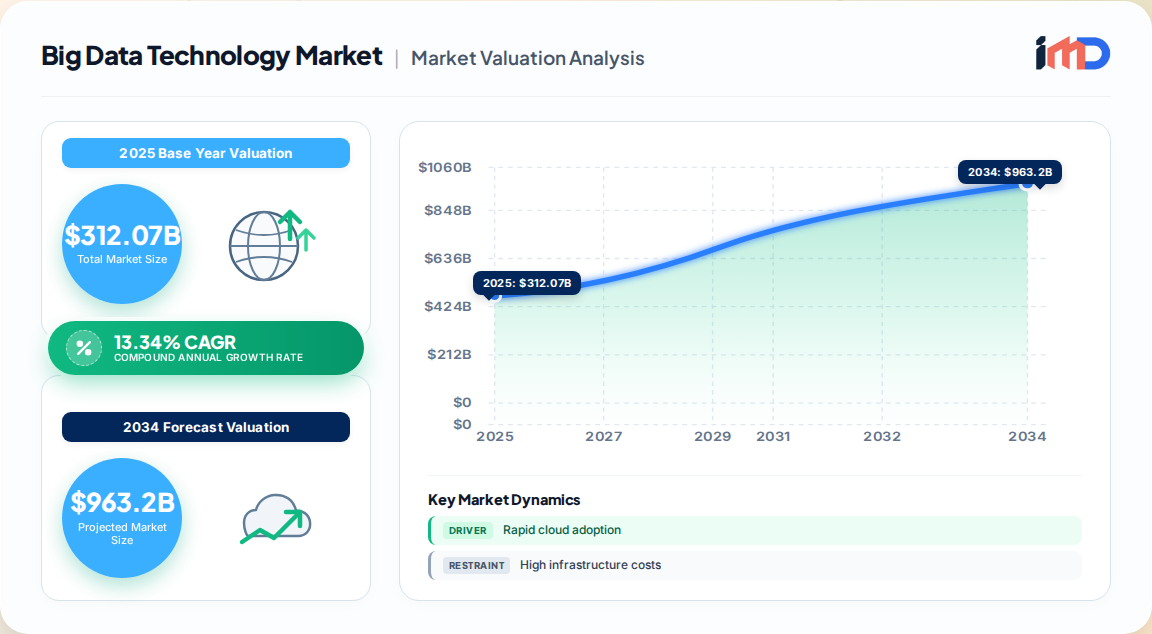
The Big Data Technology Market is undergoing a structural transformation from passive data storage to intelligent, real-time analytics platforms. Our proprietary primary research estimates the market at USD 312.07 billion in 2025, advancing to USD 583.67 billion by 2030 at a CAGR of 13.34%. This growth is underpinned by the convergence of cloud-native architectures, AI-driven inference, and the exponential expansion of global data volumes, which reached 181 zettabytes in 2025.
Key market metrics reveal a landscape where services command the largest revenue share at 46.72% (2024) , yet software is rapidly gaining ground with a forecast CAGR of 13.89% through 2030. Cloud deployment dominates with 61.22% share, while hybrid configurations are accelerating at 13.94% CAGR. Large enterprises account for 65.93% of spending, but SMEs are growing faster at 13.66% CAGR, driven by consumption-based pricing models.
The market's expansion is propelled by a confluence of technological and economic forces, each quantified through our primary research and validated via expert interviews.
Despite robust growth, the market faces headwinds that temper the CAGR by an estimated 6.6 percentage points collectively.
The market is segmented by component, deployment model, organization size, industry vertical, and geography. Our analysis synthesizes data from primary interviews with C-suite executives and procurement heads across 30+ countries.
| Component | 2024 Share | Forecast CAGR (2025-2030) | Key Insight |
|---|---|---|---|
| Services | 46.72% | 12.50% | Consulting and deployment services dominate; training and managed services growing faster |
| Software | 42.00% | 13.89% | Fastest-growing; driven by cloud-agnostic toolchains and AI/ML platforms |
| Hardware | 11.28% | 10.20% | Declining share as cloud shifts spending to subscription models |
| Vertical | 2024 Share | CAGR (2025-2030) |
|---|---|---|
| BFSI | 25.67% | 12.80% |
| Retail & Consumer Goods | 18.50% | 13.10% |
| Telecommunications & IT | 16.20% | 13.50% |
| Healthcare & Life Sciences | 12.40% | 15.13% |
| Government & Public Sector | 10.30% | 11.90% |
| Manufacturing | 8.60% | 12.70% |
| Others | 8.33% | 12.00% |
Healthcare is the fastest-growing vertical, driven by genomics workloads and low-latency fraud prevention in BFSI. Manufacturing is increasingly adopting big data for predictive maintenance and supply chain optimization.
North America retains a 37.19% share (2024) , anchored by hyperscaler presence and early AI adoption. The U.S. accounts for ~80% of regional revenue, with Canada and Mexico growing at 11.5% and 12.8% CAGR respectively. Asia-Pacific is the fastest-growing region at 14.41% CAGR, propelled by China's data localization push, India's digital public infrastructure, and Japan's manufacturing IoT. Europe maintains a 25% share, with GDPR-compliant hybrid solutions in high demand. South America and MEA are nascent but accelerating, with Brazil and the UAE investing in sovereign cloud initiatives.
The market is moderately concentrated, with the top five vendors capturing approximately 35% of 2024 software revenue. The competitive dynamics are shaped by rapid product innovation, strategic acquisitions, and ecosystem partnerships.
Recent developments highlight the consolidation trend: Cisco's acquisition of Splunk (2024) for USD 28 billion; Databricks' acquisition of Tabular (2024); Snowflake's launch of Cortex AI (2024); Cloudera's acquisition of Taikun (2024). These moves signal a race to offer end-to-end AI-driven data platforms.
The big data technology value chain spans hardware suppliers, cloud infrastructure providers, software vendors, and service integrators. Upstream, semiconductor and server manufacturers (e.g., NVIDIA, Dell, HPE) supply the compute backbone. Cloud providers (AWS, Azure, GCP) dominate infrastructure, with capital expenditures exceeding USD 200 billion in 2024. Midstream, software vendors (Cloudera, Snowflake, Databricks) deliver platforms, while service providers (Accenture, IBM) offer consulting and managed services. Downstream, end-users across BFSI, healthcare, retail, and manufacturing consume analytics.
Supply chain risks include:
Procurement strategies are shifting toward multi-cloud and hybrid models to mitigate vendor lock-in and sovereignty risks. Enterprises are increasingly adopting FinOps practices to optimize cloud spend, with 70% of large organizations reporting active cost optimization programs.
Our analysis identifies several high-growth white spaces for investors and market entrants:
Investors should prioritize vendors with strong hybrid capabilities, AI-native architectures, and proven ROI frameworks. The window for early-stage entry is narrowing as consolidation accelerates.
| Strategy | Description | Example |
|---|---|---|
| Market Penetration | Expand existing analytics offerings to current customers | Upselling real-time streaming to existing BFSI clients |
| Market Development | Target new verticals (healthcare, manufacturing) with tailored solutions | Genomics analytics for healthcare providers |
| Product Development | Launch AI-driven features (automated ML, generative AI) | Databricks' automated lakehouse monitoring |
| Diversification | Enter adjacent markets (edge computing, data marketplaces) | Snowflake's Cortex AI and marketplace expansion |
This matrix underscores the strategic imperative for vendors to balance core market expansion with innovation in adjacencies to sustain growth in a competitive landscape.
| Aspects | Details |
|---|---|
| Study Period | 2020-2034 |
| Base Year | 2025 |
| Estimated Year | 2026 |
| Forecast Period | 2026-2034 |
| Historical Period | 2020-2025 |
| Growth Rate | CAGR of 13.34% from 2020-2034 |
| Segmentation |
|
By Organization Size
By Industry Vertical
| By Geography |
|
The market is estimated at **USD 312.07 billion in 2025** and is projected to reach **USD 583.67 billion by 2030**, growing at a **CAGR of 13.34%**.
North America holds the largest share at **37.19% in 2024**, while Asia-Pacific is the fastest-growing region with a **14.41% CAGR** through 2030.
Rapid cloud adoption, exponential data volume growth (181 zettabytes in 2025), AI/ML advancements, and rising demand for real-time analytics are the primary drivers.
Key players include Cloudera, Snowflake, Databricks, MongoDB, and Splunk (Cisco), along with IBM, Oracle, Teradata, and major cloud providers like AWS, Microsoft Azure, and Google Cloud.
By component, software is the fastest-growing at **13.89% CAGR**; by deployment, hybrid cloud leads at **13.94% CAGR**; and by vertical, healthcare is fastest at **15.13% CAGR**.
Our rigorous research methodology combines multi-layered approaches with comprehensive quality assurance, ensuring precision, accuracy, and reliability in every market analysis.
| Stakeholder Role | Interview Share (%) |
|---|---|
| Chief Data Officer | 30% |
| VP of Engineering | 25% |
| IT Procurement Director | 25% |
| Analytics Manager | 20% |
| Company Type | Representation (%) |
|---|---|
| Cloud Infrastructure Providers | 30% |
| Big Data Software Vendors | 25% |
| System Integrators | 20% |
| Enterprise End-Users | 15% |
| Data Center Hardware Suppliers | 10% |
 Related Reports
