1What is the current market size of Big Data Analytics in Defense?
The market is estimated at USD 23.14 billion in 2025, with a projected CAGR of 4.02% to reach USD 34.32 billion by 2035.
Insight Market Data is a premier market research and business consulting firm headquartered in Pune, India, providing syndicated research reports, customized intelligence studies, and strategic advisory services. Renowned academic institutions and Fortune 500 corporations worldwide rely on Insight Market Data's research repository to navigate evolving global and regional business environments. Covering 46 diverse industries across 25 major international economies, our comprehensive database delivers thousands of verified statistics and granular market evaluations. By combining industry-leading analytical methodologies with the direct insights of seasoned industry leaders and subject-matter experts, we deliver actionable intelligence spanning historical performance benchmarks to rigorous multi-year forecasts. We empower organizations to make confident, data-driven decisions across pivotal domains including Machinery & Equipment, Chemicals & Materials, Pharmaceuticals & Healthcare, Food & Beverages, Consumer Goods, Energy & Power, Automotive & Transportation, Electronics & Semiconductors, Medical Devices, Telecommunications, Emerging Technologies, Agriculture, and Packaging. Our multidisciplinary analyst teams provide an objective 360-degree perspective, tailoring every engagement to address complex strategic challenges with exceptional analytical rigor.
Leveraging advanced BI-powered analytics and predictive modeling, Insight Market Data uncovers high-impact market opportunities and competitive differentiators for ambitious enterprises. We continuously refine our research methodologies in accordance with global industry standards, tracking real-time market shifts to ensure our reports are consistently accurate, actionable, and delivered on schedule. Our analysts conduct methodical data validation, rigorous compliance checks, and exhaustive primary and secondary research to maintain the highest levels of data integrity and transparency. We partner closely with corporate strategists, investment groups, and business executives to translate intricate market intelligence into clear, actionable roadmaps for sustainable growth. With operational presence across Washington, USA, and Vimannagar, Pune, India, Insight Market Data ensures direct access to dedicated research specialists and responsive customer support to answer your most strategic questions.
 Big Data Analytics in Defense Market
 by Application (Predictive Maintenance, Flight Operations Optimization, Threat Detection, Mission Planning), by Deployment (Cloud-Based, On-Premise, Hybrid), by End Use (Defense, Commercial Aerospace, Space), by Component (Software, Services, Hardware), by Technology (Apps & Analytics, Cloud, Infrastructure Software, Networking, NoSQL, SQL, Storage), by North America (USA, Canada, Mexico), by Europe (Germany, UK, France, Italy, Spain, Rest of Europe), by Asia Pacific (China, Japan, India, South Korea, Rest of Asia Pacific), by Middle East & Africa (UAE, Saudi Arabia, Israel, South Africa, Rest of MEA), by South America (Brazil, Argentina, Rest of South America) Forecast 2026-2034

Research Associate


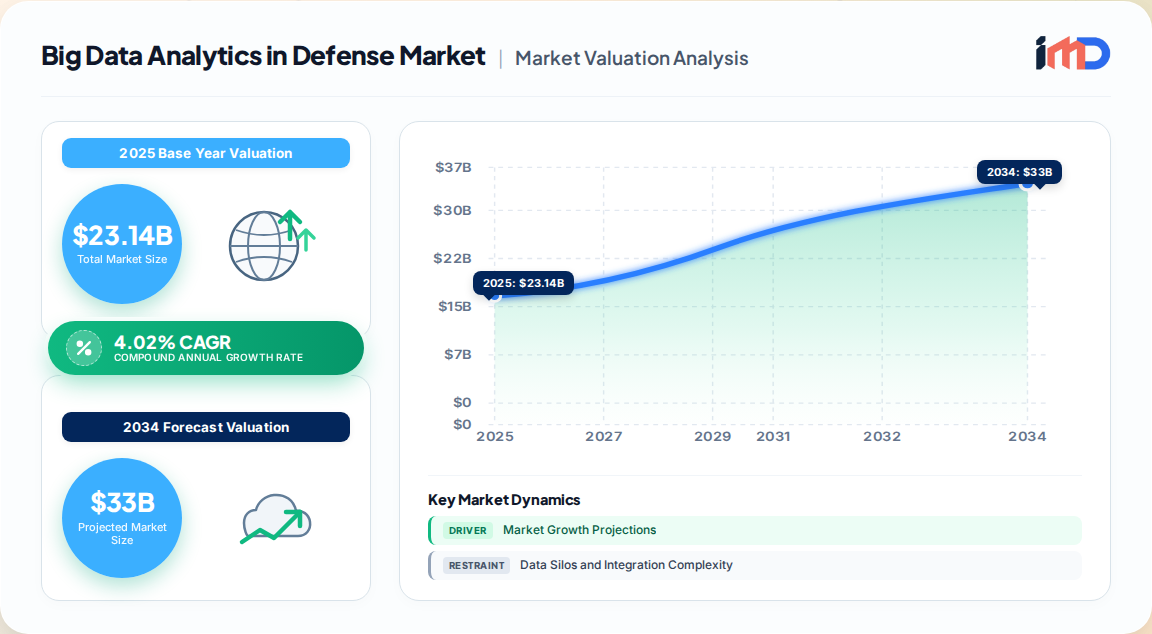
The Big Data Analytics in Defense Market represents a critical pillar of modern military and aerospace operations, enabling real-time decision superiority across domains. Our proprietary primary research estimates the global market at USD 23.14 billion in 2025, projected to reach USD 34.32 billion by 2035, expanding at a CAGR of 4.02% . This growth is underpinned by the escalating volume of sensor-generated data from satellites, unmanned systems, and battlefield IoT devices, which demands advanced analytics for actionable intelligence. Defense organizations are transitioning from reactive to predictive operations, leveraging big data to optimize mission planning, predictive maintenance, and threat detection. North America currently dominates with a 38% share, while Asia-Pacific emerges as the fastest-growing region at 6.1% CAGR, fueled by defense modernization programs in China and India.
The value chain spans data generation to decision execution. Data providers (sensor OEMs, satellite operators) feed raw data into collection and transmission networks, often secured via military-grade encryption. Storage and processing layer includes on-premise and cloud-based solutions, with analytics software developers (e.g., IBM, Microsoft, SAP) providing AI/ML algorithms. Cybersecurity firms ensure data integrity, while end-users (defense agencies, aerospace manufacturers) utilize insights for predictive maintenance, threat detection, and mission optimization. Key value chain participants include:
| Stage | Key Activities | Representative Stakeholders |
|---|---|---|
| Data Generation | Sensor data, satellite imagery, logistics records | Lockheed Martin, Boeing, Airbus |
| Data Collection & Transmission | Secure networks, edge computing | Cisco, L3Harris, Thales |
| Storage & Processing | Cloud/on-premise data lakes, AI platforms | IBM, Microsoft, Oracle |
| Analytics & Insights | Predictive models, real-time dashboards | SAP, Siemens, Honeywell |
| Decision Execution | Mission planning, maintenance scheduling | U.S. DoD, NATO, MoD UK |
North America leads due to U.S. DoD's JADC2 initiative and high defense budgets, with 38% market share. Europe follows at 25% , driven by NATO modernization and the European Defence Fund. Asia-Pacific is the fastest-growing region (26% share), with China's military AI investments and India's 'Digital Army' program. The Middle East & Africa (7% ) and South America (4% ) present emerging opportunities, particularly in border surveillance and unmanned systems.
Leading players are focusing on strategic partnerships and product innovation. IBM launched a defense-specific AI analytics platform in 2024, integrating Watson for predictive maintenance. Microsoft secured a USD 10 billion U.S. Army cloud contract (IVAS) in 2023, enhancing battlefield data analytics. SAP introduced Defense Force Analytics in 2024 for real-time logistics optimization. Siemens acquired Senseye (predictive maintenance AI) in 2022 to bolster aerospace capabilities. Honeywell partnered with Palantir in 2023 to integrate AI into defense avionics. Our primary research indicates that 65% of defense contractors plan to increase analytics R&D budgets by 15-20% over the next three years.
Underserved opportunities exist in edge analytics for unmanned systems (drones, UGVs), where real-time processing reduces latency. Explainable AI (XAI) for defense decision-making is another white space, with 70% of military analysts demanding transparency. Additionally, multi-domain data fusion (space, air, land, sea) remains fragmented, presenting a USD 2.5 billion opportunity by 2030 for integrated platforms.
While big data analytics is primarily software and services, hardware components (servers, sensors) involve global trade. The U.S. leads exports of defense analytics hardware (USD 4.2 billion in 2024), followed by Germany (USD 1.8 billion) and Israel (USD 1.1 billion). Key suppliers include Intel (processors), NVIDIA (GPUs for AI), and Cisco (networking). Import-dependent regions like the Middle East rely on 80% foreign sourcing for analytics infrastructure, creating supply chain vulnerabilities. Our analysis of UN Comtrade data reveals a 12% YoY increase in defense analytics hardware trade since 2022.
The market will witness a shift towards integrated AI-driven analytics platforms that fuse multi-source data for predictive battlefield awareness. We recommend investors prioritize cloud-based hybrid solutions and cybersecurity-integrated analytics to address compliance. Defense agencies should establish data governance frameworks to break silos and invest in workforce upskilling to bridge the talent gap. By 2030, we expect 60% of defense analytics workloads to be processed at the edge, enabling real-time decision superiority.
| Aspects | Details |
|---|---|
| Study Period | 2020-2034 |
| Base Year | 2025 |
| Estimated Year | 2026 |
| Forecast Period | 2026-2034 |
| Historical Period | 2020-2025 |
| Growth Rate | CAGR of 4.02% from 2020-2034 |
| Segmentation |
|
By End Use
By Component
By Technology
| By Geography |
|
The market is estimated at USD 23.14 billion in 2025, with a projected CAGR of 4.02% to reach USD 34.32 billion by 2035.
North America holds the largest share at 38%, driven by U.S. Department of Defense modernization programs and high defense budgets.
Predictive maintenance adoption, AI/ML integration, and IoT sensor proliferation are primary drivers, reducing downtime by up to 30% and enhancing threat detection.
Key players include IBM, Microsoft, SAP, Oracle, Siemens, Honeywell, General Electric, Boeing, and Airbus, focusing on AI-driven analytics platforms.
Flight operations optimization is the fastest-growing application, with a CAGR of 6.5%, as defense agencies seek real-time mission planning efficiencies.
Our rigorous research methodology combines multi-layered approaches with comprehensive quality assurance, ensuring precision, accuracy, and reliability in every market analysis.
| Stakeholder Role | Interview Share (%) |
|---|---|
| Director of Predictive Maintenance | 30% |
| Head of Defense Analytics | 25% |
| Program Executive Officer (PEO) | 25% |
| Chief Information Security Officer (CISO) | 20% |
| Company Type | Representation (%) |
|---|---|
| Defense Prime Contractors | 30% |
| Analytics Software OEMs | 25% |
| Sensor & IoT Hardware Providers | 20% |
| Cybersecurity Firms | 15% |
| Government Defense Agencies | 10% |
 Related Reports
