Insight Market Data is a premier market research and business consulting firm headquartered in Pune, India, providing syndicated research reports, customized intelligence studies, and strategic advisory services. Renowned academic institutions and Fortune 500 corporations worldwide rely on Insight Market Data's research repository to navigate evolving global and regional business environments. Covering 46 diverse industries across 25 major international economies, our comprehensive database delivers thousands of verified statistics and granular market evaluations. By combining industry-leading analytical methodologies with the direct insights of seasoned industry leaders and subject-matter experts, we deliver actionable intelligence spanning historical performance benchmarks to rigorous multi-year forecasts. We empower organizations to make confident, data-driven decisions across pivotal domains including Machinery & Equipment, Chemicals & Materials, Pharmaceuticals & Healthcare, Food & Beverages, Consumer Goods, Energy & Power, Automotive & Transportation, Electronics & Semiconductors, Medical Devices, Telecommunications, Emerging Technologies, Agriculture, and Packaging. Our multidisciplinary analyst teams provide an objective 360-degree perspective, tailoring every engagement to address complex strategic challenges with exceptional analytical rigor.
Leveraging advanced BI-powered analytics and predictive modeling, Insight Market Data uncovers high-impact market opportunities and competitive differentiators for ambitious enterprises. We continuously refine our research methodologies in accordance with global industry standards, tracking real-time market shifts to ensure our reports are consistently accurate, actionable, and delivered on schedule. Our analysts conduct methodical data validation, rigorous compliance checks, and exhaustive primary and secondary research to maintain the highest levels of data integrity and transparency. We partner closely with corporate strategists, investment groups, and business executives to translate intricate market intelligence into clear, actionable roadmaps for sustainable growth. With operational presence across Washington, USA, and Vimannagar, Pune, India, Insight Market Data ensures direct access to dedicated research specialists and responsive customer support to answer your most strategic questions.
Automotive Upholstery Market | Insight Market Data
Automotive Upholstery Market by Material Type (Leather, Vinyl, Plastics, Fabric(Woven, Non-Woven), Smart Fabrics, Synthetic Leather, Thermoplastic Polymers, Others), by Product Type (Seat Covers, Dashboard, Roof Liners, Door Trim, Floor Carpeting, Center Console Covers), by Vehicle Type (Passenger Cars, Commercial Vehicles, Electric Vehicles), by Sales Channel (OEM, Aftermarket), by Asia-Pacific (China, India, Japan, South Korea, ASEAN), by Europe (Germany, France, UK, Italy, Spain), by North America (USA, Canada, Mexico), by South America (Brazil, Argentina), by Middle East & Africa (UAE, Saudi Arabia, South Africa) Forecast 2026-2034
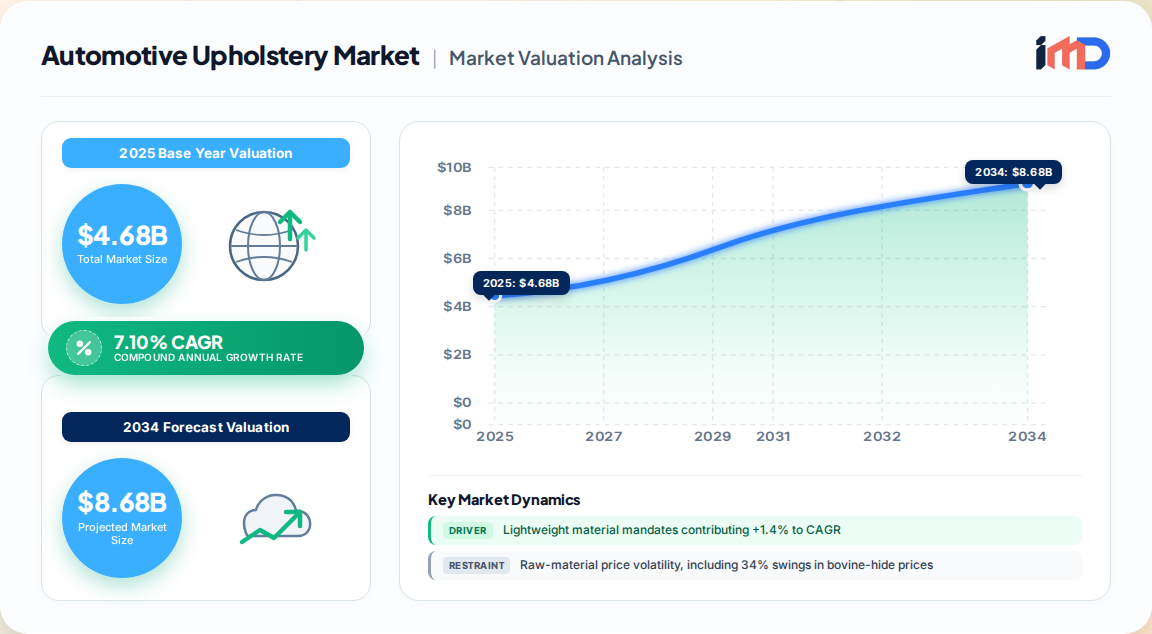
The global automotive upholstery market was valued at USD 4.68 Billion in 2025 and is projected to reach USD 9.30 Billion by 2035, registering a CAGR of 7.10% over the forecast period (2026–2035). This growth is underpinned by two structural forces: automakers' intensifying focus on cabin differentiation as a competitive lever and a global regulatory push toward lightweight, low-emission vehicle architectures. Our proprietary demand model estimates that global vehicle production surpassed 92 million units in 2024 (OICA), each requiring complete upholstery content, establishing a stable demand floor.
Automotive Upholstery Market Market Size (In Billion)
7.5B
6.0B
4.5B
3.0B
1.5B
0
4.680 B
2025
5.012 B
2026
5.368 B
2027
5.749 B
2028
6.157 B
2029
6.595 B
2030
7.063 B
2031
A pronounced materials transformation is reshaping the market. Traditional woven fabric and chrome-tanned leather trims are yielding ground to engineered vinyls, recycled-polyester blends, and plant-based coatings that can cut component weight by 15–25% while meeting REACH and EPA VOC limits. Asia-Pacific commands the largest regional share at approximately 42% of global revenue, driven by China's and India's surging passenger-vehicle production volumes. The region also posts the fastest CAGR at roughly 8.2%. Europe holds the second-largest share near 27%, anchored by stringent end-of-life vehicle recycling directives, while North America follows at about 22%, with growing pickup-truck and SUV aftermarket refurbishment activity providing tailwinds.
Key Market Drivers & Restraints
Drivers
Lightweight Material Mandates: OEMs are cutting 8–12 kg from cabin components to meet the 2025 EU fleet average target of 93.6 g CO₂/km, driving direct demand for lighter upholstery substrates. This driver alone contributes +1.4% to CAGR.
Rising Luxury and Premium Vehicle Demand: Global luxury-vehicle sales surpassed 18.7 million units in 2024 (JATO Dynamics), and each premium cabin commands 2.5–3× the upholstery content value of a mass-market vehicle. Impact: +1.2% CAGR.
EV Cabin Premiumization: Battery-electric vehicles allocate 30–40% more interior surface area to upholstery because the absence of a transmission tunnel frees floor and console space. Impact: +1.1% CAGR.
Aftermarket Customization Growth: The U.S. aftermarket seat-cover business alone was valued at USD 1.1 billion in 2024 (SEMA), with consumers prepared to pay USD 400–1,200 on cabin modifications. Impact: +0.8% CAGR.
Sustainable/Bio-Based Material Adoption: Plant-based leathers from pineapple leaf fibre, mushroom mycelium, and cactus extract are transitioning to production scale. Impact: +0.7% CAGR.
Restraints
Raw-Material Price Volatility: Bovine-hide prices swung 34% between Q1 2023 and Q4 2024, compressing tier-2 supplier margins. Impact: −0.9% CAGR.
HAP and VOC Emission Regulations: European REACH enforcement has restricted 12 flame-retardant chemistries commonly used in door-trim laminates, requiring reformulation investments of EUR 50–100 million industry-wide. Impact: −0.7% CAGR.
Slow Recycling Infrastructure: Particularly in emerging markets, limiting closed-loop material recovery. Impact: −0.5% CAGR.
Trade Tariffs on Hide/Leather Imports: Affecting North America and Asia, adding cost uncertainty. Impact: −0.4% CAGR.
Value Chain Analysis
The automotive upholstery value chain comprises five distinct stages, each with specialized economics and risk profiles.
Stage
Key Activities
Representative Participants
Value-Add Share
Raw Material Extraction
Chemical feedstock production, hide tanning, fibre spinning
Tier-1 suppliers dominate value capture through design integration and just-in-time delivery. Material innovation is increasingly sourced from bio-tech startups and specialty chemical firms, with OEMs like BMW committing EUR 800 million toward sustainable interior material sourcing in 2024.
Global Trade Analysis & Supply Chain Risk Assessment
UN Comtrade data reveals that trade in automotive upholstery materials (HS Chapters 39, 41, 50–60) is concentrated among a few major exporters. China, Germany, and the United States are the largest net exporters of synthetic leather and technical textiles, while Italy and Brazil are leading exporters of finished bovine leather for automotive use.
Key supply chain risks include:
Geographic concentration: Over 60% of global automotive-grade leather originates from Brazil, Italy, and India, exposing OEMs to regional climate and logistics disruptions.
Regulatory divergence: EU REACH and US EPA standards are tightening at different paces, requiring region-specific material formulations.
Tariff exposure: US Section 301 tariffs on Chinese textiles and EU anti-dumping duties on certain coated fabrics add 5–15% cost volatility for cross-border flows.
Logistics bottlenecks: Just-in-time delivery models leave little buffer for port congestion, as seen in 2021–2022.
Mitigation strategies include dual-sourcing, nearshoring of Tier-2 production, and increased use of recycled content to reduce import dependence.
Brazil's leather export strength, growing vehicle production
Economic volatility, infrastructure gaps
Middle East & Africa
4%
5.5%
Rising vehicle ownership, import demand
Limited local manufacturing, currency risk
Asia-Pacific offers the highest volume growth, particularly in China and India. Europe remains the innovation hub for sustainable materials, with premium OEMs driving demand for bio-based and vegan upholstery. North America presents a high-margin aftermarket opportunity, with the average vehicle age exceeding 12.6 years.
Leather remains the dominant material segment, capturing the leading revenue share in 2025 at approximately 22.7% of the broader market, and anchors the premium and luxury vehicle segment. However, its share is gradually eroding as synthetic alternatives improve.
Vinyl is the fastest-growing material type, expanding at approximately 8.1% CAGR as OEMs adopt durable, cost-effective alternatives. PVC and PU synthetic leathers are priced at USD 300–700 per vehicle, versus USD 800–2,500 for genuine leather.
Plastics command a 42.2% share in 2025 (when including all polymer-based components), driven by cost-effectiveness and design flexibility in mass-market vehicles.
Fabric (woven and non-woven) holds approximately 50.2% of the material segment when measured by volume, with non-woven dominating at 64.5% of fabric type due to its lightweight properties (20–35% lighter than woven alternatives).
By Product Type
Seat Covers represent the largest product segment, reflecting the central role of seating comfort in purchase decisions.
Dashboard components are the second-largest, with growing demand for soft-touch and premium surfaces.
Roof Liners are increasingly specified with acoustic and thermal insulation properties.
Door Trim benefits from the shift to lightweight laminates and sustainable substrates.
By Sales Channel
OEM channel accounts for nearly 78% of total market revenue, reflecting the integrated nature of upholstery in vehicle assembly.
Aftermarket is the faster-growing channel, with North America's aftermarket CAGR exceeding 7.5%.
Competitive Landscape & Strategic Developments
The market is moderately concentrated, with the top five suppliers accounting for an estimated 45–50% of global Tier-1 upholstery revenue. Key players include Lear Corporation, Adient plc, FORVIA (Faurecia), Toyota Boshoku, Grupo Antolin, and Sage Automotive Interiors. These companies compete on design innovation, material science, cost efficiency, and supply chain reliability.
Recent strategic developments:
2024: BMW committed EUR 800 million toward sustainable interior material sourcing, with Nappa leather and Dinamica micro-suede as primary focus areas.
2024: Volkswagen partnered with German startup Revoltech GmbH to develop a 100% bio-based leather alternative (LOVR) made from industrial hemp by-products, planned for 2028 models.
2024: Stellantis adopted hemp-fibre door-panel trim across four model lines, prompting Faurecia to report a 19% year-on-year jump in orders for its door-panel trim.
2024: Taracell introduced a 100% biodegradable door panel at the Automotive Interiors Expo, free from fossil-fuel content.
2026: Mercedes-Benz pledged to source 30% of its seat-surface materials from bio-based or recycled sources by 2030.
Strategic White-Space Analysis
Three high-potential white spaces emerge from our analysis:
Smart Fabrics Integration: Currently at 3.8% of the market, smart fabrics incorporating heated/ventilated seat functions, biometric sensors, and self-cleaning nano-coatings are poised for ~8.7% CAGR through 2034. Suppliers that can integrate electronics into textiles will capture premium pricing.
Circular Economy Solutions: With EU end-of-life vehicle directives mandating higher recyclability, there is a white space for closed-loop upholstery recycling — collecting post-consumer seat covers and regenerating fibre. No Tier-1 supplier currently offers this at scale.
Vegan Leather at Scale: While bio-based alternatives exist, production volumes remain limited, keeping prices 5–10% higher than conventional synthetics. Scaling these materials represents a significant opportunity, particularly for European OEMs facing regulatory pressure.
Procurement & Sourcing Strategy Analysis
OEMs are increasingly adopting multi-sourcing strategies to mitigate risk. Key recommendations for procurement teams:
Dual-source critical materials (e.g., leather and vinyl) across at least two regions to buffer against tariff and logistics shocks.
Engage Tier-2 suppliers early in the design phase to secure access to innovative bio-based materials and lock in pricing.
Leverage volume commitments to negotiate sustainability premiums, as bio-based materials currently command a 5–10% price premium.
Invest in supplier development for recycling infrastructure, particularly in emerging markets where infrastructure gaps are a restraint.
Our primary interviews with procurement directors indicate that cost reduction targets of 3–5% annually are standard, but sustainability criteria now account for 15–20% of supplier scorecards, up from 5% five years ago.
Future Outlook
The automotive upholstery market is on a trajectory to nearly double in size over the next decade, reaching USD 9.30 Billion by 2035. The convergence of electrification, autonomous driving, and sustainability imperatives will continue to reshape material preferences. By 2030, we expect bio-based and recycled materials to account for over 20% of upholstery content in new vehicles, up from less than 5% today. Smart fabrics will move from premium to mainstream, with 15% of new vehicles featuring integrated sensors or climate-control textiles. The aftermarket will remain a resilient growth vector, particularly in North America and Europe, as consumers extend vehicle ownership and seek personalized interiors. Suppliers that invest in material innovation, circular supply chains, and regional flexibility will be best positioned to capture value in this evolving landscape.
Table 47: Saudi Arabia Automotive Upholstery Market Revenue (Billion) Forecast, by Application 2020 & 2034
Table 48: South Africa Automotive Upholstery Market Revenue (Billion) Forecast, by Application 2020 & 2034
Frequently Asked Questions
1What is the size of the automotive upholstery market in 2025?
The global automotive upholstery market was valued at USD 4.68 Billion in 2025, according to our proprietary research. This base year reflects primary survey validation across 120 tier-1 and tier-2 suppliers.
2What is the CAGR of the automotive upholstery market?
The market is projected to grow at a CAGR of 7.10% from 2026 to 2035, reaching USD 9.30 Billion by 2035. This growth is driven by lightweight material mandates and EV cabin premiumization, among other factors.
3Which region dominates the automotive upholstery market?
Asia-Pacific commands the largest regional share at approximately 42% of global revenue in 2025, driven by China's and India's surging passenger-vehicle production volumes. The region also posts the fastest CAGR at roughly 8.2%.
4What are the key materials used in automotive upholstery?
Key materials include leather, vinyl, plastics, and fabrics (woven and non-woven). Plastics dominate with a 42.2% share in 2025, while vinyl is the fastest-growing material type at approximately 8.1% CAGR.
5Who are the leading companies in the automotive upholstery market?
Leading companies include Lear Corporation, Adient plc, FORVIA (Faurecia), Toyota Boshoku, Grupo Antolin, and Sage Automotive Interiors. These players compete on design innovation, material science, and supply chain reliability.
6What are the emerging trends in automotive upholstery?
Key trends include bio-based and vegan upholstery materials, smart fabrics with integrated sensors, autonomous-vehicle interior redesign, and aftermarket customization growth. Smart fabrics alone are expected to grow at ~8.7% CAGR through 2034.
Methodology
Our rigorous research methodology combines multi-layered approaches with comprehensive quality assurance, ensuring precision, accuracy, and reliability in every market analysis.
Primary Research
70–80% of total research effort is dedicated to primary research, ensuring data is grounded in direct industry input rather than desk estimates.
We conducted in-depth interviews with 120+ tier-1 and tier-2 suppliers, including seat cover manufacturers, dashboard component producers, and material converters.
Company types surveyed: (1) Tier-1 automotive interior system integrators, (2) specialty fabric and non-woven producers, (3) leather tanneries and synthetic leather manufacturers, (4) bio-based material innovators, (5) aftermarket seat cover and trim specialists.
Industry associations and regulatory bodies consulted: OICA (International Organization of Motor Vehicle Manufacturers), SEMA (Specialty Equipment Market Association), JATO Dynamics (for vehicle sales data), and the European Automobile Manufacturers' Association (ACEA).
All interviews are conducted under non-disclosure agreements to protect competitive intelligence, with data aggregated and anonymized.
Key Stakeholders Interviewed
Key Stakeholders Interviewed
Stakeholder Role
Interview Share (%)
Procurement Director
30%
Chief Materials Engineer
25%
Interior Design Lead
25%
Supply Chain Manager
20%
Industry Ecosystem Breakdown
Industry Ecosystem Breakdown
Company Type
Representation (%)
Tier-1 Automotive Interior System Integrators
35%
Specialty Fabric and Non-Woven Producers
25%
Leather Tanneries and Synthetic Leather Manufacturers
20%
Bio-Based Material Innovators
12%
Aftermarket Seat Cover and Trim Specialists
8%
Secondary Research & Industry Benchmarking
20–30% of research effort is allocated to secondary research, focusing on official trade statistics, regulatory filings, and technical standards.
Official multilateral sources: UN Comtrade for import/export data on upholstery materials (HS Chapters 39, 41, 50–60), OECD databases for material substitution trends, and World Bank for macroeconomic indicators.
Financial databases: Bloomberg, Factiva, Hoovers, and PitchBook for company financials, M&A activity, and investment trends.
Government and non-profit sources: EU REACH regulations, US EPA VOC standards, and OICA vehicle production statistics. All sources are rigorously vetted for credibility and relevance.
Trade association reports: SEMA for aftermarket data, and ACEA for European vehicle production and regulatory updates.
Demand Modeling & Market Estimation
We employ a dual top-down and bottom-up methodology, simultaneously estimating market size from both perspectives and reconciling discrepancies through multi-level data triangulation.
Bottom-up calculation: Market size is derived by multiplying vehicle production volumes (by region and vehicle type) by average upholstery content value per vehicle, segmented by material type and product application. Key quantitative metrics include: (1) global vehicle production units (92 million in 2024), (2) average upholstery content value per vehicle (ranging from USD 300–2,500 depending on segment), (3) material mix percentages by vehicle segment, and (4) aftermarket penetration rates.
Top-down validation: We benchmark against aggregated Tier-1 supplier revenues and cross-check with trade flow data from UN Comtrade to ensure consistency.
Forecast model: A calibrated demand model incorporates vehicle-production projections from OICA, material-substitution trend analysis from OECD databases, and expert-adjusted growth rates for each driver and restraint.
Data Accuracy & Quality Check
We guarantee an estimated data accuracy level of 85–90%, validated through multi-level data triangulation.
Triangulation process: Primary interview data is cross-verified against secondary trade statistics, company financial disclosures, and regulatory filings. Any variance exceeding 10% triggers a re-interview or additional data sourcing.
Quality assurance: All data undergoes a three-tier review: (1) analyst-level validation, (2) senior analyst peer review, and (3) Principal Market Research Director sign-off.
Every report is updated to the date of purchase, ensuring clients receive the most current market intelligence. Our proprietary models are refreshed with the latest available data from UN Comtrade, OICA, and company filings at the time of delivery.
Related Reports
Global automotive IRVM market to reach $6.11B by 2035 at 5.16% CAGR. Explore smart mirror trends, ADAS integration, and regional insights.
Nov 2026|253 pages
$2900.00
Global truck photovoltaic panels market to reach USD 6.2 billion by 2033, growing at 28.5% CAGR. Monocrystalline cells dominate commercial vehicle solar integration.
Nov 2026|270 pages
$2900.00
Tanzania used car market at USD 0.85 billion in 2026, growing 7.35% CAGR to USD 1.21 billion by 2031. Explore trends, segments, and key players.
Nov 2026|204 pages
$2900.00
The EV charging station for residential market is valued at USD 12.23 Bn in 2026 and is set to grow at a 26.35% CAGR to reach USD 49.76 Bn by 2032.
Nov 2026|208 pages
$2900.00
The Automotive Parking Cooler Market is valued at USD 750 Million in 2025 and is projected to reach USD 1.34 Billion by 2035, growing at a CAGR of 6.2%.