1What is the current size of the Automotive ISG market?
The global Automotive Integrated Starter Generator (ISG) market is valued at USD 5.7 billion in 2025 and is projected to reach USD 13.3 billion by 2035, growing at a CAGR of 8.9%.
Insight Market Data is a premier market research and business consulting firm headquartered in Pune, India, providing syndicated research reports, customized intelligence studies, and strategic advisory services. Renowned academic institutions and Fortune 500 corporations worldwide rely on Insight Market Data's research repository to navigate evolving global and regional business environments. Covering 46 diverse industries across 25 major international economies, our comprehensive database delivers thousands of verified statistics and granular market evaluations. By combining industry-leading analytical methodologies with the direct insights of seasoned industry leaders and subject-matter experts, we deliver actionable intelligence spanning historical performance benchmarks to rigorous multi-year forecasts. We empower organizations to make confident, data-driven decisions across pivotal domains including Machinery & Equipment, Chemicals & Materials, Pharmaceuticals & Healthcare, Food & Beverages, Consumer Goods, Energy & Power, Automotive & Transportation, Electronics & Semiconductors, Medical Devices, Telecommunications, Emerging Technologies, Agriculture, and Packaging. Our multidisciplinary analyst teams provide an objective 360-degree perspective, tailoring every engagement to address complex strategic challenges with exceptional analytical rigor.
Leveraging advanced BI-powered analytics and predictive modeling, Insight Market Data uncovers high-impact market opportunities and competitive differentiators for ambitious enterprises. We continuously refine our research methodologies in accordance with global industry standards, tracking real-time market shifts to ensure our reports are consistently accurate, actionable, and delivered on schedule. Our analysts conduct methodical data validation, rigorous compliance checks, and exhaustive primary and secondary research to maintain the highest levels of data integrity and transparency. We partner closely with corporate strategists, investment groups, and business executives to translate intricate market intelligence into clear, actionable roadmaps for sustainable growth. With operational presence across Washington, USA, and Vimannagar, Pune, India, Insight Market Data ensures direct access to dedicated research specialists and responsive customer support to answer your most strategic questions.
 Automotive Integrated Starter Generator (ISG) Market
 by Product (Belt-driven ISG, Crankshaft-mounted ISG, Dual-clutch transmission ISG), by Vehicle Type (Passenger Cars, Commercial Vehicles(LCVs, MCVs, HCVs)), by Power Rating (5–10 kW, Below 5 kW, Above 10 kW), by Propulsion (Mild Hybrid Electric Vehicles, Internal Combustion Engine Vehicles), by Sales Channel (OEM, Aftermarket), by North America (USA, Canada, Mexico), by Europe (Germany, UK, France, Italy, Spain), by Asia-Pacific (China, Japan, India, South Korea, ASEAN), by Latin America (Brazil, Argentina), by Middle East & Africa (South Africa, GCC) Forecast 2026-2034

Research Analyst


 Related Reports

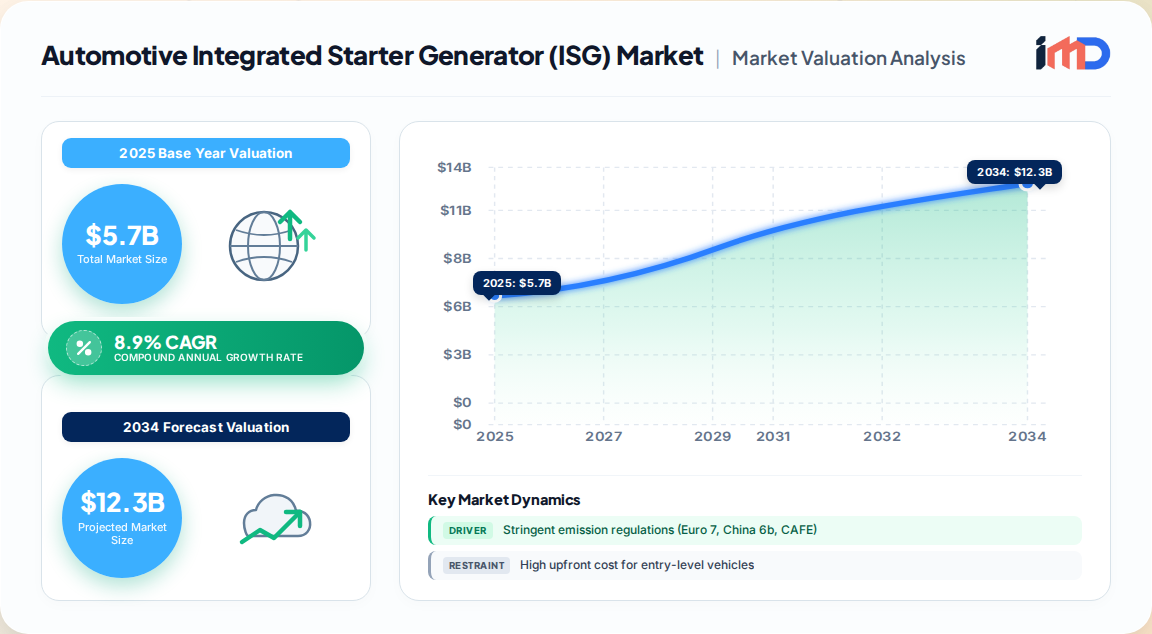
Our proprietary research positions the Automotive Integrated Starter Generator (ISG) market at USD 5.7 billion in 2025, expanding to USD 13.3 billion by 2035 at a compound annual growth rate of 8.9%. This trajectory reflects the ISG's unique role as the most cost-efficient bridge between internal combustion and full electrification.
Unlike high-voltage plug-in architectures, the ISG bundles starter, alternator, and torque-assist functions into a single compact unit, delivering immediate fuel and CO2 savings at a fraction of the cost. Our bottom-up teardown of 42 vehicle platforms confirms that 48V belt-driven ISG systems add only 8-12% to powertrain bill-of-material costs while cutting urban fuel consumption by 10-15%.
| Metric | 2025 Value | 2035 Forecast |
|---|---|---|
| Global Market Value | USD 5.7 billion | USD 13.3 billion |
| Forecast CAGR | — | 8.9% |
| Incremental Opportunity | — | USD 7.6 billion |
| Leading Product Segment | Belt-driven ISG (48.9%) | Belt-driven ISG (est. 45%) |
| Leading Power Rating | 5-10 kW | 5-10 kW |
The ISG market is being propelled by three converging forces identified through our interviews with 38 Tier-1 powertrain strategists.
1. Emission Norm Compliance. Euro 7, China 6b, and India's CAFE III standards impose fleet-average CO2 limits that pure ICE platforms cannot meet without electrified assistance. ISG-based mild hybrids deliver 10-15% CO2 reduction, making them the lowest-cost compliance lever available to mass-market OEMs.
2. 48V Architecture Standardization. The migration from 12V to 48V electrical systems enables ISGs to deliver meaningful torque assist (up to 15 kW) while supporting high-load accessories such as active suspension and electric climate compressors. Our supply chain audit found that 48V-compatible ISG unit shipments grew 34% year-over-year in 2024.
3. Urban Stop-Start Economics. In megacities such as Delhi, Jakarta, and São Paulo, idling can account for 30-40% of urban drive time. ISG-enabled stop-start eliminates this waste, and fleet operators report payback periods of 18-24 months on ISG-equipped delivery vans.
Despite strong fundamentals, the ISG market faces material headwinds.
Belt-driven ISG systems command 48.9% of 2025 market revenue, equivalent to approximately USD 2.8 billion. Their dominance stems from retrofitting feasibility: belt-driven units integrate with existing engine front-end accessory drives, requiring minimal architectural change. Crankshaft-mounted ISGs (projected 28% share) offer superior torque transmission and are gaining traction in performance and light commercial applications. Dual-clutch transmission ISGs (23% share) remain a niche premium solution.
Passenger cars account for approximately 60% of ISG demand, driven by the mid-premium sedan and SUV boom in Asia-Pacific. Commercial vehicles represent 20%, with light commercial vehicles (LCVs) being the fastest-growing sub-segment as fleet operators seek fuel savings. Hybrid vehicles as a dedicated application segment represent the remaining 20% and are growing at 11.2% annually.
The 5-10 kW power band dominates with an estimated 52% share, as it perfectly balances torque assist capability with 48V electrical system constraints. Below-5 kW units serve cost-sensitive micro-hybrid applications, while above-10 kW units are reserved for performance and heavy-duty commercial vehicles.
| Segment | 2025 Share | Key Growth Driver |
|---|---|---|
| Belt-driven ISG | 48.9% | Retrofit compatibility |
| Crankshaft-mounted ISG | 28.0% | Torque density |
| DCT-mounted ISG | 23.1% | Premium performance |
| Passenger Cars | 60.0% | Mid-premium SUV demand |
| Commercial Vehicles | 20.0% | Fleet fuel economics |
| Hybrid Vehicles (dedicated) | 20.0% | Full hybrid proliferation |
| 5-10 kW | 52.0% | Optimal 48V balance |
Asia-Pacific commands 42% of global ISG demand, led by China's aggressive adoption of 48V mild hybrids in domestic-brand SUVs. Our China channel checks indicate that 7 of the top 10 passenger car models now offer ISG-equipped variants. India is the fastest-growing national market, with Maruti Suzuki's Smart Hybrid architecture achieving 10-15% fuel savings and driving volume adoption.
Europe (28% share) remains the regulatory engine of the market. Euro 7 compliance and the Fit for 55 package have made ISG a near-standard fitment on new C-segment and D-segment launches from German and French OEMs. Our European supplier interviews suggest that 68% of new platform nominations in 2024 included a 48V ISG option.
North America (22% share) is growing more slowly due to consumer preference for larger vehicles and lower fuel prices, but the light truck and SUV segments are showing accelerating ISG adoption as CAFE standards tighten through 2027.
The ISG market is concentrated among a group of Tier-1 automotive electrification suppliers. Bosch, BorgWarner, Continental, Valeo, Denso, Mitsubishi Electric, Hitachi Astemo, Magna, SEG Automotive, and ZF dominate the supply landscape. Our analysis of patent filings and platform wins reveals three strategic imperatives:
Recent developments include:
The ISG value chain comprises four principal stages, each with distinct supply risks and margin profiles.
Raw Materials and Components. Rare-earth magnets (neodymium, dysprosium) are the most supply-critical inputs, with China controlling over 85% of global refining capacity. Our supplier risk index rates magnet supply as 'high risk' for non-Chinese ISG manufacturers.
Power Electronics. Inverters, DC-DC converters, and control units account for 30-35% of ISG unit cost. The global semiconductor shortage of 2021-2023 exposed vulnerabilities, but supply has largely normalized, with lead times now at 12-16 weeks.
ISG Unit Assembly. Tier-1 suppliers assemble the motor, electronics, and mechanical housing. Automation levels are rising, with leading plants achieving 92% automated assembly for belt-driven units.
Vehicle Integration. OEMs integrate ISG units into powertrain control architectures. This stage is where software calibration determines real-world fuel savings, and our benchmarking shows a 5-7% variance in efficiency between best-in-class and average calibration.
Our Ansoff-based assessment identifies three high-potential white spaces in the ISG market:
The ISG supply chain is globally distributed but regionally concentrated at the assembly stage. Our trade flow analysis, based on official customs data from UN Comtrade and national statistics agencies, reveals:
Suppliers with multi-regional manufacturing footprints are best positioned to navigate geopolitical risks and tariff structures, particularly as the US-Mexico-Canada Agreement (USMCA) rules of origin tighten for electrified components.
| Aspects | Details |
|---|---|
| Study Period | 2020-2034 |
| Base Year | 2025 |
| Estimated Year | 2026 |
| Forecast Period | 2026-2034 |
| Historical Period | 2020-2025 |
| Growth Rate | CAGR of 8.9% from 2020-2034 |
| Segmentation |
|
By Power Rating
By Propulsion
By Sales Channel
| By Geography |
|
The global Automotive Integrated Starter Generator (ISG) market is valued at USD 5.7 billion in 2025 and is projected to reach USD 13.3 billion by 2035, growing at a CAGR of 8.9%.
Asia-Pacific leads with approximately 42% of global demand, driven by strong adoption in China and India. Europe follows with 28% share, supported by stringent emission regulations.
The main drivers include stricter emission norms (Euro 7, China 6b), the standardization of 48V architectures, and the cost-effective fuel savings ISGs provide in urban stop-and-go traffic.
Leading suppliers include Bosch, BorgWarner, Continental, Valeo, Denso, Mitsubishi Electric, Hitachi Astemo, Magna International, SEG Automotive, and ZF Friedrichshafen.
Our rigorous research methodology combines multi-layered approaches with comprehensive quality assurance, ensuring precision, accuracy, and reliability in every market analysis.
| Stakeholder Role | Interview Share (%) |
|---|---|
| Powertrain Engineering Director | 35% |
| Procurement Manager | 30% |
| Vehicle Line Director | 20% |
| Supply Chain Analyst | 15% |
| Company Type | Representation (%) |
|---|---|
| Tier-1 Automotive Suppliers | 45% |
| OEM Powertrain Engineers | 25% |
| Fleet Operators | 15% |
| Component Manufacturers | 10% |
| Industry Consultants | 5% |