1What is the automotive grade MCU chip market size?
The market is valued at USD 12.34 billion in 2026 and is projected to reach USD 18.29 billion by 2031, growing at a CAGR of 8.18%.
Insight Market Data is a premier market research and business consulting firm headquartered in Pune, India, providing syndicated research reports, customized intelligence studies, and strategic advisory services. Renowned academic institutions and Fortune 500 corporations worldwide rely on Insight Market Data's research repository to navigate evolving global and regional business environments. Covering 46 diverse industries across 25 major international economies, our comprehensive database delivers thousands of verified statistics and granular market evaluations. By combining industry-leading analytical methodologies with the direct insights of seasoned industry leaders and subject-matter experts, we deliver actionable intelligence spanning historical performance benchmarks to rigorous multi-year forecasts. We empower organizations to make confident, data-driven decisions across pivotal domains including Machinery & Equipment, Chemicals & Materials, Pharmaceuticals & Healthcare, Food & Beverages, Consumer Goods, Energy & Power, Automotive & Transportation, Electronics & Semiconductors, Medical Devices, Telecommunications, Emerging Technologies, Agriculture, and Packaging. Our multidisciplinary analyst teams provide an objective 360-degree perspective, tailoring every engagement to address complex strategic challenges with exceptional analytical rigor.
Leveraging advanced BI-powered analytics and predictive modeling, Insight Market Data uncovers high-impact market opportunities and competitive differentiators for ambitious enterprises. We continuously refine our research methodologies in accordance with global industry standards, tracking real-time market shifts to ensure our reports are consistently accurate, actionable, and delivered on schedule. Our analysts conduct methodical data validation, rigorous compliance checks, and exhaustive primary and secondary research to maintain the highest levels of data integrity and transparency. We partner closely with corporate strategists, investment groups, and business executives to translate intricate market intelligence into clear, actionable roadmaps for sustainable growth. With operational presence across Washington, USA, and Vimannagar, Pune, India, Insight Market Data ensures direct access to dedicated research specialists and responsive customer support to answer your most strategic questions.

 Automotive Grade MCU Chip Market
 by Bit Class (8-Bit, 16-Bit, 32-Bit), by Application (Powertrain and Chassis, Safety and ADAS, Body Electronics, Infotainment and Connectivity, Telematics), by Vehicle Propulsion Type (Passenger ICE, Commercial ICE, BEV, HEV/PHEV, FCEV), by Process-Node Technology (≥28nm, 40-22nm, ≤16nm FinFET), by Core Architecture (ARM Cortex-M, ARM Cortex-R/A, RISC-V), by North America (USA, Canada, Mexico), by Europe (Germany, UK, France, Italy, Spain), by Asia Pacific (China, Japan, South Korea, India), by South America (Brazil, Argentina), by Middle East & Africa (South Africa, UAE) Forecast 2026-2034

Research Analyst

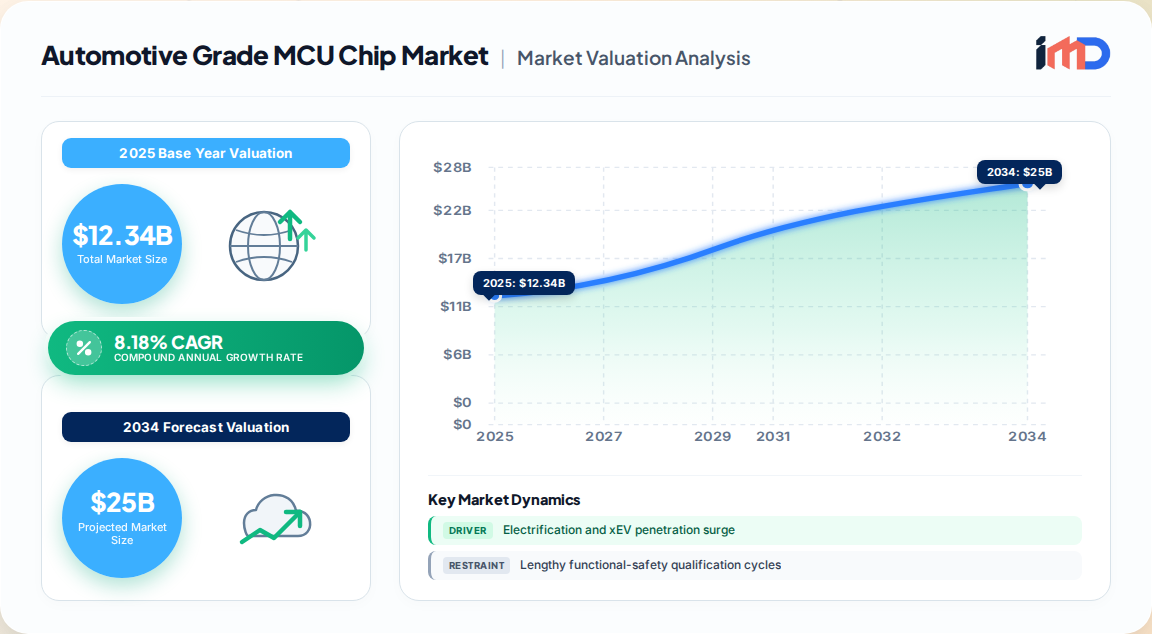
The automotive grade MCU chip market encompasses microcontrollers specifically designed and qualified for automotive applications, meeting stringent reliability, temperature, and functional safety standards. These chips are the electronic brains behind virtually every vehicle subsystem, from powertrain and chassis control to advanced driver assistance systems (ADAS), body electronics, and infotainment. Our proprietary research estimates the global automotive grade MCU chip market at USD 12.34 billion in 2026, projected to reach USD 18.29 billion by 2031, expanding at a CAGR of 8.18% during the forecast period. This growth is underpinned by the accelerating electrification of vehicles, the proliferation of ADAS features, the transition to software-defined vehicle (SDV) architectures, and tightening cybersecurity regulations worldwide.
The market is characterized by high concentration, with the top five suppliers controlling approximately 81.5% of global revenue. Infineon Technologies leads with a 28.5% share, followed by NXP Semiconductors, Renesas Electronics, STMicroelectronics, and Texas Instruments. These incumbents leverage deep application expertise, extensive tool ecosystems, and long-standing Tier-1 relationships to maintain their positions. However, the landscape is evolving as RISC-V adoption gains momentum and new entrants target specialized niches.
The automotive MCU market is propelled by several powerful forces. Electrification and the surge in xEV penetration represent the most significant driver, contributing a 2.10% impact on CAGR. Battery-electric vehicles require more than 300 controllers compared to roughly 70 in internal combustion engine (ICE) vehicles, quadrupling MCU unit demand. Thermal loads in 800V traction systems drive designs rated for junction temperatures beyond 150°C, spurring innovation in packaging and process technology.
ADAS and autonomous feature content add 1.80% to CAGR. Level 2 platforms already embed about USD 500 in semiconductors per vehicle, an order of magnitude above basic vehicles. Progression to Level 3 and Level 4 autonomy mandates sensor fusion, redundancy, and ASIL-D conformance, requiring high-performance MCUs with integrated AI accelerators. Software-defined vehicle and OTA architectures contribute 1.40% to CAGR, as frequent software updates demand embedded MRAM and fast erase/write cycles. NXP's 16nm S32K5 family, for instance, writes firmware 15 times faster than flash while meeting ASIL-D targets.
Cyber-security regulations (UN R155 and ISO/SAE 21434) add 0.90% to CAGR. Hardware security modules and secure-boot roots now ship standard, and the USD 22.5 billion impact of automotive cyber incidents in 2024 underscores the urgency. Zonal E/E architecture transitions contribute 1.20%, while localization incentives such as the US CHIPS Act and European Chips Act add 0.80%.
However, the market faces notable restraints. Lengthy functional-safety qualification cycles (ASIL-D certification takes 18-24 months) reduce CAGR by 1.30%. Persistent 150mm foundry capacity bottlenecks, with over 75% of automotive controllers still on ≥28nm nodes, subtract 0.80%. Junction-temperature derating issues above 150°C and rising ISO 26262/21434 compliance costs further temper growth by 0.60% and 0.90%, respectively.
By Bit Class: The 16-bit segment retained 35.40% revenue share in 2025, primarily in body electronics. However, 32-bit devices are the growth engine, recording an 11.2% CAGR and forecast to reach USD 10.62 billion by 2031. The shift to 32-bit is driven by ADAS demand and software-defined-vehicle workloads. ARM Cortex-R5 dominates safety-critical roles, while Infineon's TriCore excels in powertrain.
By Application: Safety and ADAS captured the fastest CAGR at 13.6%, while powertrain and chassis held 25.60% of market share in 2025. Body electronics remains a volume stronghold, though growth is moderate.
By Vehicle Propulsion: Battery electric vehicles are the quickest-growing segment at 13.10% CAGR, while commercial ICE maintained a 27.80% slice of the market in 2025. The transition to electric powertrains is reshaping MCU requirements, with increased demand for high-voltage isolation and real-time control.
By Process Node: ≤16nm FinFET devices posted an 11.9% CAGR, whereas 40-22nm nodes commanded a 22.10% revenue share in 2025. Advanced nodes enable higher integration and performance for zonal controllers.
By Core Architecture: ARM Cortex-R/A solutions accelerated at a 15.0% CAGR, while RISC-V held 8.35% of 2025 revenue but is growing swiftly, driven by cost-sensitive applications and supply chain diversification.
Asia-Pacific is the fastest-growing region, with a 13.2% CAGR, driven by China's aggressive EV production, Japan's mature automotive supply chain, and South Korea's semiconductor prowess. The region is expected to account for over 40% of global revenue by 2031. North America held an 18.80% share in 2025 and is projected to grow steadily, supported by CHIPS Act incentives and high ADAS penetration. Europe remains a key market for safety-critical and premium vehicles, with stringent regulations accelerating MCU content per vehicle.
The automotive grade MCU chip market is highly consolidated, with the top five players dominating. Infineon's 28.5% share reflects its strength in powertrain and ADAS. NXP leverages its S32 platform for zonal and domain controllers. Renesas focuses on functional safety and embedded AI, while STMicroelectronics and Texas Instruments emphasize broad portfolios and cost-effective solutions.
Recent strategic developments include Infineon's introduction of the AURIX TC4x family with AI acceleration and advanced security, targeting zonal architectures. NXP launched the S32K5 family with 16nm MRAM and ASIL-D compliance, enabling faster OTA updates. Renesas unveiled the RH850/U2B series for high-performance domain control. RISC-V adoption is gaining traction, with several vendors announcing RISC-V-based automotive MCUs. Supply chain localization efforts are accelerating, with new fabs in the US and Europe targeting automotive-grade nodes.
The automotive MCU value chain spans semiconductor foundries, OSAT providers, Tier-1 integrators, and OEMs. The fabless model dominates, with companies like NXP and STMicroelectronics relying on foundries such as TSMC and GlobalFoundries. However, the industry is increasingly moving toward dual-sourcing and localized production to mitigate geopolitical risks. The 2021-2023 chip shortage exposed vulnerabilities, prompting OEMs to engage directly with foundries and sign long-term supply agreements.
Key risks include mature-node capacity constraints, with only about 7% expansion in 2025, and geographic concentration in Taiwan and South Korea. The CHIPS Act and European Chips Act aim to reduce this dependency, but new fabs will take years to ramp. Additionally, the shift to advanced nodes (≤16nm) requires significant capital investment, favoring large incumbents.
Several opportunities exist for new entrants and incumbents alike. The aftermarket retrofit and fleet upgrade cycle for ADAS and telematics presents a growing niche. Emerging-market EV localization, particularly in India, ASEAN, and Latin America, offers volume potential for cost-optimized MCUs. In-vehicle AI compute for autonomy is another white space, with demand for MCUs integrating neural processing units (NPUs) and sensor fusion capabilities. RISC-V-based MCUs for zonal and body applications represent a disruptive opportunity, especially for cost-sensitive segments and OEMs seeking supply chain diversification.
OEMs and Tier-1 suppliers are increasingly adopting multi-sourcing strategies to ensure supply continuity. Key procurement considerations include:
Buyers should also monitor regulatory developments, such as the EU Cyber Resilience Act, which may impose additional requirements on MCU security features.
| Aspects | Details |
|---|---|
| Study Period | 2020-2034 |
| Base Year | 2025 |
| Estimated Year | 2026 |
| Forecast Period | 2026-2034 |
| Historical Period | 2020-2025 |
| Growth Rate | CAGR of 8.18% from 2020-2034 |
| Segmentation |
|
By Vehicle Propulsion Type
By Process-Node Technology
By Core Architecture
| By Geography |
|
The market is valued at USD 12.34 billion in 2026 and is projected to reach USD 18.29 billion by 2031, growing at a CAGR of 8.18%.
Asia-Pacific is the largest and fastest-growing region, accounting for over 40% of global revenue and growing at 13.2% CAGR, driven by China, Japan, and South Korea.
Electrification and xEV penetration, ADAS regulatory mandates, software-defined vehicle architectures, and cybersecurity regulations are the primary growth drivers.
Infineon Technologies leads with 28.5% market share, followed by NXP Semiconductors, Renesas Electronics, STMicroelectronics, and Texas Instruments.
Our rigorous research methodology combines multi-layered approaches with comprehensive quality assurance, ensuring precision, accuracy, and reliability in every market analysis.
| Stakeholder Role | Interview Share (%) |
|---|---|
| Chief Technology Officer (CTO) | 25% |
| Procurement Director | 30% |
| Functional Safety Manager | 20% |
| Hardware Engineering Lead | 25% |
| Company Type | Representation (%) |
|---|---|
| Automotive MCU Vendors | 35% |
| Tier-1 System Integrators | 25% |
| OEM Platform Architects | 20% |
| Foundry Service Providers | 12% |
| Software & Security Solution Vendors | 8% |
 Related Reports
