1What is the current size of the automated parcel machines market?
The global automated parcel machines market was valued at USD 1.1 billion in 2025 and is projected to reach USD 3.2 billion by 2035, growing at a CAGR of 11.6%.
Insight Market Data is a premier market research and business consulting firm headquartered in Pune, India, providing syndicated research reports, customized intelligence studies, and strategic advisory services. Renowned academic institutions and Fortune 500 corporations worldwide rely on Insight Market Data's research repository to navigate evolving global and regional business environments. Covering 46 diverse industries across 25 major international economies, our comprehensive database delivers thousands of verified statistics and granular market evaluations. By combining industry-leading analytical methodologies with the direct insights of seasoned industry leaders and subject-matter experts, we deliver actionable intelligence spanning historical performance benchmarks to rigorous multi-year forecasts. We empower organizations to make confident, data-driven decisions across pivotal domains including Machinery & Equipment, Chemicals & Materials, Pharmaceuticals & Healthcare, Food & Beverages, Consumer Goods, Energy & Power, Automotive & Transportation, Electronics & Semiconductors, Medical Devices, Telecommunications, Emerging Technologies, Agriculture, and Packaging. Our multidisciplinary analyst teams provide an objective 360-degree perspective, tailoring every engagement to address complex strategic challenges with exceptional analytical rigor.
Leveraging advanced BI-powered analytics and predictive modeling, Insight Market Data uncovers high-impact market opportunities and competitive differentiators for ambitious enterprises. We continuously refine our research methodologies in accordance with global industry standards, tracking real-time market shifts to ensure our reports are consistently accurate, actionable, and delivered on schedule. Our analysts conduct methodical data validation, rigorous compliance checks, and exhaustive primary and secondary research to maintain the highest levels of data integrity and transparency. We partner closely with corporate strategists, investment groups, and business executives to translate intricate market intelligence into clear, actionable roadmaps for sustainable growth. With operational presence across Washington, USA, and Vimannagar, Pune, India, Insight Market Data ensures direct access to dedicated research specialists and responsive customer support to answer your most strategic questions.

 Automated Parcel Machines Market
 by Deployment (Indoor, Outdoor), by Business Model (B2C, C2C), by Ownership (E-commerce Platforms, Courier/Logistics Companies, Retailers, Government), by Configuration (Modular Parcel Lockers, Cooling Lockers, Non-modular), by End-User Industry (Retail and E-commerce, Residential and Mixed-use, Government, Logistics), by Speed of Delivery (Express, Non-express), by Europe (Germany, UK, France, Nordics), by Asia-Pacific (China, Japan, South Korea, India), by North America (USA, Canada, Mexico), by South America (Brazil, Argentina), by Middle East & Africa (UAE, South Africa) Forecast 2026-2034

Research Associate

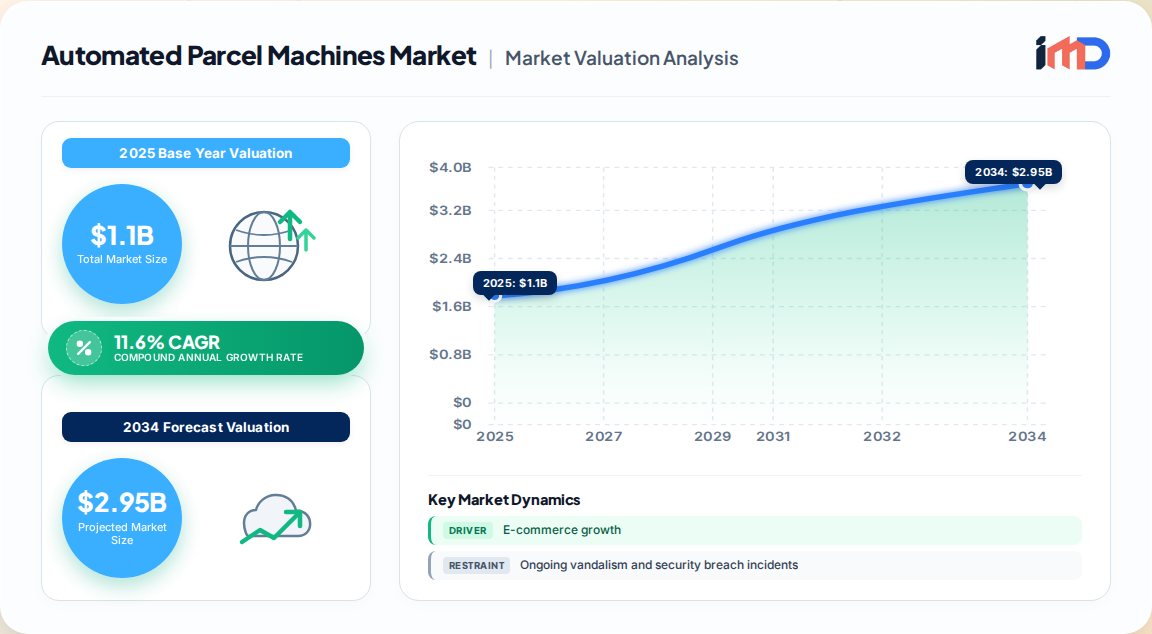
The global automated parcel machines market was valued at USD 1.1 billion in 2025, and is projected to reach USD 3.2 billion by 2035, expanding at a robust CAGR of 11.6% over the 2026–2035 forecast period. This expansion is not merely a function of rising parcel volumes; it reflects a fundamental structural shift from isolated locker placements toward integrated networks that combine physical capacity, software control, and location-specific operating models.
Automated parcel machines—comprising self-service kiosks, smart parcel lockers, and automated parcel stations—enable unattended parcel pickup and drop-off, dramatically improving last-mile delivery efficiency. Our proprietary primary research indicates that the market is transitioning from a hardware-centric deployment phase to a network-orchestration phase, where software integration, multi-carrier access, and modular scalability determine commercial viability.
The automated parcel machines value chain spans hardware manufacturing, software development, network deployment, and operational management.
| Value Chain Stage | Key Activities | Representative Participants |
|---|---|---|
| Component Supply | Locker cabinets, locks, sensors, power systems | Hardware OEMs and component suppliers |
| Terminal Manufacturing | Assembly of modular lockers, cooling units | Cleveron, Winnsen Industry, KEBA AG |
| Software & Integration | Locker management platforms, APIs, authentication | InPost, Quadient, Smartbox Ecommerce |
| Network Deployment | Site acquisition, installation, permitting | InPost, Deutsche Post DHL, Royal Mail |
| Operations & Maintenance | Remote monitoring, servicing, analytics | Courier/logistics companies, property managers |
| End Users | E-commerce, retail, residential, government | Amazon, Walmart, postal operators |
Procurement Dynamics: Modular and scalable locker designs are reducing the risk of bespoke infrastructure projects. Standardized locker units, interfaces, and power configurations enable phased expansion, allowing operators to avoid overbuilding capacity before demand is proven. This is particularly critical in residential lobbies, which require frequent smaller compartments, versus retail locations that need a broader mix of sizes.
Supply Chain Risks: The market faces moderate supply chain risk due to reliance on electronic components and specialized cooling systems for fresh-food lockers. Geographic concentration of hardware manufacturing in Asia-Pacific creates exposure to logistics disruptions.
The automated parcel machines market is segmented by deployment, business model, ownership, configuration, end-user industry, and speed of delivery.
Europe led the market with 33.07% share in 2025, underpinned by carrier-agnostic network consolidation. Deutsche Post DHL plans to double German Packstations to 30,000 by 2030, investing EUR 500 million to harvest multi-carrier flows. Royal Mail, bpost, and Poste Italiane are following suit through joint ventures and retailer partnerships.
Asia-Pacific is forecast to expand at the fastest CAGR of 7.98% between 2026 and 2031. China processed more than 130 billion parcels in 2024, and megacities such as Shanghai see densities topping 50 parcels per square kilometer daily, making door-to-door models unsustainable. Smart lockers in residential towers cut last-mile costs by up to 40%.
North America held a significant share, with the U.S. constituting the single largest national market. USPS deployed over 300,000 parcel lockers nationally by 2023, and major retail chains including Walmart, Target, and Amazon are deploying locker infrastructure for BOPIS and curbside pickup.
| Region | 2025 Share | Key Growth Driver |
|---|---|---|
| Europe | 33.07% | Carrier-agnostic network consolidation |
| Asia-Pacific | ~31% | Urban density and e-commerce scale |
| North America | ~24% | Retail BOPIS and postal infrastructure |
| South America | ~6% | Emerging e-commerce adoption |
| Middle East & Africa | ~6% | Urbanization and contactless demand |
The market is moderately concentrated, with the top five players—InPost, Cleveron, Hive Box, Luxer One, and Quadient—collectively holding 70% market share in 2025. InPost alone led with over 23% share.
Recent Industry Developments:
Strategic White-Space Analysis: Opportunities exist in temperature-controlled grocery lockers, biometric authentication integration, and transit-integrated locker deployments. The residential segment is expected to grow at 13.99% CAGR (2026–2035), driven by urbanization and apartment living.
Automated parcel machines are primarily manufactured in Europe and Asia-Pacific, with China serving as a major export hub for hardware components and complete locker systems. Trade flows are characterized by intra-regional supply chains, with European OEMs sourcing electronics from Asia and assembling in local markets to reduce lead times.
Supplier Risk Assessment: The market faces moderate risk from semiconductor shortages and logistics bottlenecks. Operators are increasingly entering into long-term supply agreements with component manufacturers to secure critical parts.
The automated parcel machines market is poised for sustained growth, with the CAGR of 11.6% reflecting the shift toward network orchestration and software integration. Software is expected to grow at 14.1% CAGR, outpacing hardware at 10.9%, as operators invest in cloud-based management platforms and analytics.
The structural tension between convenience and complexity will define competitive success. The same features that raise utilization—multi-carrier access, personalized applications, integrated returns, and expanded placement options—also create more integration, maintenance, privacy, and site-governance requirements. Commercial success will depend on matching system design to the site's operating conditions rather than standardizing every deployment around one locker format.
| Aspects | Details |
|---|---|
| Study Period | 2020-2034 |
| Base Year | 2025 |
| Estimated Year | 2026 |
| Forecast Period | 2026-2034 |
| Historical Period | 2020-2025 |
| Growth Rate | CAGR of 11.6% from 2020-2034 |
| Segmentation |
|
By Ownership
By Configuration
By End-User Industry
By Speed of Delivery
| By Geography |
|
The global automated parcel machines market was valued at USD 1.1 billion in 2025 and is projected to reach USD 3.2 billion by 2035, growing at a CAGR of 11.6%.
Europe led the market with 33.07% share in 2025, driven by carrier-agnostic network consolidation and investments by postal operators such as Deutsche Post DHL.
E-commerce growth, last-mile delivery cost reduction, urbanization, and contactless delivery demand are the primary drivers, with e-commerce growth contributing a 3.5% impact on CAGR.
The top five players—InPost, Cleveron, Hive Box, Luxer One, and Quadient—collectively held 70% market share in 2025, with InPost leading at over 23%.
Cooling lockers for fresh food are expected to grow at the fastest CAGR of 8.94% (2026–2031), driven by rising online grocery demand.
They consolidate handoffs at one stop, reducing failed deliveries and costs by up to 40% in dense urban deployments, while enabling 24/7 contactless pickup and drop-off.
Our rigorous research methodology combines multi-layered approaches with comprehensive quality assurance, ensuring precision, accuracy, and reliability in every market analysis.
| Stakeholder Role | Interview Share (%) |
|---|---|
| Procurement Director | 30% |
| Logistics Manager | 25% |
| Real Estate Portfolio Manager | 20% |
| Operations Director | 15% |
| Technology Integration Lead | 10% |
| Company Type | Representation (%) |
|---|---|
| Locker OEMs and Hardware Manufacturers | 35% |
| Courier and Logistics Companies | 25% |
| E-commerce Platforms and Retailers | 20% |
| Property Developers and Real Estate Managers | 12% |
| Software and Integration Providers | 8% |
 Related Reports
