1What is the size of the Asia-Pacific motorcycle loan market in 2025?
The Asia-Pacific motorcycle loan market is estimated at USD 71.5 billion in 2025 and is projected to reach USD 115.15 billion by 2030, growing at a 10% CAGR.
Insight Market Data is a premier market research and business consulting firm headquartered in Pune, India, providing syndicated research reports, customized intelligence studies, and strategic advisory services. Renowned academic institutions and Fortune 500 corporations worldwide rely on Insight Market Data's research repository to navigate evolving global and regional business environments. Covering 46 diverse industries across 25 major international economies, our comprehensive database delivers thousands of verified statistics and granular market evaluations. By combining industry-leading analytical methodologies with the direct insights of seasoned industry leaders and subject-matter experts, we deliver actionable intelligence spanning historical performance benchmarks to rigorous multi-year forecasts. We empower organizations to make confident, data-driven decisions across pivotal domains including Machinery & Equipment, Chemicals & Materials, Pharmaceuticals & Healthcare, Food & Beverages, Consumer Goods, Energy & Power, Automotive & Transportation, Electronics & Semiconductors, Medical Devices, Telecommunications, Emerging Technologies, Agriculture, and Packaging. Our multidisciplinary analyst teams provide an objective 360-degree perspective, tailoring every engagement to address complex strategic challenges with exceptional analytical rigor.
Leveraging advanced BI-powered analytics and predictive modeling, Insight Market Data uncovers high-impact market opportunities and competitive differentiators for ambitious enterprises. We continuously refine our research methodologies in accordance with global industry standards, tracking real-time market shifts to ensure our reports are consistently accurate, actionable, and delivered on schedule. Our analysts conduct methodical data validation, rigorous compliance checks, and exhaustive primary and secondary research to maintain the highest levels of data integrity and transparency. We partner closely with corporate strategists, investment groups, and business executives to translate intricate market intelligence into clear, actionable roadmaps for sustainable growth. With operational presence across Washington, USA, and Vimannagar, Pune, India, Insight Market Data ensures direct access to dedicated research specialists and responsive customer support to answer your most strategic questions.
 Asia-Pacific Motorcycle Loan Market
 by Provider Type (Banks, NBFCs (Non-Banking Financial Services), OEMs (Original Equipment Manufacturers), Others (Fintech Companies)), by Vehicle Type (Two-Wheeler, Passenger Car, Commercial Vehicle), by Loan Type (New Motorcycle, Used Motorcycle), by Percentage of Amount Sanctioned (Less than 25%, 25-50%, 51-75%, More than 75%), by Tenure (Less than 3 Years, 3-5 Years, More than 5 Years), by India, by China, by Japan, by Vietnam, by Indonesia, by Thailand, by Australia, by Rest of Asia-Pacific Forecast 2026-2034

Research Analyst


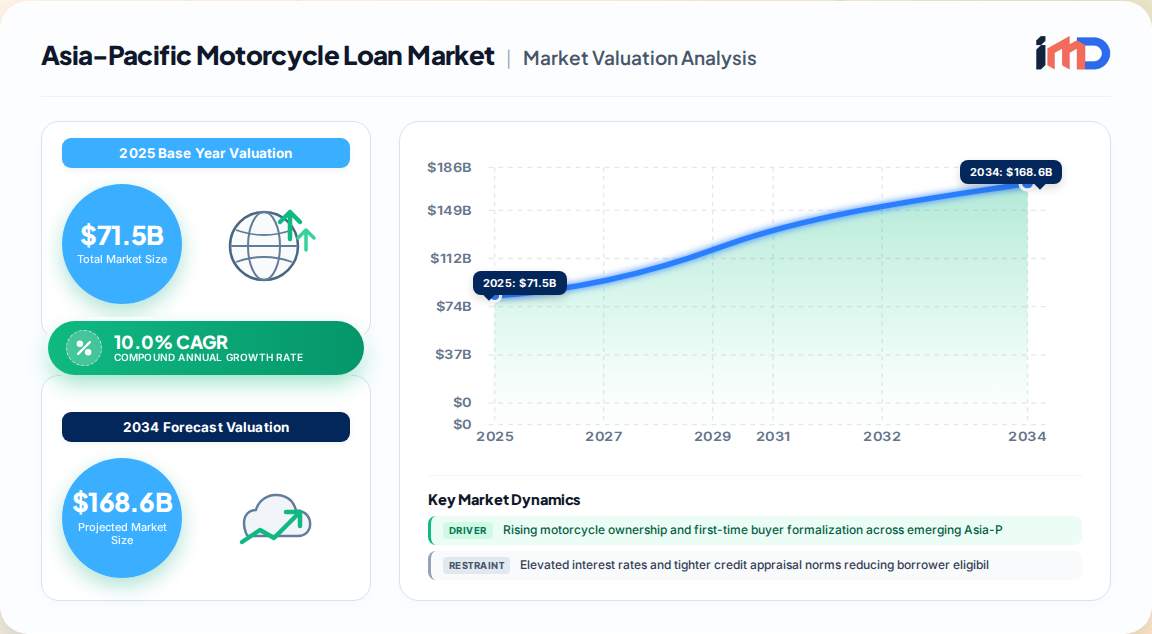
The Asia-Pacific motorcycle loan market is valued at USD 71.5 billion in 2025 and is projected to reach USD 115.15 billion by 2030, expanding at a 10.0% CAGR over the forecast period. This growth is anchored in a deep, structurally expanding two-wheeler mobility base—approximately 44.5 billion units of motorcycles and scooters were sold across the region in 2025—and the progressive formalization of retail credit in emerging ASEAN and South Asian economies.
Unlike more mature vehicle finance segments, the motorcycle loan market in Asia-Pacific is characterized by low market concentration, a diverse lender universe encompassing banks, NBFCs, OEM captive financiers, and fintech platforms, and pronounced country-level heterogeneity in interest rate structures, regulatory regimes, and consumer credit behavior. Our proprietary bottom-up modeling indicates that roughly 62% of new two-wheeler purchases in India and Vietnam are now credit-intermediated, compared to under 40% in the Philippines and Indonesia—leaving substantial headroom for loan penetration-led growth independent of unit sales.
| Metric | 2025 Value | 2030 Forecast | CAGR (2025–2030) |
|---|---|---|---|
| Market Size (USD Billion) | 71.5 | 115.15 | 10.0% |
| Two-Wheeler Unit Base (Million Units, 2025) | ~44.5 | ~58.0 | ~5.4% |
| Loan Penetration (New Vehicle, Blended) | ~55% | ~68% | — |
| Market Concentration | Low | Low–Moderate | — |
1. Rising Motorcycle Ownership and First-Time Buyer Formalization Motorcycles remain the most affordable motorized personal transport option across Asia-Pacific. In India alone, domestic two-wheeler sales reached 20.5 million units in CY2025, sustaining replacement demand and first-time purchases in Tier-2 and Tier-3 cities. Each incremental million units sold expands the addressable financing pool by an estimated USD 1.2–1.8 billion at prevailing average ticket sizes.
2. Customized and Digital-First Loan Products Lenders are shifting from standardized installment structures to customized tenure and down-payment configurations. Embedded point-of-sale financing at dealerships now enables real-time approvals, compressing disbursement cycles from days to minutes. This directly raises conversion rates, particularly among younger, credit-thin borrowers.
3. Urbanization and Gig-Economy Demand Rapid urban migration and the expansion of last-mile delivery platforms across Southeast Asia have created recurring commercial two-wheeler demand. Fleet operators and individual delivery riders constitute a distinct borrower segment with predictable income streams and high vehicle utilization, supporting lower default risk and specialized lending products.
4. Policy-Backed Electrification Government incentive programs—such as India's PM E-DRIVE scheme, which allocated USD 1.3 billion to support electric two-wheeler rollout—are narrowing upfront cost gaps and stimulating specialized EV financing. Lenders are partnering with OEMs to offer subvention schemes and lower interest rates for battery-powered vehicles, creating a new loan product category with significant long-term upside.
The Asia-Pacific motorcycle loan value chain comprises four principal lender archetypes, each with distinct cost structures and risk appetites:
| Provider Type | Core Strength | Typical Ticket Size | Key Constraint |
|---|---|---|---|
| Banks | Low cost of funds, branch reach | Mid to high | Slower underwriting cycles |
| NBFCs | Speed, flexible credit norms | Low to mid | Higher cost of funds |
| OEM Captives | Dealer integration, subvention capability | All segments | Captive to single brand |
| Fintech Platforms | Digital onboarding, alternative data | Low | Funding access and scale |
Downstream, dealership networks and organized re-commerce platforms are increasingly embedding credit at the point of sale. This proximity to the customer has proven critical for sustaining volume growth in competitive markets. Upstream, funding availability from capital markets and securitization channels—supported by the broader deepening of Asian capital markets—remains a key determinant of lender capacity to scale.
India dominates the regional market, accounting for an estimated 32% of Asia-Pacific motorcycle loan value. Favorable demographics, low interest rates relative to regional peers, and high motorcycle penetration underpin its leadership. Lenders in India increasingly offer online loan applications and differentiated pricing based on creditworthiness, deepening market access.
China represents the second-largest market at approximately 22% share, though growth is tempered by a maturing two-wheeler fleet and a faster shift toward electric scooters with distinct financing profiles. Japan contributes a stable 12% share, characterized by high credit penetration and low default rates.
Southeast Asian markets—Vietnam (9%), Indonesia (8%), and Thailand (6%)—collectively represent the fastest-growing sub-region, driven by youthful demographics, rising disposable incomes, and increasing formalization of consumer credit. Australia (4%) operates as a mature, high-ticket market with strong bank participation.
The Asia-Pacific motorcycle loan market is highly competitive and fragmented, with no single lender holding dominant share. Competition centers on interest rate pricing, repayment flexibility, and value-added services. Recent strategic moves include:
Fintech entrants are aggressively scaling digital two-wheeler financing, with platforms such as OTO Capital reporting committed lending partner disbursement capacity exceeding INR 800 crore over a 12-month horizon.
Several high-potential white spaces emerge from our analysis:
While motorcycle loans are financial products without direct trade flows, the underlying vehicle supply chain critically shapes credit demand and collateral values. Asia-Pacific is the world's dominant two-wheeler production and export hub, with India, China, and ASEAN economies supplying motorcycles and components globally. Supply chain disruptions—whether from semiconductor shortages, battery raw material price volatility (lithium prices fell more than 80% from their 2022 peak through early 2025), or trade policy uncertainty—transmit directly into vehicle availability, pricing, and therefore loan demand and collateral valuations. Lenders with diversified OEM relationships and robust inventory finance frameworks are better positioned to manage these supply-side shocks.
| Aspects | Details |
|---|---|
| Study Period | 2020-2034 |
| Base Year | 2025 |
| Estimated Year | 2026 |
| Forecast Period | 2026-2034 |
| Historical Period | 2020-2025 |
| Growth Rate | CAGR of 10.0% from 2020-2034 |
| Segmentation |
|
By Vehicle Type
By Loan Type
By Percentage of Amount Sanctioned
By Tenure
| By Geography |
|
The Asia-Pacific motorcycle loan market is estimated at USD 71.5 billion in 2025 and is projected to reach USD 115.15 billion by 2030, growing at a 10% CAGR.
India dominates the regional market, accounting for approximately 32% of Asia-Pacific motorcycle loan value, driven by high motorcycle penetration, favorable interest rates, and expanding digital lending access.
The market is segmented into banks, non-banking financial companies (NBFCs), OEM captive financiers, and fintech companies. Banks hold the largest share, while fintech platforms are the fastest-growing provider type.
Key drivers include rising motorcycle ownership, urbanization, customized loan products, digital lending platforms, gig-economy demand for commercial two-wheelers, and policy-backed electrification initiatives such as India's PM E-DRIVE scheme.
Major players include Ford Motor Credit Company, Toyota Financial Services, China International Capital Corporation, Citi Bank, and Mitsubishi HC Capital Asia Pacific, alongside regional banks and NBFCs.
The market is expected to grow at a CAGR of 10% from 2025 to 2030, reaching USD 115.15 billion by the end of the forecast period.
Our rigorous research methodology combines multi-layered approaches with comprehensive quality assurance, ensuring precision, accuracy, and reliability in every market analysis.
| Stakeholder Role | Interview Share (%) |
|---|---|
| Chief Risk Officer | 25% |
| Head of Two-Wheeler Lending | 30% |
| Retail Credit Product Manager | 28% |
| Dealer Finance Operations Director | 17% |
| Company Type | Representation (%) |
|---|---|
| Banks | 35% |
| Non-Banking Financial Companies (NBFCs) | 28% |
| OEM Captive Financiers | 20% |
| Fintech Lending Platforms | 12% |
| Credit Bureaus and Aggregators | 5% |
 Related Reports


Analyst at Providence Strategic Partners at Petaling Jaya
I have received the report already. Thanks you for your help.it has been a pleasure working with you. Thank you again for a good quality report

Internationalization Director
Yes, as a matter of fact we are totally satisfied with both reports that we have purchased and will continue to do so during this process of the internationalization of our brand.

Head of Product Management and Marketing
We are using your report, and it gave us valuable information."

Regional Director, Marketing and Business Development
We've received the report and have reviewed the content. Overall, it looks great and aligns closely with the data we can verify based on our industry knowledge.

VP of Sales
Thank you very much for sharing the report. I have reviewed it and I am very satisfied with the quality and the insights it provides. It will certainly be valuable for our internal discussions.