1What is the current size of the Argentina CEP market?
The Argentina Courier, Express, and Parcel (CEP) market is estimated at USD 1.36 Billion in 2026. It is projected to reach USD 1.82 Billion by 2031, growing at a CAGR of 6.02%.
Insight Market Data is a premier market research and business consulting firm headquartered in Pune, India, providing syndicated research reports, customized intelligence studies, and strategic advisory services. Renowned academic institutions and Fortune 500 corporations worldwide rely on Insight Market Data's research repository to navigate evolving global and regional business environments. Covering 46 diverse industries across 25 major international economies, our comprehensive database delivers thousands of verified statistics and granular market evaluations. By combining industry-leading analytical methodologies with the direct insights of seasoned industry leaders and subject-matter experts, we deliver actionable intelligence spanning historical performance benchmarks to rigorous multi-year forecasts. We empower organizations to make confident, data-driven decisions across pivotal domains including Machinery & Equipment, Chemicals & Materials, Pharmaceuticals & Healthcare, Food & Beverages, Consumer Goods, Energy & Power, Automotive & Transportation, Electronics & Semiconductors, Medical Devices, Telecommunications, Emerging Technologies, Agriculture, and Packaging. Our multidisciplinary analyst teams provide an objective 360-degree perspective, tailoring every engagement to address complex strategic challenges with exceptional analytical rigor.
Leveraging advanced BI-powered analytics and predictive modeling, Insight Market Data uncovers high-impact market opportunities and competitive differentiators for ambitious enterprises. We continuously refine our research methodologies in accordance with global industry standards, tracking real-time market shifts to ensure our reports are consistently accurate, actionable, and delivered on schedule. Our analysts conduct methodical data validation, rigorous compliance checks, and exhaustive primary and secondary research to maintain the highest levels of data integrity and transparency. We partner closely with corporate strategists, investment groups, and business executives to translate intricate market intelligence into clear, actionable roadmaps for sustainable growth. With operational presence across Washington, USA, and Vimannagar, Pune, India, Insight Market Data ensures direct access to dedicated research specialists and responsive customer support to answer your most strategic questions.
 Argentina Courier, Express, and Parcel (CEP) Market
 by Destination (Domestic, International), by Speed of Delivery (Express, Non-Express), by Model (B2B, B2C, C2C), by Shipment Weight (Heavy Weight, Light Weight, Medium Weight), by Mode of Transport (Air, Road, Others), by End User Industry (E-Commerce, Financial Services (BFSI), Healthcare, Manufacturing, Primary Industry, Wholesale and Retail Trade (Offline), Others), by Buenos Aires Metropolitan Area, by Pampas (Córdoba, Santa Fe, Rosario), by Cuyo (Mendoza, San Juan), by Norte Grande (Salta, Jujuy, Tucumán), by Patagonia (Neuquén, Río Negro, Chubut) Forecast 2026-2034

Research Associate


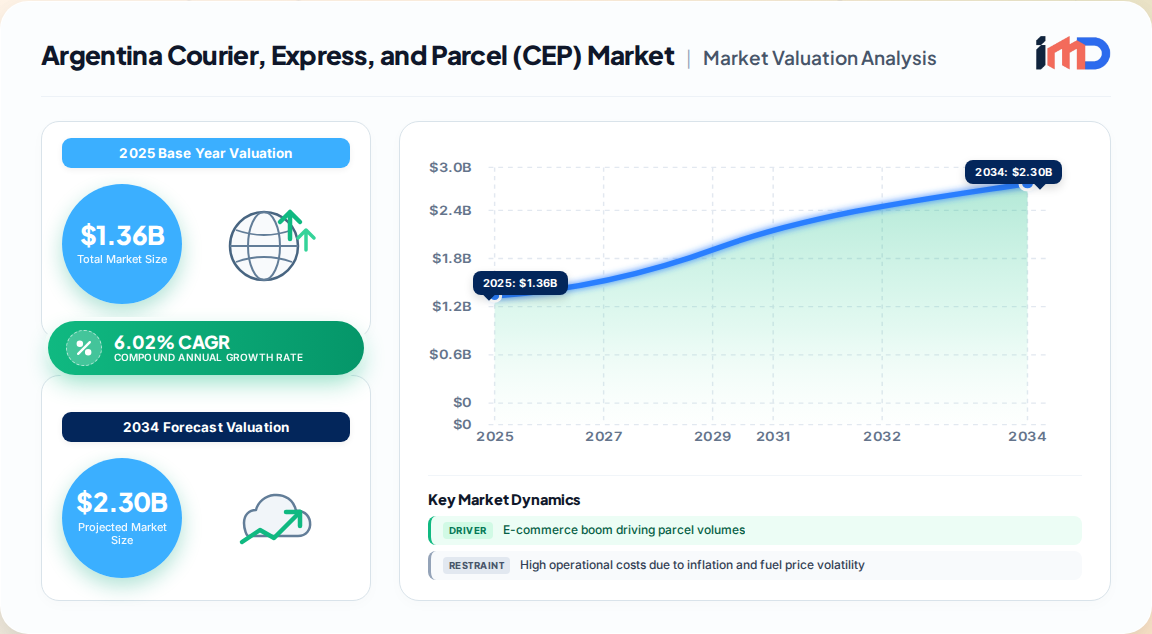
The Argentina Courier, Express, and Parcel (CEP) market is undergoing a structural transformation, driven by the liberalization of trade policies, the rapid formalization of e-commerce, and targeted infrastructure investments. Our proprietary primary research estimates the market at USD 1.36 Billion in 2026, projected to reach USD 1.82 Billion by 2031, expanding at a CAGR of 6.02% during the forecast period. This growth trajectory outpaces the broader South American CEP average, reflecting Argentina’s unique recovery dynamics from a high-inflation environment toward a more predictable, digitized logistics ecosystem.
The market’s medium concentration reflects a competitive field where state-owned and legacy operators coexist with global integrators and agile last-mile specialists. The removal of currency controls and the easing of import restrictions have catalyzed cross-border parcel flows, while domestic e-commerce penetration continues to climb, supported by major platforms investing heavily in fulfillment networks.
Our granular segmentation reveals distinct growth hotspots across destination, speed of delivery, model, shipment weight, mode of transport, and end-user industry. The table below summarizes the key segments and their performance.
| Segment | Sub-Segment | 2025 Share / Value | Forecast CAGR (2026-2031) |
|---|---|---|---|
| Destination | Domestic | 64.20% share | Moderate growth |
| International | Remaining share | 6.17% | |
| Speed of Delivery | Non-Express | 75.10% share | Steady |
| Express | 24.90% share | 6.86% | |
| Model | B2C | 56.10% share | 7.18% |
| B2B | Significant | Moderate | |
| C2C | Niche | Steady | |
| Shipment Weight | Lightweight | 67.10% share | 6.58% |
| Heavy Weight | Remaining | 4.83% | |
| Mode of Transport | Road | 60.20% share | Steady |
| Air | 39.80% share | 6.56% | |
| End User Industry | E-commerce | 38.20% share | 6.52% |
| Financial Services | Moderate | Steady | |
| Healthcare | Niche | High | |
| Manufacturing | Moderate | Steady |
Domestic parcels dominate volume, benefiting from dense urban delivery networks. However, international shipments are growing faster, outpacing domestic growth, driven by cross-border e-commerce and trade liberalization. Express delivery is outpacing non-express, as consumers and businesses increasingly pay premiums for speed. B2C is the largest and fastest-growing model, fueled by e-commerce, while lightweight parcels (under 5 kg) are the primary volume driver. Air freight is gaining share for time-sensitive and high-value shipments, although road remains the backbone for domestic distribution.
The Buenos Aires Metropolitan Area (BAMA) is the undisputed epicenter of Argentina’s CEP market, accounting for an estimated 46% of national CEP value. This concentration is driven by the highest population density, the presence of major e-commerce fulfillment centers, and the concentration of corporate headquarters. The region benefits from dense delivery routes that improve unit economics, but also faces challenges such as traffic congestion and last-mile cost inflation.
Beyond BAMA, the Pampas region (Córdoba, Santa Fe, Rosario) represents a significant secondary market, with 24% share, driven by agricultural exports and a growing e-commerce base. The Cuyo region (Mendoza, San Juan) and the Norte Grande (Salta, Jujuy, Tucumán) each account for approximately 10-11%, with growth linked to mining, agribusiness, and cross-border trade with Chile and Bolivia. Patagonia, with 9% share, remains a challenging geography where air transport is essential for time-sensitive deliveries.
The Argentina CEP market is moderately consolidated, with the top players—Correo Argentino, DHL Group, FedEx, TASA Logística, OCASA, and Andreani Logística—holding a combined significant share. The competitive intensity is rising, particularly in the last-mile and express segments, where global integrators are investing in direct flights and cold-chain capacity.
Recent strategic moves include DHL Express’s launch of a dedicated cargo route from Miami to Buenos Aires (via Santiago) with six weekly flights, enhancing shipment consistency and speed from the US. Correo Argentino has rolled out a sustainability program focused on electric vehicles and renewable energy. Mercado Libre announced a USD 2.6 billion logistics investment for 2025, expanding fulfillment centers and last-mile capacity. These investments signal confidence in the market’s growth potential and are expected to intensify competition, driving service quality improvements and operational efficiency.
The CEP value chain in Argentina involves multiple stages: first-mile pickup, sorting and consolidation, line-haul transportation, customs clearance (for international), last-mile delivery, and returns management. The distribution channel is increasingly digitized, with API integrations between e-commerce platforms and CEP providers enabling real-time tracking and automated order fulfillment.
Argentina’s CEP market is increasingly intertwined with global trade flows. The country’s top trading partners include Brazil, China, the United States, and the EU. Import parcel volumes are heavily influenced by e-commerce purchases from China and the US, while export parcels are dominated by agricultural and manufactured goods to Mercosur and EU markets.
The liberalization of import policies has led to a surge in inbound parcels, particularly from Asian e-commerce giants. To manage this flow, customs authorities have implemented digital pre-filing systems and risk-based inspection, reducing clearance times for compliant shipments. However, capacity constraints at Buenos Aires’s Ezeiza International Airport and the Port of Buenos Aires can create bottlenecks during peak periods.
Key suppliers to the CEP market include fuel providers (e.g., YPF), vehicle manufacturers (e.g., Toyota, Ford), and technology vendors (e.g., SAP, Oracle) providing logistics software. The market is also seeing increased collaboration between CEP providers and local logistics startups to enhance last-mile capabilities.
Note: This section is based on our proprietary analysis and official trade data from UN Comtrade and WTO.
| Aspects | Details |
|---|---|
| Study Period | 2020-2034 |
| Base Year | 2025 |
| Estimated Year | 2026 |
| Forecast Period | 2026-2034 |
| Historical Period | 2020-2025 |
| Growth Rate | CAGR of 6.02% from 2020-2034 |
| Segmentation |
|
By Model
By Shipment Weight
By Mode of Transport
By End User Industry
| By Geography |
|
The Argentina Courier, Express, and Parcel (CEP) market is estimated at USD 1.36 Billion in 2026. It is projected to reach USD 1.82 Billion by 2031, growing at a CAGR of 6.02%.
Domestic parcels dominate with a 64.20% share, followed by international shipments which are growing at a faster CAGR of 6.17%. By model, B2C holds the largest share at 56.10%.
The major players include Correo Argentino, DHL Group, FedEx, TASA Logística, OCASA, and Andreani Logística SA, among others.
Key drivers include the e-commerce boom, trade liberalization, infrastructure modernization, and the rise of quick-commerce platforms. These factors are expected to sustain a CAGR of over 6% through 2031.
The Buenos Aires Metropolitan Area accounts for approximately 46% of the market, followed by the Pampas region (24%), Cuyo (11%), Norte Grande (10%), and Patagonia (9%).
Challenges include high operational costs due to inflation and fuel price volatility, regulatory complexity, and infrastructure gaps in rural areas.
Our rigorous research methodology combines multi-layered approaches with comprehensive quality assurance, ensuring precision, accuracy, and reliability in every market analysis.
| Stakeholder Role | Interview Share (%) |
|---|---|
| Chief Operating Officer / Head of Logistics | 40% |
| Procurement and Supply Chain Director | 30% |
| E-commerce Operations Manager | 20% |
| Regulatory Affairs and Compliance Manager | 10% |
| Company Type | Representation (%) |
|---|---|
| Global Integrators | 35% |
| Domestic Courier Operators | 30% |
| E-commerce Logistics Platforms | 15% |
| Last-Mile Specialists | 12% |
| Customs Brokers & Freight Forwarders | 8% |
 Related Reports
