1What is the current size of the Anti-Drone Laser Weapons Market?
The global Anti-Drone Laser Weapons Market was valued at **USD 1.7 Billion in 2025** and is projected to reach **USD 5.2 Billion by 2034**, growing at a CAGR of 15%.
Insight Market Data is a premier market research and business consulting firm headquartered in Pune, India, providing syndicated research reports, customized intelligence studies, and strategic advisory services. Renowned academic institutions and Fortune 500 corporations worldwide rely on Insight Market Data's research repository to navigate evolving global and regional business environments. Covering 46 diverse industries across 25 major international economies, our comprehensive database delivers thousands of verified statistics and granular market evaluations. By combining industry-leading analytical methodologies with the direct insights of seasoned industry leaders and subject-matter experts, we deliver actionable intelligence spanning historical performance benchmarks to rigorous multi-year forecasts. We empower organizations to make confident, data-driven decisions across pivotal domains including Machinery & Equipment, Chemicals & Materials, Pharmaceuticals & Healthcare, Food & Beverages, Consumer Goods, Energy & Power, Automotive & Transportation, Electronics & Semiconductors, Medical Devices, Telecommunications, Emerging Technologies, Agriculture, and Packaging. Our multidisciplinary analyst teams provide an objective 360-degree perspective, tailoring every engagement to address complex strategic challenges with exceptional analytical rigor.
Leveraging advanced BI-powered analytics and predictive modeling, Insight Market Data uncovers high-impact market opportunities and competitive differentiators for ambitious enterprises. We continuously refine our research methodologies in accordance with global industry standards, tracking real-time market shifts to ensure our reports are consistently accurate, actionable, and delivered on schedule. Our analysts conduct methodical data validation, rigorous compliance checks, and exhaustive primary and secondary research to maintain the highest levels of data integrity and transparency. We partner closely with corporate strategists, investment groups, and business executives to translate intricate market intelligence into clear, actionable roadmaps for sustainable growth. With operational presence across Washington, USA, and Vimannagar, Pune, India, Insight Market Data ensures direct access to dedicated research specialists and responsive customer support to answer your most strategic questions.
 Anti-Drone Laser Weapons Market
 by Type (High Energy Laser Systems, Fiber Laser Systems), by Platform (Ground-based, Handheld, Mobile, Naval, Airborne, Space), by Application (Military & Defense, Commercial, Homeland Security), by Range (Short Range (Up to 1 km), Medium Range (1 km - 5 km), Long Range (Above 5 km)), by End-User (Government & Defense, Aerospace & Defense Contractors), by North America (USA, Canada, Mexico), by Europe (Germany, UK, France, Italy, Netherlands), by Asia Pacific (China, Japan, South Korea, India, Australia), by Middle East & Africa (Saudi Arabia, UAE, Israel, Turkey), by South America (Brazil, Argentina) Forecast 2026-2034

Research Associate


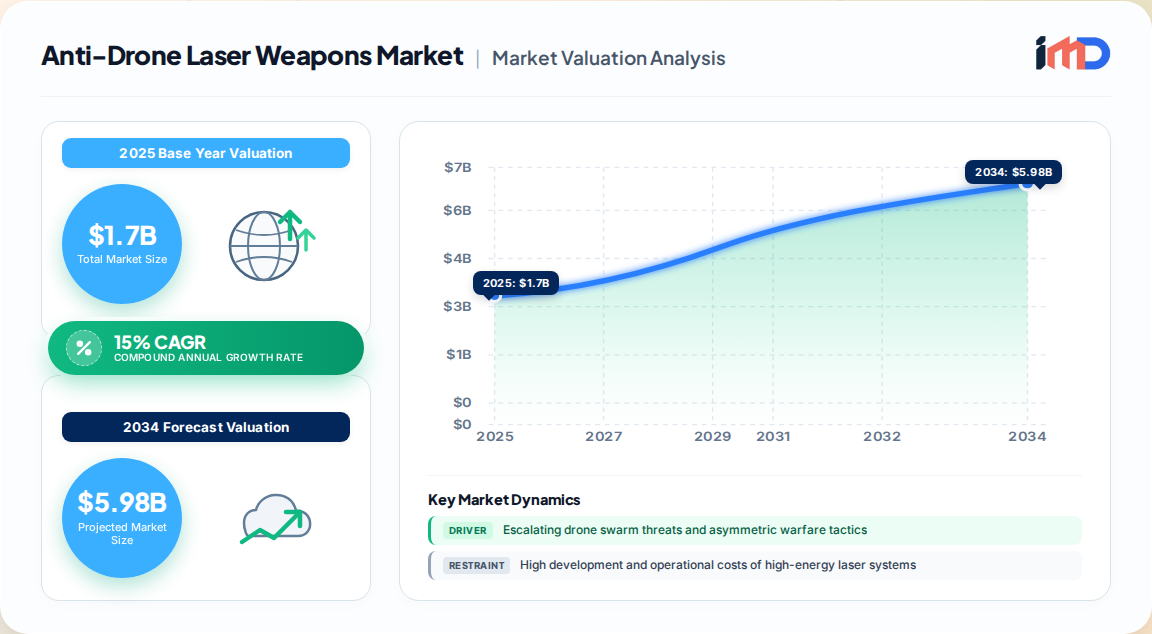
The global Anti-Drone Laser Weapons Market is undergoing a structural transformation from experimental directed-energy prototypes to fielded, combat-proven defense assets. Our proprietary primary research and expert interview cycle estimates the market at USD 1.7 Billion in 2025, with a projected trajectory to USD 5.2 Billion by 2034, representing a robust CAGR of 15% across the forecast period. This expansion is not merely a function of increased defense budgets; it reflects a fundamental recalibration of cost-exchange ratios in modern air defense.
The proliferation of low-cost unmanned aerial systems (UAS) and weaponized commercial drones has rendered traditional kinetic interceptors economically unsustainable. A single short-range interceptor missile can cost between USD 100,000 and USD 500,000, while a modified commercial drone may cost under USD 5,000. Laser-based counter-drone systems, with a marginal cost per shot often estimated in the single-digit dollars, offer a decisive economic counter to the asymmetric drone threat. Our analysis of procurement data indicates that high-energy laser (HEL) systems and fiber laser systems are the primary technology vectors attracting capital, moving from laboratory kill-chain demonstrations to operational deployment on naval vessels, ground vehicles, and fixed installations.
The primary growth engine for this market is the asymmetric cost imbalance of drone defense. Military forces worldwide are prioritizing systems that can engage multiple threats per power cycle at minimal marginal cost. This has accelerated procurement timelines significantly. For instance, the U.S. Air Force's deployment of the Compact Laser Weapon System to undisclosed European locations in 2026 underscores a shift toward layered air defense architectures that integrate laser weapons with electronic warfare and kinetic interceptors.
Despite the bullish outlook, the market faces significant headwinds. High development and operational costs, coupled with technical challenges in power supply and cooling, continue to constrain widespread adoption.
Our market segmentation reveals that ground-based platforms dominate current demand, accounting for an estimated 41.6% share of directed energy weapons spending, driven by ground force counter-UAS and short-range air defense requirements. However, the naval segment is expected to grow at a CAGR of over 11.5% through 2034, as navies integrate high-energy lasers to protect ships against missile and drone threats.
| Segment | Dominant Category | Key Insight |
|---|---|---|
| By Weapon Type | High-Energy Laser Systems | 65.8% share; proven combat effectiveness and technology maturity |
| By Platform | Ground-Based | 41.6% share; immediate counter-UAS deployment demand |
| By Range | Short Range (Up to 1 km) | High demand for base protection and point defense |
| By Application | Military & Defense | Primary revenue driver; homeland security is fastest-growing |
| By End-User | Army | 43.2% share; ground-based counter-drone integration programs |
The fiber laser sub-segment is gaining rapid traction due to its superior beam quality, efficiency, and modular scalability. In April 2025, India's Sahastra Shakti Mk-II(A) 30 kW fiber-laser system achieved a 100% kill probability against fixed-wing UAVs and quadcopter swarms at ranges up to 5 km, demonstrating the operational readiness of fiber-based architectures.
North America commands the largest share of the anti-drone laser weapons market, estimated at 38% of global revenue. This dominance is underpinned by the U.S. military's structured development programs, including the Army's Indirect Fire Protection Capability (IFPC) and the Navy's Laser Weapon System (LaWS). The region is also home to leading defense contractors with extensive directed-energy portfolios.
The market is characterized by a mix of established defense primes and agile technology specialists. Key players include Raytheon Technologies, Lockheed Martin, Northrop Grumman, Israel Aerospace Industries, Avnon HLS (SKYLOCK), DroneShield, and Blighter Surveillance, among others. Competitive strategy is shifting toward open-architecture systems and multi-domain interoperability.
Recent strategic developments underscore the market's momentum:
The value chain for anti-drone laser weapons spans component suppliers, system integrators, and end-users. Critical upstream components include high-power laser diodes, beam directors, optical coatings, and thermal management systems. Supply chain risks are concentrated in rare-earth materials and advanced semiconductor fabrication, where export controls can disrupt production. System integrators, typically large defense contractors, assemble these components into deployable platforms, often leveraging public-private partnerships to accelerate research and development. End-users include military agencies, homeland security departments, and critical infrastructure operators. The trend toward modular, scalable designs is enabling suppliers to offer compact laser modules that can be integrated across multiple platforms, broadening the addressable market.
| Aspects | Details |
|---|---|
| Study Period | 2020-2034 |
| Base Year | 2025 |
| Estimated Year | 2026 |
| Forecast Period | 2026-2034 |
| Historical Period | 2020-2025 |
| Growth Rate | CAGR of 15% from 2020-2034 |
| Segmentation |
|
By Application
By Range
By End-User
| By Geography |
|
The global Anti-Drone Laser Weapons Market was valued at **USD 1.7 Billion in 2025** and is projected to reach **USD 5.2 Billion by 2034**, growing at a CAGR of 15%.
North America holds the largest market share at approximately 38%, driven by extensive U.S. military research and procurement programs for directed energy weapons.
The primary driver is the **asymmetric cost imbalance** of countering cheap drones with expensive missiles. Laser weapons offer a cost-per-shot of just a few dollars, making them economically viable against drone swarms.
Key players include Raytheon Technologies, Lockheed Martin, Northrop Grumman, Israel Aerospace Industries, Avnon HLS (SKYLOCK), and DroneShield, among others.
Our rigorous research methodology combines multi-layered approaches with comprehensive quality assurance, ensuring precision, accuracy, and reliability in every market analysis.
| Stakeholder Role | Interview Share (%) |
|---|---|
| Program Managers for Directed Energy | 35% |
| Chief Technology Officers / Laser Weapon Developers | 25% |
| Defense Procurement Directors | 20% |
| Field Commanders / Counter-UAS Operators | 20% |
| Company Type | Representation (%) |
|---|---|
| High-Power Laser Module Manufacturers | 30% |
| Beam Director & Optics Specialists | 20% |
| System Integration Primes | 25% |
| Military & Defense End-Users | 15% |
| Homeland Security & Critical Infrastructure Operators | 10% |
 Related Reports
