1What is the projected size of the anaerobic systems market by 2033?
Our proprietary research projects the global anaerobic systems market to reach USD 39.4 Billion by 2033, expanding from USD 18.1 Billion in 2025 at a 10.3% CAGR.
Insight Market Data is a premier market research and business consulting firm headquartered in Pune, India, providing syndicated research reports, customized intelligence studies, and strategic advisory services. Renowned academic institutions and Fortune 500 corporations worldwide rely on Insight Market Data's research repository to navigate evolving global and regional business environments. Covering 46 diverse industries across 25 major international economies, our comprehensive database delivers thousands of verified statistics and granular market evaluations. By combining industry-leading analytical methodologies with the direct insights of seasoned industry leaders and subject-matter experts, we deliver actionable intelligence spanning historical performance benchmarks to rigorous multi-year forecasts. We empower organizations to make confident, data-driven decisions across pivotal domains including Machinery & Equipment, Chemicals & Materials, Pharmaceuticals & Healthcare, Food & Beverages, Consumer Goods, Energy & Power, Automotive & Transportation, Electronics & Semiconductors, Medical Devices, Telecommunications, Emerging Technologies, Agriculture, and Packaging. Our multidisciplinary analyst teams provide an objective 360-degree perspective, tailoring every engagement to address complex strategic challenges with exceptional analytical rigor.
Leveraging advanced BI-powered analytics and predictive modeling, Insight Market Data uncovers high-impact market opportunities and competitive differentiators for ambitious enterprises. We continuously refine our research methodologies in accordance with global industry standards, tracking real-time market shifts to ensure our reports are consistently accurate, actionable, and delivered on schedule. Our analysts conduct methodical data validation, rigorous compliance checks, and exhaustive primary and secondary research to maintain the highest levels of data integrity and transparency. We partner closely with corporate strategists, investment groups, and business executives to translate intricate market intelligence into clear, actionable roadmaps for sustainable growth. With operational presence across Washington, USA, and Vimannagar, Pune, India, Insight Market Data ensures direct access to dedicated research specialists and responsive customer support to answer your most strategic questions.
 Anaerobic Systems Market
 by Technology (Wet Anaerobic Digestion, Dry Anaerobic Digestion, Two-Phase Anaerobic Digestion, Batch Anaerobic Digestion), by Offering (Hardware(Digester Tanks, Biogas Handling Equipment, Monitoring & Control Equipment, Feedstock Pre-Processing Equipment), Software(Simulation Software, Energy Modeling Software, Data Management Software), Services(Designing & Installation, Operation & Maintenance)), by Feedstock Type (Agricultural Waste, Industrial Waste, Municipal Waste, Sewage Sludge, Food Waste, Animal Manure), by Capacity (Small-scale, Medium-scale, Large-scale), by Application (Agricultural & Industrial Waste Management, Power Generation, Fuel, Composting, Fertilizers), by End Use (Agriculture, Energy & Utilities, Waste Management, Automotive, Commercial & Residential, Industrial), by North America (USA, Canada, Mexico), by Europe (Germany, UK, France, Italy, Spain, Rest of Europe), by Asia Pacific (China, Japan, India, South Korea, Australia, Rest of Asia Pacific), by South America (Brazil, Argentina, Rest of South America), by Middle East & Africa (Saudi Arabia, UAE, South Africa, Rest of Middle East & Africa) Forecast 2026-2034


Senior Research Analyst

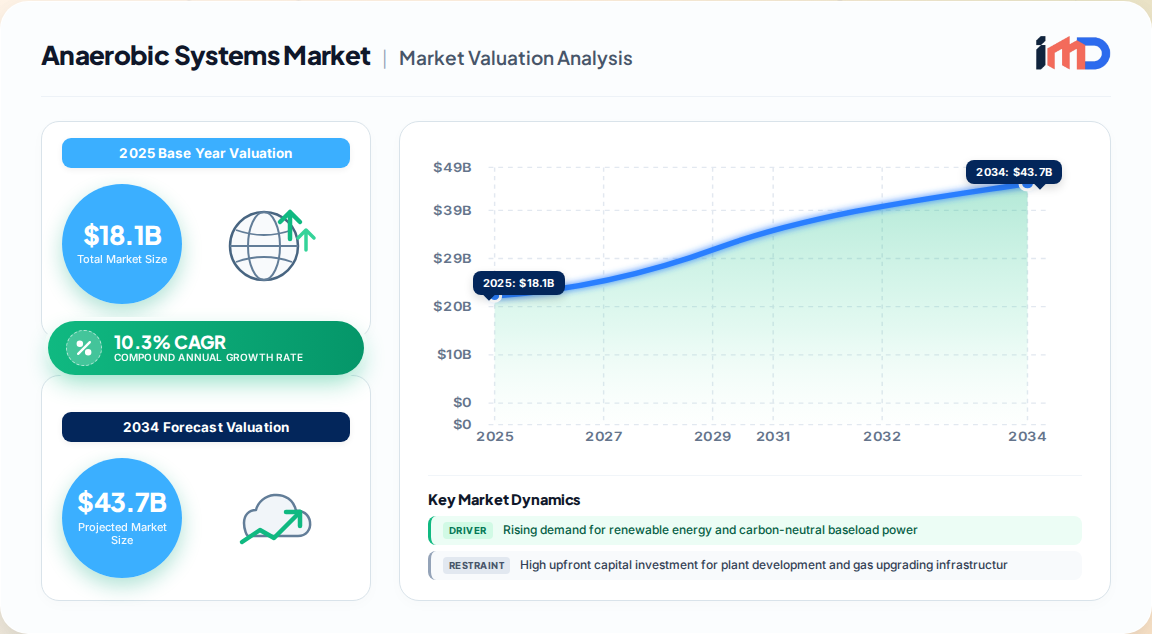
The global anaerobic systems market is entering a structurally mature growth phase, transitioning from a niche waste-treatment cost center into a profit-generating resource-recovery engine. Our proprietary primary research and expert interview program estimate the market at USD 18.1 Billion in 2025, expanding at a 10.3% CAGR to reach USD 39.4 Billion by 2033 — roughly a 2.2x expansion in under a decade.
Anaerobic systems encompass the engineered hardware, software, and services that biologically convert organic matter into biogas, renewable natural gas (RNG), and nutrient-rich digestate in oxygen-free environments. Deployment spans municipal wastewater treatment, agricultural manure and residue processing, industrial organic effluent handling, and food-waste diversion.
Three structural forces underpin this trajectory: binding decarbonization mandates, methane-abatement regulation, and the bankability of RNG offtake contracts. Anaerobic systems are now treated by utilities and industrials as dispatchable baseload renewable assets rather than discretionary sustainability projects.
Demand is being pulled by a concentrated set of regulatory and economic catalysts that our interviews with plant operators and project developers consistently flag.
| Force | Impact on Anaerobic Systems Demand |
|---|---|
| Rising renewable energy demand | Biogas as dispatchable, carbon-neutral baseload power and transport fuel |
| Methane-emission regulation | Capturing landfill and manure methane becomes compliance-driven |
| Waste-diversion mandates | Landfill diversion of organic waste forces AD capacity buildout |
| Circular-economy targets | Digestate valorized as bio-fertilizer, improving project economics |
| High upfront CAPEX | Principal barrier for small and mid-scale operators |
| Feedstock supply-chain complexity | Segregation and transport logistics constrain operational consistency |
| Permitting timelines | Lengthy approvals delay project COD and financing close |
Technology choice is increasingly dictated by feedstock moisture content and project scale. Wet anaerobic digestion retains dominant share on the strength of operational maturity and proven scalability at municipal and agricultural facilities.
On feedstock, agricultural waste and industrial organic waste dominate volumes, while food waste is the fastest-growing feedstock category in our model due to retail and food-processing diversion programs. By end use, agriculture accounts for over 30% of value, with the energy sector the fastest-accelerating buyer as RNG contracts scale.
The anaerobic systems value chain is differentiated by engineering intensity and long asset lifecycles.
Hardware accounts for the largest offering share at approximately 46.7%, reflecting the capital-equipment intensity of plant buildout. Procurement is shifting toward design-build-operate bundled contracts, with O&M retained by the technology provider to protect performance guarantees on methane yield.
Regional momentum is uneven and driven by policy maturity, feedstock availability, and gas infrastructure depth.
| Region | Position | Key Characteristics |
|---|---|---|
| North America | Largest share (~35.1%) | Large-scale agriculture, RNG project investment, pipeline injection |
| Europe | Mature leader | Stringent regulation, high renewable subsidies, grid integration |
| Asia-Pacific | Fastest-growing | Urbanization, industrial scale-up in China and India, decentralized solutions |
| Latin America | Emerging | Agro-industrial byproduct conversion, economic necessity |
| Middle East & Africa | Incremental | Water treatment and food-security investment in arid climates |
Europe retains a high-tech optimization focus with strong biomethane grid injection, while Asia-Pacific's growth is propelled by scalable waste-to-energy demand and rapid urbanization. North America's trajectory is anchored in high-capacity industrial and agricultural RNG applications.
The competitive arena blends diversified environmental-services majors, specialized AD engineering firms, and technology entrants in monitoring and automation.
Recent strategic activity confirms consolidation around RNG: energy majors acquiring biogas platforms, technology providers merging to bundle upgrading with digestion, and modular decentralized designs gaining traction to shorten project timelines. Competitive advantage increasingly rests on guaranteed methane yield, integrated upgrading capability, and digital O&M.
The most defensible white-space sits at the intersection of anaerobic systems and digital optimization. Plants that deploy AI-driven feed-forward control can lift methane output materially without additional CAPEX, creating a services-led revenue stream for technology providers.
The forward view through 2033 is one of sustained double-digit expansion, moderated only by CAPEX cycles and permitting friction. Stakeholders that secure feedstock access and offtake certainty will capture disproportionate value in this maturing but still high-growth market.
| Aspects | Details |
|---|---|
| Study Period | 2020-2034 |
| Base Year | 2025 |
| Estimated Year | 2026 |
| Forecast Period | 2026-2034 |
| Historical Period | 2020-2025 |
| Growth Rate | CAGR of 10.3% from 2020-2034 |
| Segmentation |
|
By Feedstock Type
By Capacity
By Application
By End Use
| By Geography |
|
Our proprietary research projects the global anaerobic systems market to reach USD 39.4 Billion by 2033, expanding from USD 18.1 Billion in 2025 at a 10.3% CAGR.
Wet anaerobic digestion holds the largest share at approximately 52.2% in 2025, driven by operational maturity and scalability, while two-phase anaerobic digestion is the fastest-growing at a 13.3% CAGR.
North America leads with roughly 35.1% of global revenue in 2025, while Asia-Pacific is the fastest-growing region on the back of urbanization and industrial waste-to-energy demand.
Key drivers include rising renewable energy demand, methane-emission regulation, landfill diversion mandates, and the bankability of renewable natural gas offtake contracts.
The software segment is growing fastest at 11.7% CAGR, fueled by SCADA integration, energy-modeling tools, and AI-driven process optimization.
Our rigorous research methodology combines multi-layered approaches with comprehensive quality assurance, ensuring precision, accuracy, and reliability in every market analysis.
| Stakeholder Role | Interview Share (%) |
|---|---|
| Plant Operations Director | 32% |
| Chief Sustainability Officer | 24% |
| Wastewater Treatment Manager | 26% |
| Procurement Director | 18% |
| Company Type | Representation (%) |
|---|---|
| Digester & Biogas Equipment OEMs | 30% |
| EPC & Plant Design-Build Firms | 22% |
| Biogas Upgrading Technology Providers | 18% |
| Industrial & Municipal Waste Generators | 18% |
| O&M Service Providers | 12% |
 Related Reports
