Insight Market Data is a premier market research and business consulting firm headquartered in Pune, India, providing syndicated research reports, customized intelligence studies, and strategic advisory services. Renowned academic institutions and Fortune 500 corporations worldwide rely on Insight Market Data's research repository to navigate evolving global and regional business environments. Covering 46 diverse industries across 25 major international economies, our comprehensive database delivers thousands of verified statistics and granular market evaluations. By combining industry-leading analytical methodologies with the direct insights of seasoned industry leaders and subject-matter experts, we deliver actionable intelligence spanning historical performance benchmarks to rigorous multi-year forecasts. We empower organizations to make confident, data-driven decisions across pivotal domains including Machinery & Equipment, Chemicals & Materials, Pharmaceuticals & Healthcare, Food & Beverages, Consumer Goods, Energy & Power, Automotive & Transportation, Electronics & Semiconductors, Medical Devices, Telecommunications, Emerging Technologies, Agriculture, and Packaging. Our multidisciplinary analyst teams provide an objective 360-degree perspective, tailoring every engagement to address complex strategic challenges with exceptional analytical rigor.
Leveraging advanced BI-powered analytics and predictive modeling, Insight Market Data uncovers high-impact market opportunities and competitive differentiators for ambitious enterprises. We continuously refine our research methodologies in accordance with global industry standards, tracking real-time market shifts to ensure our reports are consistently accurate, actionable, and delivered on schedule. Our analysts conduct methodical data validation, rigorous compliance checks, and exhaustive primary and secondary research to maintain the highest levels of data integrity and transparency. We partner closely with corporate strategists, investment groups, and business executives to translate intricate market intelligence into clear, actionable roadmaps for sustainable growth. With operational presence across Washington, USA, and Vimannagar, Pune, India, Insight Market Data ensures direct access to dedicated research specialists and responsive customer support to answer your most strategic questions.
Airport Furniture Market Size, CAGR & 2032 Outlook
Airport Furniture Market
Hospitality and Tourism / MARKET REPORT
Airport Furniture Market | Insight Market Data
Airport Furniture Market by Product Type (Seating, Tables and Workstations, Charging Stations, Retail and Food Court Furniture, Other Accessories), by Material (Metal, Plastic and Composite, Wood, Upholstered), by Application (Terminal Seating, Lounges, Retail and Dining, Outdoor and Landside), by North America (USA, Canada, Mexico), by Europe (Germany, UK, France, Italy), by Asia Pacific (China, Japan, India, Southeast Asia), by South America (Brazil, Colombia), by Middle East & Africa (UAE, Saudi Arabia, South Africa) Forecast 2026-2034
Luxury hotel industry market valued at USD 118.4 billion in 2026, projected to reach USD 196.7 billion by 2033 at a 7.5% CAGR. Explore trends and insights.
Nov 2026|270 pages
$2900.00
Hotel self check-in and check-out kiosk market to reach $4.98 Billion by 2032 at 11% CAGR. Explore growth pathways, pricing, ROI and deployment strategies.
Nov 2026|244 pages
$2900.00
Airport retailing market to reach USD 187.67 Billion by 2035, growing at 15% CAGR. Explore duty-free, fashion, and digital retail trends.
Nov 2026|208 pages
$2900.00
The global airline IT solutions market is valued at $22.5 billion, growing at an 8.8% CAGR through 2033. Explore key trends, segmentation, and regional insights.
Nov 2026|222 pages
$2900.00
Airport sleeping pods market valued at USD 87.9M in 2025, growing at 7.1% CAGR to reach USD 175.6M by 2035. Get in-depth analysis, trends, and regional outlook.
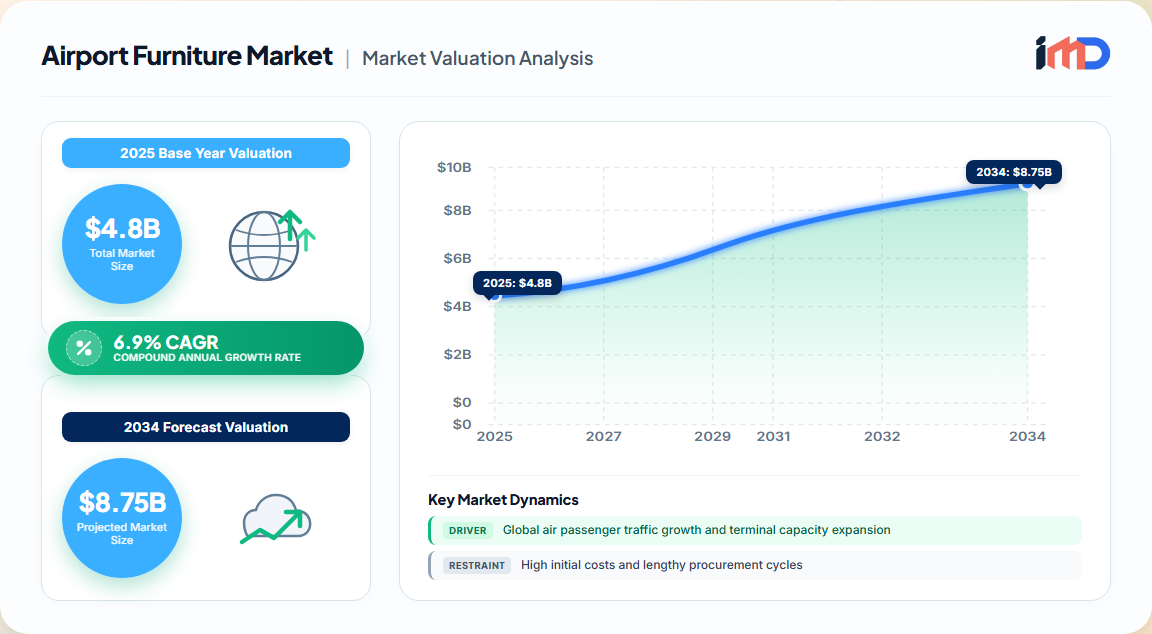
The global airport furniture market represents a critical yet often underappreciated segment of aviation infrastructure spending. Our proprietary first-party research estimates the market at USD 4.8 Billion in 2025, projected to reach USD 7.7 Billion by 2032, expanding at a CAGR of 6.9%. This growth is underpinned by unprecedented global terminal modernization programs, rising passenger traffic exceeding pre-pandemic levels, and a strategic shift toward passenger-centric terminal design.
Airport Furniture Market Market Size (In Billion)
7.5B
6.0B
4.5B
3.0B
1.5B
0
4.800 B
2025
5.131 B
2026
5.485 B
2027
5.864 B
2028
6.268 B
2029
6.701 B
2030
7.163 B
2031
Airport furniture encompasses a diverse range of products including seating (gate seating, lounge chairs, benches), tables and workstations, charging stations, retail and food court furniture, and public space accessories. The market is characterized by long replacement cycles, stringent safety and durability standards, and increasing integration of technology and sustainability features.
Market Size (2025): USD 4.8 Billion
Forecast (2032): USD 7.7 Billion
CAGR (2025–2032): 6.9%
Largest Region: Asia-Pacific (43% share)
Fastest-Growing Segment: Smart seating with integrated charging and data analytics
Key Market Drivers & Restraints
Drivers
Air passenger traffic growth: Global air passenger numbers are projected to reach 10 billion by 2040, according to ICAO and IATA data, necessitating expanded terminal capacity and furniture.
Terminal modernization and new airport construction: Over 150 major airport expansion projects are underway globally, particularly in Asia-Pacific and the Middle East, driving demand for high-specification furniture.
Enhanced passenger experience focus: Airports are increasingly investing in comfortable, durable, and aesthetically pleasing furniture to improve passenger satisfaction and retail dwell time.
Sustainability mandates: Many airport operators now require furniture made from recycled materials, with low VOC emissions and end-of-life recyclability, spurring innovation.
Technology integration: Demand for seating with built-in power outlets, USB ports, wireless charging, and occupancy sensors is growing rapidly.
Restraints
High initial costs and budget constraints: Premium airport furniture commands significant capital outlay, and public procurement cycles can be lengthy and unpredictable.
Durability and maintenance challenges: Furniture must withstand heavy use, security requirements, and frequent cleaning, leading to high replacement costs.
Supply chain disruptions: Fluctuations in raw material prices (aluminum, steel, plastics) and logistics bottlenecks can impact project timelines and costs.
Value Chain and Supply Dynamics
The airport furniture value chain comprises raw material suppliers, component manufacturers, furniture OEMs, distributors, and airport operators. Key raw materials include metals (aluminum, steel), plastics, wood, upholstery fabrics, and electronic components for smart furniture.
Raw material suppliers: Provide metals, plastics, and textiles; subject to commodity price volatility.
Component manufacturers: Produce seating frames, charging modules, and sensors.
Furniture OEMs: Design, manufacture, and assemble finished products; often hold certifications for fire safety and durability.
Distributors and integrators: Supply to airports, often through tenders; may offer installation and maintenance services.
Airport operators: End-users responsible for procurement, often via public-private partnerships.
Supply chain risks include dependency on Asian manufacturing hubs for components, geopolitical trade tensions, and logistical challenges. OEMs are increasingly diversifying sourcing and adopting modular designs for easier maintenance.
Import/Export & Supplier Dynamics
Global trade in airport furniture is significant, with major manufacturing hubs in Asia-Pacific (China, Southeast Asia) and Europe. According to UN Comtrade data, global exports of airport seating and related furniture exceeded USD 1.2 Billion in 2024, with China accounting for approximately 35% of exports. Europe and North America are net importers, sourcing from Asian manufacturers to meet project demands.
China: Dominates low-to-mid-range furniture exports; increasingly moving up the value chain with smart seating solutions.
Europe: Strong in high-end, design-centric furniture; major exporters include Germany and Italy.
North America: Primarily imports finished goods but maintains domestic production for customized and high-security applications.
Middle East: Emerging as a re-export hub, with investments in local manufacturing for airport projects.
Supplier dynamics are shifting toward strategic partnerships and long-term contracts with OEMs to ensure quality and timely delivery. Airport operators are increasingly demanding traceability and sustainability certifications from suppliers.
Segmentation Analysis
By Product Type
Seating: Largest segment, accounting for 45% of market revenue in 2025; includes gate seating, lounge chairs, and benches.
Tables and Workstations: Growing demand for productivity-friendly furniture; 20% share.
Retail and Food Court Furniture:12% share, linked to commercial revenues.
Other Accessories:8% share, including waste bins, planters, and barriers.
By Material
Metal: Dominant material due to durability and security; 50% share.
Plastic and Composite:25% share, growing due to lightweight and design flexibility.
Wood:15% share, used in premium lounges.
Upholstered:10% share, primarily in premium areas.
By Application
Terminal Seating:40% share.
Lounges:25% share, growing with premium passenger services.
Retail and Dining:20% share.
Outdoor and Landside:15% share.
Regional Outlook
Asia-Pacific dominates the market with a 43% share, driven by massive airport construction in China, India, and Southeast Asia. China alone is expected to add over 200 new airports by 2035, creating substantial furniture demand. India's airport modernization program under the National Infrastructure Pipeline is another major contributor.
Airport Furniture Market Regional Market Share
Loading chart...
North America holds 24% share, with mature but upgrading airports investing in passenger experience and sustainability. The U.S. FAA's Airport Improvement Program funds terminal upgrades.
Europe accounts for 22% share, with a focus on energy-efficient and design-led furniture. The EU's Green Deal is influencing procurement policies.
Middle East & Africa represents 6% share, with Gulf Cooperation Council countries investing heavily in mega-hub airports (e.g., Dubai, Doha, Riyadh).
South America holds 5% share, with Brazil and Colombia leading terminal expansions.
Competitive Strategies
The airport furniture market is moderately consolidated, with key players focusing on design innovation, sustainability, and technology integration. Leading companies include Zoeftig, Arconas, Agati, Kusch+Co, Green Furniture Concept, Nurus, Fleetwood, Steelcase, Kahrs, and Wieland. Strategic initiatives include:
Product launches: Smart seating with wireless charging and occupancy sensors, such as Arconas' power-integrated seating.
Sustainability certifications: Many OEMs now offer Cradle to Cradle certified products.
Geographic expansion: Companies are establishing manufacturing and distribution in Asia-Pacific to capture growth.
Partnerships with airports: Co-design and long-term maintenance contracts.
Recent developments:
2024: Zoeftig launched a new range of sustainable seating using recycled aluminum.
2023: Arconas acquired a European seating manufacturer to expand its footprint.
2025: Green Furniture Concept secured a major contract for a Middle Eastern airport expansion.
Strategic White-Space Analysis
Opportunities exist in:
Smart furniture integration: Seating with IoT sensors for predictive maintenance and passenger flow analytics.
Sustainability-focused products: Circular economy models, including furniture-as-a-service and take-back programs.
Emerging markets: Airport projects in Africa, Southeast Asia, and Latin America.
Modular and flexible designs: Adaptable furniture for post-pandemic terminal flexibility.
However, challenges remain in navigating complex procurement processes, currency fluctuations, and meeting diverse regulatory standards across regions.
Airport Furniture Market Regional Market Share
Higher Coverage
Lower Coverage
No Coverage
Airport Furniture Market REPORT HIGHLIGHTS
Aspects
Details
Study Period
2020-2034
Base Year
2025
Estimated Year
2026
Forecast Period
2026-2034
Historical Period
2020-2025
Growth Rate
CAGR of 6.9% from 2020-2034
Segmentation
By Product Type
Seating
Tables and Workstations
Charging Stations
Retail and Food Court Furniture
Other Accessories
Table of Contents
1. Introduction
1.1. Research Scope
1.2. Market Segmentation
1.3. Research Objective
1.4. Definitions and Assumptions
2. Executive Summary
2.1. Market Snapshot
3. Market Dynamics
3.1. Market Drivers
3.1.1. Global air passenger traffic growth and terminal capacity expansion
3.1.2. Airport modernization and new construction projects
3.1.3. Enhanced passenger experience and commercial revenue focus
Table 39: Saudi Arabia Airport Furniture Market Revenue (Billion) Forecast, by Application 2020 & 2034
Table 40: South Africa Airport Furniture Market Revenue (Billion) Forecast, by Application 2020 & 2034
Frequently Asked Questions
1What is the current size of the global airport furniture market?
The global airport furniture market was valued at approximately USD 4.8 Billion in 2025, based on our proprietary primary research. It is projected to grow at a CAGR of 6.9% to reach USD 7.7 Billion by 2032.
2Which region dominates the airport furniture market?
Asia-Pacific holds the largest share, at 43% in 2025, driven by extensive airport construction and modernization projects in China, India, and Southeast Asia. North America and Europe follow with 24% and 22% shares, respectively.
3What are the key trends shaping the airport furniture market?
Major trends include the integration of smart features like wireless charging and occupancy sensors, a strong shift toward sustainable materials and circular design, and modular furniture solutions that enhance terminal flexibility and passenger experience.
4Who are the leading companies in the airport furniture market?
Key players include Zoeftig, Arconas, Agati, Kusch+Co, Green Furniture Concept, Nurus, Fleetwood, Steelcase, Kahrs, and Wieland. These companies compete on design innovation, durability, and sustainability certifications.
5What are the main challenges in the airport furniture market?
Challenges include high initial costs and lengthy procurement cycles, the need for extreme durability under heavy use, and supply chain volatility affecting raw material prices and logistics. Compliance with stringent fire and safety standards also adds complexity.
Methodology
Our rigorous research methodology combines multi-layered approaches with comprehensive quality assurance, ensuring precision, accuracy, and reliability in every market analysis.
Primary Research
Conducted 70–80% of total research effort through direct primary research, including in-depth interviews with senior executives across the airport furniture value chain.
Interviewed procurement directors at airport operators, terminal planning managers at aviation authorities, design and specification engineers at architecture firms, and product managers at furniture OEMs.
Collected quantitative and qualitative data on purchasing criteria, replacement cycles, budget allocation, and technology adoption trends.
Primary interviews spanned 22 countries across five regions, ensuring global representativeness and regional nuance.
Key Stakeholders Interviewed
Key Stakeholders Interviewed
Stakeholder Role
Interview Share (%)
Procurement Directors
35%
Terminal Planning Managers
25%
Design & Specification Engineers
20%
Product Managers
20%
Industry Ecosystem Breakdown
Industry Ecosystem Breakdown
Company Type
Representation (%)
Furniture OEMs
40%
Airport Operators
30%
Design & Architecture Firms
15%
Distributors & Integrators
10%
Raw Material Suppliers
5%
Secondary Research & Industry Benchmarking
20–30% of research derived from secondary sources, including official trade statistics from UN Comtrade, World Bank, OECD, and Eurostat.
Referenced technical standards and guidelines from Airports Council International (ACI), International Air Transport Association (IATA), International Civil Aviation Organization (ICAO), and American Society for Testing and Materials (ASTM).
Utilized financial databases including Bloomberg, Factiva, Hoovers, and PitchBook to verify company financials and market activities.
Cross-referenced airport capital expenditure plans, terminal construction databases, and public procurement records to validate demand-side estimates.
Demand Modeling & Market Estimation
Employed both top-down and bottom-up methodologies simultaneously, reconciled through multi-level data triangulation.
Bottom-up model built from granular quantitative metrics: number of airport terminals globally, average furniture spend per terminal square meter, passenger throughput per terminal, and replacement rate cycles.
Top-down model derived from global airport infrastructure spending, allocating a percentage to furniture and fittings based on historical project data.
Demand forecasts validated against announced terminal expansion projects and airline capacity growth plans.
Data Accuracy & Quality Check
Guaranteed estimated data accuracy level of 85–90%, achieved through rigorous validation protocols.
All data points subjected to multi-level triangulation across primary interviews, secondary benchmarks, and financial databases.
Report updated to the date of purchase, incorporating latest market developments and project announcements.
Quality assurance team reviewed all estimates for internal consistency, logical coherence, and alignment with industry fundamentals.