1What is the airport automated people mover system market size in 2026?
The total APM market is estimated at USD 616.8 million in 2026, with airports accounting for 67% of sales, equivalent to approximately USD 413 million.
Insight Market Data is a premier market research and business consulting firm headquartered in Pune, India, providing syndicated research reports, customized intelligence studies, and strategic advisory services. Renowned academic institutions and Fortune 500 corporations worldwide rely on Insight Market Data's research repository to navigate evolving global and regional business environments. Covering 46 diverse industries across 25 major international economies, our comprehensive database delivers thousands of verified statistics and granular market evaluations. By combining industry-leading analytical methodologies with the direct insights of seasoned industry leaders and subject-matter experts, we deliver actionable intelligence spanning historical performance benchmarks to rigorous multi-year forecasts. We empower organizations to make confident, data-driven decisions across pivotal domains including Machinery & Equipment, Chemicals & Materials, Pharmaceuticals & Healthcare, Food & Beverages, Consumer Goods, Energy & Power, Automotive & Transportation, Electronics & Semiconductors, Medical Devices, Telecommunications, Emerging Technologies, Agriculture, and Packaging. Our multidisciplinary analyst teams provide an objective 360-degree perspective, tailoring every engagement to address complex strategic challenges with exceptional analytical rigor.
Leveraging advanced BI-powered analytics and predictive modeling, Insight Market Data uncovers high-impact market opportunities and competitive differentiators for ambitious enterprises. We continuously refine our research methodologies in accordance with global industry standards, tracking real-time market shifts to ensure our reports are consistently accurate, actionable, and delivered on schedule. Our analysts conduct methodical data validation, rigorous compliance checks, and exhaustive primary and secondary research to maintain the highest levels of data integrity and transparency. We partner closely with corporate strategists, investment groups, and business executives to translate intricate market intelligence into clear, actionable roadmaps for sustainable growth. With operational presence across Washington, USA, and Vimannagar, Pune, India, Insight Market Data ensures direct access to dedicated research specialists and responsive customer support to answer your most strategic questions.
 Airport Automated People Mover System
 by Application (Airport, Urban Transit, Mixed-Use Developments, Theme Parks, Others), by System Type (Duo Rail, Automated Guideway Transit(AGT), Maglev, Monorail, Cable-Propelled Systems, Others), by North America (USA, Canada, Mexico), by Europe (Germany, UK, France, Italy, Spain, Netherlands), by Asia-Pacific (China, Japan, India, South Korea, Singapore, Malaysia, Australia), by Middle East & Africa (GCC Countries, Saudi Arabia, UAE, South Africa, Egypt), by South America (Brazil, Argentina) Forecast 2026-2034

Research Associate


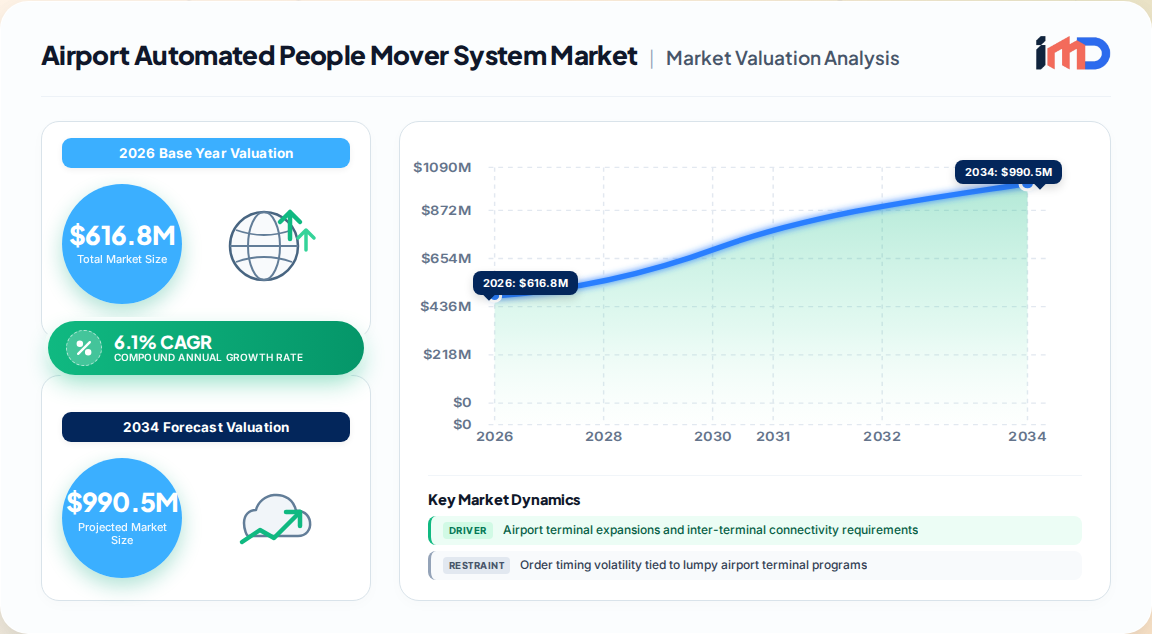
The global airport automated people mover (APM) system market is entering a decade of structural renewal and greenfield expansion. Our proprietary primary research estimates the total APM market—across all applications—at USD 616.8 million in 2026, with airports commanding 67% of application sales, equivalent to approximately USD 413 million. By 2036, the broader APM market is projected to reach USD 1,115.1 million, representing a 6.1% CAGR and an added revenue pool of USD 498.3 million.
Airports are the anchor application because terminals, concourses, remote parking, and rental car centers are too far apart to walk yet too close for conventional bus transit to operate efficiently. This structural imperative ensures that airport APM demand remains largely insulated from broader macroeconomic cycles, tied instead to long-term aviation passenger growth and terminal capital programs.
| Metric | Value (2025–2036) |
|---|---|
| Market Size 2025 | USD 581.3 million (total APM) |
| Market Size 2026 | USD 616.8 million (total APM) |
| Airport Segment Share 2026 | 67% (approx. USD 413 million) |
| Projected Market Size 2036 | USD 1,115.1 million |
| CAGR 2026–2036 | 6.1% |
| Added Revenue 2026–2036 | USD 498.3 million |
| Market Expansion Multiple | 1.8x |
Three dominant trends define the current cycle. First, renewal of first-generation airport systems opened between 2000 and 2010 is the largest block of new orders. Guideways from that era are reaching end-of-life for vehicles and signaling. The April 2026 ten-year renewal of the ATL SkyTrain by Mitsubishi Heavy Industries—covering new signaling, additional vehicles, and replacement units through March 2036—exemplifies this trend. Renewals bundle vehicles, signaling, and maintenance into a decade-long package, incentivizing airports to stay with the incumbent supplier to avoid running two technologies on one guideway.
Second, greenfield mega-projects are reshaping regional order pipelines. Dubai Aviation City Corporation awarded an APM of approximately 50 km with nine stations and 165 vehicles for Al Maktoum International Airport in August 2026, due for completion in December 2031. This single award will anchor the GCC order pipeline for the next five years.
Third, automated operation and maintenance (O&M) is becoming a margin battleground. Crystal Mover Services, part of the MHI Group, has operated the ATL SkyTrain since December 2009 and signed a five-year O&M renewal in December 2024—before the ten-year upgrade contract of 2026. Suppliers holding O&M contracts are first in line for subsequent vehicle and signaling renewals. Robotic guideway inspection is entering O&M contracts as the rail track inspection and maintenance robotics market grows at a projected 12.5% CAGR through 2036.
The airport APM market is segmented by system type and application. Duo rail systems dominate with an estimated 82% of system type sales in 2026, more than ten times the estimated 8% for AGT and maglev. Duo rail's supremacy stems from its proven reliability in high-duty-cycle airport environments, standardized vehicle platforms, and lower lifecycle cost. Monorail and cable-propelled systems serve niche applications—theme parks and low-capacity connectors—while AGT and maglev remain limited by higher infrastructure costs and proprietary control systems.
| Application Segment | Estimated Share 2026 |
|---|---|
| Airport | 67% |
| Urban Transit | 18% |
| Mixed-Use Developments | 7% |
| Theme Parks | 5% |
| Others | 3% |
| Total | 100% |
Within airports, demand splits across three sub-use cases: inter-terminal connectors, concourse-to-concourse circulation, and airport-to-rental-car/parking links. The ATL SkyTrain renewal and Dubai's 50 km system illustrate the range. Urban transit, at 18%, covers AGT and light metro lines such as Singapore's Sengkang-Punggol LRT, where MHI received a follow-up order for 8 two-car trains in October 2026, taking planned deliveries to 33 trainsets.
Asia-Pacific and the Middle East are the fastest-growing regions, though North America remains the largest single market due to its extensive installed base and modernization cycle. Our country-level CAGRs for 2026–2036 show China leading at 6.5%, followed by the GCC Countries at 6.4% (driven by the Dubai Al Maktoum award), and India at 6.3%. South Korea at 6.0% leads a middle group with ASEAN (5.9%) and the United States (5.8%). Japan is lowest at 5.4% on mature AGT networks.
| Country/Region | 2026–2036 CAGR |
|---|---|
| China | 6.5% |
| GCC Countries | 6.4% |
| India | 6.3% |
| South Korea | 6.0% |
| ASEAN | 5.9% |
| United States | 5.8% |
| Japan | 5.4% |
| World | 6.1% |
North America's dominance is underpinned by airport renewals at Atlanta, Denver, and Tampa. Denver International Airport took delivery of 26 Innovia cars in February 2026, with 19 more ordered in 2025. Tampa International Airport put new Innovia R vehicles into service in March 2026. In Asia, Incheon International Airport handled 38.39 million passengers in H1 2026, the busiest in the world, supporting Korea's steady APM investment.
The airport APM market is an oligopoly characterized by high barriers to entry: proprietary guideway and signaling technologies, long qualification cycles, and reference-based procurement. Incumbents with installed bases and O&M contracts hold a decisive advantage in the renewal wave. Mitsubishi Heavy Industries and Alstom are the primary beneficiaries, with Alstom putting the first upgraded Innovia APM R vehicles into passenger service on the Atlanta Plane Train during April–June 2026.
The competitive dynamic is shifting from new-build wins to lifecycle value capture. A typical renewal contract bundles vehicles, signaling, and maintenance for 10–15 years, creating predictable revenue streams. Suppliers without O&M footprints face difficulty displacing incumbents; airports prefer continuity to avoid dual-technology guideways. This dynamic favors early engagement: suppliers should prepare renewal packages for every system older than 15 years ahead of tender.
Airport operators procure APM systems through multi-year, performance-based contracts. Key evaluation criteria include total cost of ownership, proven availability (typically >99.5%), safety record, and interoperability with existing systems. The lumpy nature of APM orders—tied to terminal programs—creates timing risk; Alstom group orders fell 37% to EUR 2,560 million in the three months to June 2026, illustrating order volatility.
Buyers are increasingly integrating APM procurement with broader airport automation budgets, including automated guided vehicles (AGVs) for baggage and apron operations. The AGV market is forecast at an 8% CAGR through 2036, and airport authorities will tender APM and AGV systems from the same automation budget. Suppliers capable of offering integrated people and baggage movement solutions will capture share.
Principal risks include: (1) order timing volatility—APM awards arrive in large, irregular blocks, with each contract delivered over five to ten years; (2) competition for factory slots—APM cars draw on the same supplier base as metro and light rail vehicles, so APM lines compete with metro orders for manufacturing capacity, even with a modest 3.9% CAGR forecast for rolling stock through 2036; (3) long tender cycles—public procurement and political approvals can delay projects by years; and (4) technology disruption—driverless road vehicles and autonomous shuttles could compete for short-haul airport connections. However, these alternatives lack the capacity and reliability of fixed-guideway APMs for high-volume airport circulation, limiting substitution risk.
Renewals of systems opened before 2010 will drive the next wave of APM orders, starting in the United States where Atlanta has committed to a ten-year upgrade and other American airports operate lines of the same vintage. Dubai is the exception, with a 50 km greenfield system for Al Maktoum that will fill the GCC order pipeline until 2031.
We recommend suppliers prioritize three actions: (1) proactive renewal packaging—engage airport operators 3–5 years before system end-of-life with bundled vehicle, signaling, and O&M proposals; (2) O&M capability investment—secure long-term service contracts to lock in renewal rights and generate stable cash flow; and (3) regional footprint expansion—establish local engineering and maintenance hubs in the GCC and Asia-Pacific to capture greenfield and renewal demand. The market's 1.8x expansion by 2036 offers substantial runway for suppliers that align with these structural forces.
| Aspects | Details |
|---|---|
| Study Period | 2020-2034 |
| Base Year | 2026 |
| Estimated Year | 2026 |
| Forecast Period | 2026-2034 |
| Historical Period | 2020-2025 |
| Growth Rate | CAGR of 6.1% from 2020-2034 |
| Segmentation |
|
| By Geography |
|
The total APM market is estimated at USD 616.8 million in 2026, with airports accounting for 67% of sales, equivalent to approximately USD 413 million.
The broader APM market is projected to grow at a 6.1% CAGR from 2026 to 2036, reaching USD 1,115.1 million by 2036.
North America leads with an estimated 39.64% revenue share in 2025, driven by extensive airport renewal programs in Atlanta, Denver, and Tampa.
Dubai Aviation City Corporation awarded an APM of about 50 km with nine stations and 165 vehicles for Al Maktoum International Airport in August 2026, due for completion in December 2031.
Duo rail systems hold an estimated 82% of system type sales in 2026 due to proven reliability, standardized platforms, and lower lifecycle costs in high-duty-cycle airport environments.
Our rigorous research methodology combines multi-layered approaches with comprehensive quality assurance, ensuring precision, accuracy, and reliability in every market analysis.
| Stakeholder Role | Interview Share (%) |
|---|---|
| Airport Operations Director | 35% |
| Capital Program Manager | 30% |
| APM System Engineer | 20% |
| Procurement Head | 15% |
| Company Type | Representation (%) |
|---|---|
| Duo Rail Vehicle OEMs | 35% |
| AGT & Monorail Integrators | 20% |
| Signaling & Control Providers | 20% |
| O&M Service Contractors | 15% |
| Airport Terminal EPCs | 10% |
 Related Reports
