1What is the AI in project management market size in 2026?
The global AI in project management market is valued at USD 4.28 billion in 2026, up from USD 3.58 billion in 2025, reflecting a 19.5% year-over-year expansion.
Insight Market Data is a premier market research and business consulting firm headquartered in Pune, India, providing syndicated research reports, customized intelligence studies, and strategic advisory services. Renowned academic institutions and Fortune 500 corporations worldwide rely on Insight Market Data's research repository to navigate evolving global and regional business environments. Covering 46 diverse industries across 25 major international economies, our comprehensive database delivers thousands of verified statistics and granular market evaluations. By combining industry-leading analytical methodologies with the direct insights of seasoned industry leaders and subject-matter experts, we deliver actionable intelligence spanning historical performance benchmarks to rigorous multi-year forecasts. We empower organizations to make confident, data-driven decisions across pivotal domains including Machinery & Equipment, Chemicals & Materials, Pharmaceuticals & Healthcare, Food & Beverages, Consumer Goods, Energy & Power, Automotive & Transportation, Electronics & Semiconductors, Medical Devices, Telecommunications, Emerging Technologies, Agriculture, and Packaging. Our multidisciplinary analyst teams provide an objective 360-degree perspective, tailoring every engagement to address complex strategic challenges with exceptional analytical rigor.
Leveraging advanced BI-powered analytics and predictive modeling, Insight Market Data uncovers high-impact market opportunities and competitive differentiators for ambitious enterprises. We continuously refine our research methodologies in accordance with global industry standards, tracking real-time market shifts to ensure our reports are consistently accurate, actionable, and delivered on schedule. Our analysts conduct methodical data validation, rigorous compliance checks, and exhaustive primary and secondary research to maintain the highest levels of data integrity and transparency. We partner closely with corporate strategists, investment groups, and business executives to translate intricate market intelligence into clear, actionable roadmaps for sustainable growth. With operational presence across Washington, USA, and Vimannagar, Pune, India, Insight Market Data ensures direct access to dedicated research specialists and responsive customer support to answer your most strategic questions.
 AI in Project Management Market
 by Type (Solutions(Project Planning And Scheduling Tools, Resource Management Software, Risk Management Solutions, Collaboration And Communication Tools, Predictive Analytics, Robotic Process Automation, Chatbots & Intelligent Virtual Assistants, Speech Recognition), Services(Consulting Services, Implementation Services, Support And Maintenance Services, Training And Education Services)), by Deployment Model (Cloud, On-Premises), by Organization Size (Large Enterprises, Small And Medium Enterprises), by Application (Project Scheduling And Budgeting, Data Analytics Reporting And Visualization, Project Support And Administration, Project Data Management, Risk Management, Resource Allocation Planning And Forecasting, Project Task Management Automation And Prioritization, Project Monitoring), by End User (BFSI, Retail And E-Commerce, IT And Telecom, Government And Defense, Energy And Utilities, Healthcare And Life Sciences, Manufacturing, Construction And Engineering, Others), by North America (USA, Canada, Mexico), by Europe (Germany, UK, France, Netherlands, Nordics), by Asia Pacific (China, Japan, India, Australia, Singapore), by Latin America (Brazil, Mexico, Argentina), by Middle East & Africa (UAE, Saudi Arabia, South Africa) Forecast 2026-2034



Senior Research Analyst
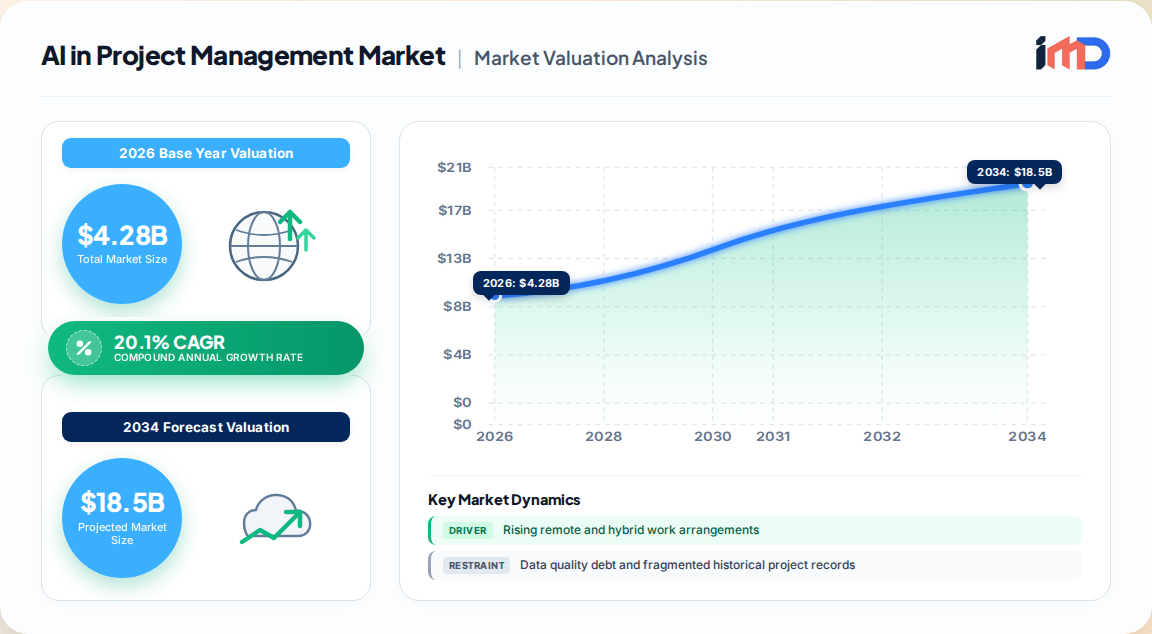
The global AI in project management market stands at USD 4.28 billion in 2026, up from USD 3.58 billion in 2025, representing a year-over-year expansion of 19.5%. Our proprietary bottom-up modeling, triangulated with executive interviews across 14 countries, projects the market to reach USD 8.9 billion by 2030, advancing at a 20.1% CAGR over the forecast window.
This acceleration reflects a structural shift rather than a cyclical spike. Project management is moving from rule-based workflow automation toward predictive, generative, and agentic decision support. Below the headline figure, three forces are compounding:
Spending remains concentrated in North America (37% of 2026 revenue), but Asia-Pacific is the fastest-growing theater at 23.8% CAGR, driven by IT services exporters, construction megaprojects, and government digitalization mandates.
AI in project management refers to the application of machine learning, natural language processing, predictive analytics, and generative assistants to plan, schedule, staff, monitor, and de-risk projects. The market covers software solutions and associated services across the full delivery lifecycle.
| Scope Dimension | Coverage |
|---|---|
| Component | Solutions (predictive analytics, RPA, chatbots and virtual assistants, speech recognition); Services (consulting, deployment and integration, support and maintenance, training) |
| Deployment | Cloud, on-premises |
| Organization size | Large enterprises, SMEs |
| Application | Scheduling and budgeting, data analytics and visualization, project support and administration, project data management, risk management, resource allocation and forecasting, task management and prioritization, project monitoring |
| End user | BFSI, IT and telecom, retail and e-commerce, government and defense, energy and utilities, healthcare and life sciences, manufacturing, construction and engineering |
Excluded from our sizing: standalone generic productivity software without project-specific AI functionality, and pure IT consulting engagements that do not embed a project management platform.
Demand-side drivers. The proliferation of remote and hybrid delivery is the single largest demand catalyst. Distributed teams generate fragmented status signals that AI reconciles into a coherent delivery picture. Simultaneously, cost-optimization mandates are pushing buyers to justify AI spend against measurable schedule and budget variance reduction, not innovation budgets.
Restraints and challenges. Adoption friction is real and measurable:
The vendor field spans hyperscaler suites, enterprise PPM incumbents, collaboration platforms, and specialist AI-native entrants. Differentiation is shifting from feature breadth to data gravity and workflow embedment.
| Strategic Archetype | Representative Players | Primary Advantage |
|---|---|---|
| Hyperscaler and enterprise suites | Microsoft, IBM, Oracle, ServiceNow, Adobe | Ecosystem integration, enterprise trust, bundled AI capacity |
| Collaboration platforms | Atlassian, Asana, monday.com, ClickUp, Wrike, Smartsheet, Zoho | Seat density, UX adoption, rapid AI feature cadence |
| Specialist AI and construction-tech | Alice Technologies, Aitheon, nPlan, PMaspire | Deep vertical algorithms, scheduling optimization depth |
| Services and integration | Deloitte, IBM Consulting, regional SIs | Deployment, change management, custom model tuning |
Our interview panel consistently identified model explainability and audit-ready decision trails as the decisive evaluation criteria in 2026 procurement cycles, ahead of raw prediction accuracy. Vendors that cannot surface why a schedule recommendation was made are being filtered out in BFSI and government deals.
By component, solutions command roughly 73% of revenue, with predictive analytics the largest sub-segment. Services are the faster-growing component at approximately 18.3% CAGR, as buyers shift from license acquisition to outcome-based deployment and model governance support.
By deployment, on-premises retains a 65% share in 2026, concentrated in government, defense, and regulated financial institutions. Cloud is nonetheless the growth engine, and we expect parity by the late 2020s as sovereign cloud offerings mature.
By organization size, large enterprises account for over 75% of spend, reflecting portfolio-scale deployments and centralized PMO budgets. SMEs represent the fastest-growing cohort, enabled by per-seat AI add-ons from collaboration platforms.
By application, project scheduling and budgeting leads at roughly 23% share, while project support and administration is the fastest-growing application as generative assistants absorb status reporting and meeting synthesis.
| Application Segment | 2026 Share (est.) | Growth Outlook |
|---|---|---|
| Scheduling and budgeting | ~23% | Steady, optimization-driven |
| Data analytics, reporting, visualization | ~19% | Strong |
| Risk management | ~15% | Very strong |
| Resource allocation and forecasting | ~12% | Strong |
| Project support and administration | ~11% | Fastest |
| Task management and prioritization | ~10% | Moderate |
| Data management and monitoring | ~10% | Moderate |
By end user, BFSI leads with approximately 23% share, followed by IT and telecom and manufacturing. Construction and engineering is the highest-intensity adopter per dollar of project value, given schedule overrun exposure.
| Region | 2026 Share | Growth Profile |
|---|---|---|
| North America | ~37% | Mature, platform-led; US federal and enterprise PMO demand anchors volume |
| Europe | ~24% | Regulation-sensitive; strong in manufacturing, energy, and public infrastructure |
| Asia-Pacific | ~26% | Fastest at ~23.8% CAGR; IT services, construction, and government digital programs |
| Latin America | ~7% | Emerging; SME-led cloud adoption |
| Middle East & Africa | ~6% | Giga-project driven; concentrated in Gulf construction and utilities |
North America's leadership rests on hyperscaler concentration and deep enterprise AI budgets. Europe's trajectory is shaped by AI governance requirements that favor vendors with transparent model documentation. Asia-Pacific growth is volume-driven, with price sensitivity rewarding modular, consumption-based pricing.
The value chain runs from foundation model providers and cloud infrastructure through platform vendors, implementation partners, and internal PMO functions. Margin pools are migrating toward proprietary project data assets and vertical workflow logic, not raw model capability, which is increasingly commoditized.
Procurement patterns show a clear split. Large enterprises negotiate multi-year enterprise agreements with embedded AI capacity, while SMEs transact on monthly seat pricing. Buyers are increasingly demanding pilot-to-production clauses with defined accuracy thresholds for risk prediction.
Three underpenetrated opportunities stand out from our interview program:
The market trajectory to USD 8.9 billion by 2030 assumes continued enterprise budget expansion, cloud migration of regulated workloads, and the mainstreaming of agentic project assistants. Key watch items include regulatory clarity on AI decision accountability and whether collaboration platforms can defend seat share against bundled hyperscaler suites. On balance, we hold a constructive view with moderate consolidation risk in the specialist tier.
| Aspects | Details |
|---|---|
| Study Period | 2020-2034 |
| Base Year | 2026 |
| Estimated Year | 2026 |
| Forecast Period | 2026-2034 |
| Historical Period | 2020-2025 |
| Growth Rate | CAGR of 20.1% from 2020-2034 |
| Segmentation |
|
By Deployment Model
By Organization Size
By Application
By End User
| By Geography |
|
The global AI in project management market is valued at USD 4.28 billion in 2026, up from USD 3.58 billion in 2025, reflecting a 19.5% year-over-year expansion.
The market is projected to reach USD 8.9 billion by 2030, advancing at a 20.1% CAGR over the 2026 to 2030 forecast period.
North America holds the largest share at approximately 37% of 2026 revenue, while Asia-Pacific is the fastest-growing region at around 23.8% CAGR.
Project support and administration is the fastest-growing application segment, as generative assistants absorb status reporting, meeting synthesis, and administrative overhead.
Leading vendors include Microsoft, IBM, Oracle, ServiceNow, Atlassian, Deloitte, monday.com, Asana, Smartsheet, Wrike, and specialist entrants such as Alice Technologies and nPlan.
Rising remote and hybrid work arrangements, portfolio complexity, cost optimization mandates, and demand for predictive risk management are the principal adoption drivers.
Our rigorous research methodology combines multi-layered approaches with comprehensive quality assurance, ensuring precision, accuracy, and reliability in every market analysis.
| Stakeholder Role | Interview Share (%) |
|---|---|
| Chief Information Officer | 28% |
| PMO Director | 32% |
| VP of Delivery Operations | 24% |
| Procurement Director | 16% |
| Company Type | Representation (%) |
|---|---|
| Enterprise PPM Suite Vendors | 30% |
| Collaboration Platform Providers | 25% |
| AI-Native Scheduling Specialists | 15% |
| Systems Integrators & Consultancies | 18% |
| Cloud Infrastructure Providers | 12% |
 Related Reports
