1What is the current market size of the 3D food printing market?
The global 3D food printing market was valued at $699.5 million in 2026 and is projected to reach $5,483.4 million by 2033, growing at a CAGR of 34.2%.
Insight Market Data is a premier market research and business consulting firm headquartered in Pune, India, providing syndicated research reports, customized intelligence studies, and strategic advisory services. Renowned academic institutions and Fortune 500 corporations worldwide rely on Insight Market Data's research repository to navigate evolving global and regional business environments. Covering 46 diverse industries across 25 major international economies, our comprehensive database delivers thousands of verified statistics and granular market evaluations. By combining industry-leading analytical methodologies with the direct insights of seasoned industry leaders and subject-matter experts, we deliver actionable intelligence spanning historical performance benchmarks to rigorous multi-year forecasts. We empower organizations to make confident, data-driven decisions across pivotal domains including Machinery & Equipment, Chemicals & Materials, Pharmaceuticals & Healthcare, Food & Beverages, Consumer Goods, Energy & Power, Automotive & Transportation, Electronics & Semiconductors, Medical Devices, Telecommunications, Emerging Technologies, Agriculture, and Packaging. Our multidisciplinary analyst teams provide an objective 360-degree perspective, tailoring every engagement to address complex strategic challenges with exceptional analytical rigor.
Leveraging advanced BI-powered analytics and predictive modeling, Insight Market Data uncovers high-impact market opportunities and competitive differentiators for ambitious enterprises. We continuously refine our research methodologies in accordance with global industry standards, tracking real-time market shifts to ensure our reports are consistently accurate, actionable, and delivered on schedule. Our analysts conduct methodical data validation, rigorous compliance checks, and exhaustive primary and secondary research to maintain the highest levels of data integrity and transparency. We partner closely with corporate strategists, investment groups, and business executives to translate intricate market intelligence into clear, actionable roadmaps for sustainable growth. With operational presence across Washington, USA, and Vimannagar, Pune, India, Insight Market Data ensures direct access to dedicated research specialists and responsive customer support to answer your most strategic questions.
 3D Food Printing Market
 by Component (Hardware, Software, Services), by Technology (Extrusion-based printing, Binder jetting, Selective laser sintering, Inkjet printing), by Ingredient (Dough, Fruits and vegetables, Proteins, Sauces, Dairy products, Carbohydrates, Confectionery, Others), by End Use (Commercial, Government, Residential), by North America (USA, Canada, Mexico), by Europe (Germany, UK, France, Italy, Spain, Netherlands), by Asia Pacific (China, Japan, India, South Korea, Australia), by South America (Brazil, Argentina), by Middle East & Africa (South Africa, UAE, Saudi Arabia) Forecast 2026-2034

Research Associate


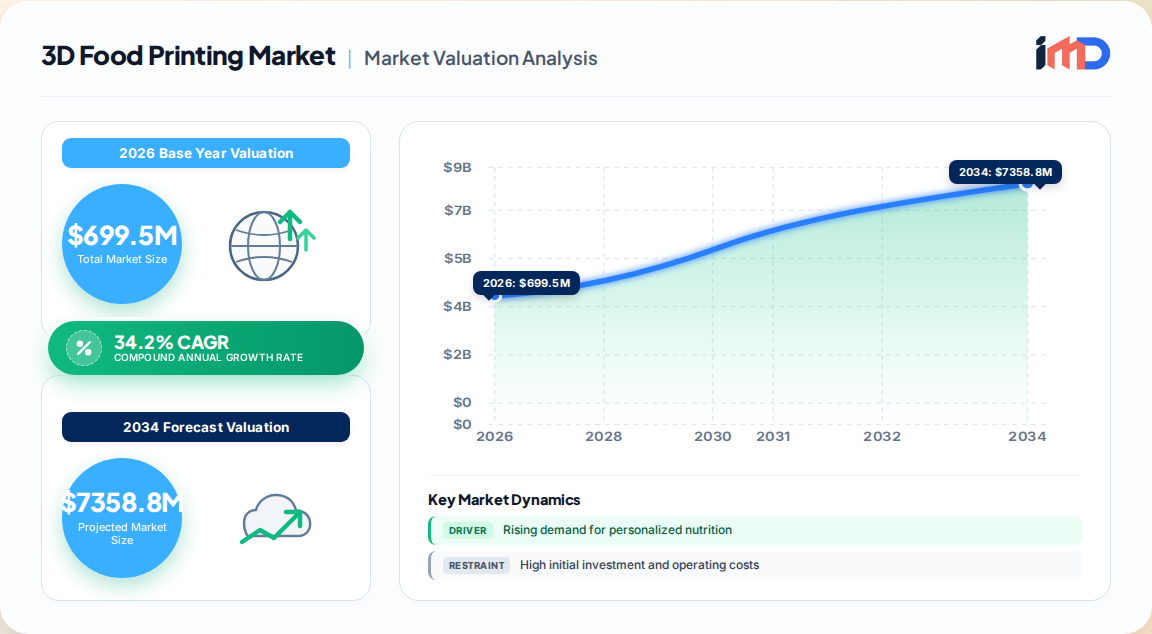
The global 3D food printing market is experiencing a paradigm shift from experimental culinary novelty to a scalable digital manufacturing platform. Our proprietary primary research estimates the market at $699.5 million in 2026, projected to reach $5,483.4 million by 2033, expanding at a CAGR of 34.2%. This growth is underpinned by the convergence of personalized nutrition, sustainable protein production, and advancements in multi-material extrusion technologies.
North America remains the dominant regional market, holding a 33.0% revenue share in 2025, driven by high consumer disposable income and a robust ecosystem of food-tech startups and research institutions. However, Asia Pacific is emerging as the fastest-growing region, propelled by aging demographics, government initiatives for food security, and rapid urbanization.
Drivers:
Restraints:
The 3D food printing value chain comprises several distinct stages, each critical to market expansion.
| Stage | Key Activities | Major Participants |
|---|---|---|
| Hardware & Software Providers | Design and manufacture of printers, extruders, nozzles, slicing software, and control systems | OEMs such as 3D Systems, Natural Machines, byFlow |
| Ingredient Formulation | Development of food inks (dough, purees, gels, proteins) with optimal rheological properties | Ingredient suppliers, food-tech firms (e.g., Redefine Meat, Novameat) |
| Food Service & Manufacturing | Adoption in restaurants, bakeries, confectioneries, and large-scale production facilities | Commercial end-users (52% share in 2025) |
| Distribution & Retail | Sale of printers and printed food products to consumers and institutions | Retailers, e-commerce platforms |
| Research & Development | Collaboration between academia, technology providers, and food manufacturers to advance materials and applications | Research institutions, consortiums (e.g., EU-funded projects) |
The hardware segment dominates the market with a 63.0% share in 2025, reflecting the critical role of printer components in achieving precision and reliability. Software is gaining traction as manufacturers seek integrated solutions for recipe management and process control.
The 3D food printing market is not yet a heavily traded commodity, but supply chain dynamics are evolving. Hardware components (printers, nozzles) are primarily manufactured in North America, Europe, and East Asia, with China emerging as a key exporter of lower-cost printers. Food inks, being perishable, are typically produced locally, reducing cross-border trade.
Key supply chain risks include:
North America leads in adoption, driven by a strong food-tech ecosystem and high consumer awareness. The U.S. market benefits from government R&D funding (e.g., military and NASA contracts) and collaborations between universities and industry.
Europe is a close second, with a focus on sustainability and personalized nutrition. The EU-funded HyPAD project and FoodiniPro program highlight regional commitment to innovation. Germany, the Netherlands, and Spain are key hubs, hosting leading companies like byFlow, TNO, and Natural Machines.
Asia Pacific is poised for explosive growth, with a CAGR of 36.5% forecast from 2026 to 2033. Aging populations in Japan and South Korea, coupled with food security concerns in China and India, are driving demand for nutrient-rich, texture-modified foods. Government initiatives and rising disposable incomes further accelerate adoption.
Latin America and the Middle East & Africa are nascent but present opportunities in institutional settings (hospitals, schools) and for disaster relief applications.
The market is characterized by a mix of established technology giants and agile startups. Key players include 3D Systems Corporation, Natural Machines, byFlow, Redefine Meat, Novameat, BeeHex, and Choc Edge. Strategic collaborations are rampant, such as Steakholder Foods' demonstration center for 3D-printed meat and Revo Foods' Vienna "Taste Factory" with a capacity of 60 tonnes per month.
Recent developments include:
Significant untapped opportunities exist in:
Companies investing in multi-material printing, speed enhancements, and food-ink formulation will be well-positioned to capture value in this rapidly evolving market.
| Aspects | Details |
|---|---|
| Study Period | 2020-2034 |
| Base Year | 2026 |
| Estimated Year | 2026 |
| Forecast Period | 2026-2034 |
| Historical Period | 2020-2025 |
| Growth Rate | CAGR of 34.2% from 2020-2034 |
| Segmentation |
|
By Ingredient
By End Use
| By Geography |
|
The global 3D food printing market was valued at $699.5 million in 2026 and is projected to reach $5,483.4 million by 2033, growing at a CAGR of 34.2%.
North America leads the market with a 33.0% revenue share in 2025, driven by high consumer disposable income and a strong food-tech ecosystem. Asia Pacific is the fastest-growing region.
Extrusion-based printing holds the largest share (over 62% in 2025), followed by binder jetting, selective laser sintering, and inkjet printing. Extrusion is preferred for its compatibility with a wide range of food inks.
Key companies include 3D Systems Corporation, Natural Machines, byFlow, Redefine Meat, Novameat, BeeHex, and Choc Edge, among others. Strategic collaborations and product launches are shaping the competitive landscape.
Drivers include rising demand for personalized nutrition, sustainable food production, technological advancements in printing, and the need to reduce food waste through on-demand manufacturing.
Our rigorous research methodology combines multi-layered approaches with comprehensive quality assurance, ensuring precision, accuracy, and reliability in every market analysis.
| Stakeholder Role | Interview Share (%) |
|---|---|
| C-Level Executives (CEO, CTO) | 35% |
| R&D and Innovation Directors | 30% |
| Procurement Managers | 20% |
| Regulatory & Quality Assurance Heads | 15% |
| Company Type | Representation (%) |
|---|---|
| Hardware OEMs (Printer Manufacturers) | 30% |
| Ingredient & Food Ink Suppliers | 25% |
| Food Service & Restaurant Chains | 20% |
| Research Institutions & Universities | 15% |
| Software & AI Solution Providers | 10% |
 Related Reports
